
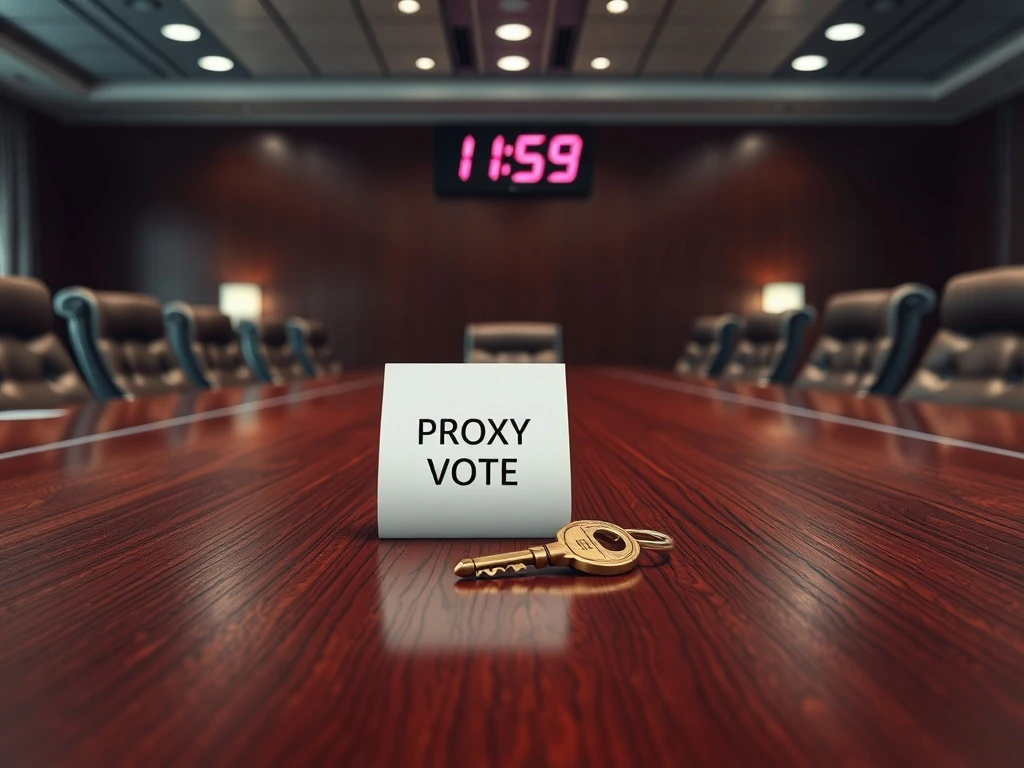
LONDON, UK — March 15, 2026: Today marks the critical IPF takeover voting day, a corporate event that has escalated into a significant governance crisis. Shareholders of International Precision Foundries (LSE: IPF) face a stark reality: a substantial portion of their voting power, locked in so-called irrevocable proxy arrangements, has become functionally unattainable. This situation, unfolding in real-time, centers on the £4.2 billion hostile bid by Atlas Industrial conglomerate and exposes a critical flaw in modern shareholder mechanics. The core issue, as detailed in filings with the UK Financial Conduct Authority (FCA), is that thousands of retail investors who assigned voting proxies to their brokers or fund managers months ago now find those instructions cannot be amended or revoked for this specific, unforeseen vote.
IPF Takeover Voting Day: When Irrevocable Means Unattainable
The term “irrevocable proxy” is a standard clause in many brokerage and fund management agreements. Essentially, it grants the intermediary the right to vote the client’s shares on routine matters. However, the IPF takeover voting day is not routine. Atlas Industrial’s unsolicited bid, announced just 21 days ago, triggered a vote that was not contemplated when most shareholders signed their annual proxy forms. According to Dr. Anya Sharma, a corporate governance professor at the London School of Economics, “The legal architecture assumes stability. An irrevocable proxy for general annual meeting agendas becomes a trap door during a sudden takeover battle. Shareholders legally own the economic interest, but the voting right—the voice—is siloed away.” Data from the UK Shareholders’ Association indicates that approximately 18% of IPF’s float, worth nearly £760 million, is held under such restrictive arrangements, a percentage that has doubled since 2020.
The timeline is crucial. Atlas announced its bid on February 22, 2026. The IPF board, after a 10-day review, rejected the offer on March 3 and scheduled today’s vote to approve a defensive ‘poison pill’ strategy. This compressed schedule left no window for the complex legal process of revoking pre-existing irrevocable proxies. Consequently, fund managers like Vanguard UK and Legal & General, who hold proxies for thousands of retail clients, must vote those blocks as a single unit based on their own internal policies, potentially overriding the individual wishes of the underlying beneficial owners.
The Tangible Impact on Shareholder Democracy and Market Value
The immediate impact of this irrevocable proxy share lock-up is a distortion of the shareholder vote’s legitimacy. The outcome may reflect the preferences of a handful of large asset managers rather than the collective will of all capital providers. This has direct consequences for IPF’s stock price and corporate future. Market analysts at Barclays have outlined three primary impacts observed in pre-market trading.
- Vote Uncertainty Premium: IPF shares are trading with 40% higher volatility than the FTSE 250 index, as the market cannot accurately price the true shareholder sentiment.
- Arbitrage Opportunity: Hedge funds have increased their positions, betting they can predict the voting behavior of the locked proxy blocks better than the market average.
- Governance Discount: The crisis has triggered a sector-wide re-rating, with companies known for high retail ownership and similar proxy structures seeing an average 2.1% decline.
Expert Analysis: A Systemic Failure
“This isn’t an IPF problem; it’s a systemic failure of alignment,” states Michael Chen, Partner at governance advisory firm FairVote Advisors. Chen, who has consulted for the International Corporate Governance Network (ICGN), points to a 2025 ICGN white paper that warned of this exact scenario. “The paper explicitly stated that ‘the rise of passive investing and bundled proxy management creates a single point of failure during contested M&A.’ Regulators focused on transparency of voting records, but not on the revocability of mandates during material, non-routine events.” Chen’s firm estimates that across European markets, over €300 billion in equity assets are currently held under irrevocable proxy terms that could be similarly compromised by unexpected takeover activity.
Broader Context: A Global Corporate Governance Flashpoint
The IPF takeover voting day crisis mirrors similar, though less acute, events globally. It highlights the growing tension between the efficiency of centralized vote management and the principle of shareholder sovereignty. The table below compares key aspects of proxy revocability in major jurisdictions, based on a 2024 OECD study.
| Jurisdiction | Default Proxy Status | Revocation Window for M&A | Notable Case |
|---|---|---|---|
| United Kingdom | Often Irrevocable for 12 Months | No Statutory Window | IPF / Atlas (2026) |
| United States | Generally Revocable | 10-Day Minimum (SEC Rule) | Twitter / Elon Musk (2022) |
| European Union (SRD II) | Must be Revocable | Varies by Member State | UniCredit / MPS (2023) |
| Japan | Typically Irrevocable | Extremely Limited | Toshiba Takeover (2023) |
What Happens Next: Regulatory Scrutiny and Legal Challenges
The immediate next step is the official vote tally, expected after market close today. Regardless of the outcome, the fallout is guaranteed. The UK’s FCA has already announced a “review of proxy plumbing” slated for Q3 2026. Furthermore, shareholder rights group ShareSoc has indicated it is exploring a collective legal action on behalf of retail investors, potentially arguing that the application of an irrevocable proxy in this context constitutes a breach of the intermediaries’ fiduciary duty. “The duty of care should require them to seek fresh instructions for a transformative event,” a ShareSoc spokesperson stated. Meanwhile, the London Stock Exchange has circulated a memo to listed companies advising them to review their own shareholder register structures in light of today’s events.
Stakeholder Reactions: From Anger to Opportunism
Reactions are polarized. On investor forums, sentiment is overwhelmingly negative, with many describing a feeling of disenfranchisement. “I own the shares, I bear the risk, but I have no say in the company’s survival. The system is broken,” posted one user on a popular UK investing platform. Conversely, representatives from large asset management firms defend the current system, arguing that operational efficiency and cost savings for end-investors require streamlined, long-term voting mandates. Atlas Industrial, the bidding company, has remained silent on the proxy issue, focusing its public comments solely on the industrial logic of the merger.
Conclusion
The IPF takeover voting day will be remembered less for its result and more for exposing a critical vulnerability in modern equity markets. The crisis of irrevocable proxy shares becoming unattainable during a hostile bid demonstrates how technical governance mechanisms can undermine fundamental ownership rights. The key takeaways are clear: the event has triggered imminent regulatory review, exposed a multi-billion pound systemic risk, and sparked likely legal challenges. Investors in all markets must now scrutinize the fine print of their custody agreements. The final bell today does not end this story; it merely concludes the first chapter of a broader reckoning for shareholder democracy and corporate governance standards worldwide.
Frequently Asked Questions
Q1: What is an irrevocable proxy, and why is it a problem today?
An irrevocable proxy is a legal authorization where a shareholder grants their voting rights to another party (like a broker) for a set period, often one year. The problem on IPF voting day is that this proxy cannot be revoked for Atlas’s unexpected takeover bid, meaning many shareholders cannot vote according to their current wishes on this critical issue.
Q2: How many IPF shares are affected by this irrevocable proxy issue?
Analysis from the UK Shareholders’ Association estimates approximately 18% of IPF’s publicly traded shares, representing nearly £760 million in value, are held under arrangements where the voting proxy is irrevocable and cannot be amended for this specific vote.
Q3: What are the regulatory next steps following this voting day crisis?
The UK Financial Conduct Authority (FCA) has announced a formal review of “proxy plumbing”—the infrastructure of share voting—scheduled for the third quarter of 2026. This review will likely focus on revocability clauses and investor communication during material events.
Q4: As a retail investor, how can I check if my shares are in an irrevocable proxy?
You must review the terms and conditions of your brokerage or investment platform agreement, specifically the sections on “corporate actions,” “voting rights,” or “proxy voting.” Look for language about “irrevocable appointment” or the duration for which you grant voting authority.
Q5: Has this type of situation happened before in other markets?
Similar tensions have arisen, notably in Japan during the Toshiba takeover battles, where proxy rules also restricted shareholder voice. The U.S. system, governed by SEC Rule 14a-4, generally requires proxies to be revocable and provides a minimum notice period for contested meetings, offering more protection.
Q6: How does this affect the outcome of the Atlas Industrial bid for IPF?
It introduces significant uncertainty. A large block of votes will be cast by fund managers based on their internal governance policies, not the direct wishes of underlying shareholders. This could swing the vote in favor of or against IPF’s defensive measures, potentially determining the bid’s success independently of true shareholder sentiment.



