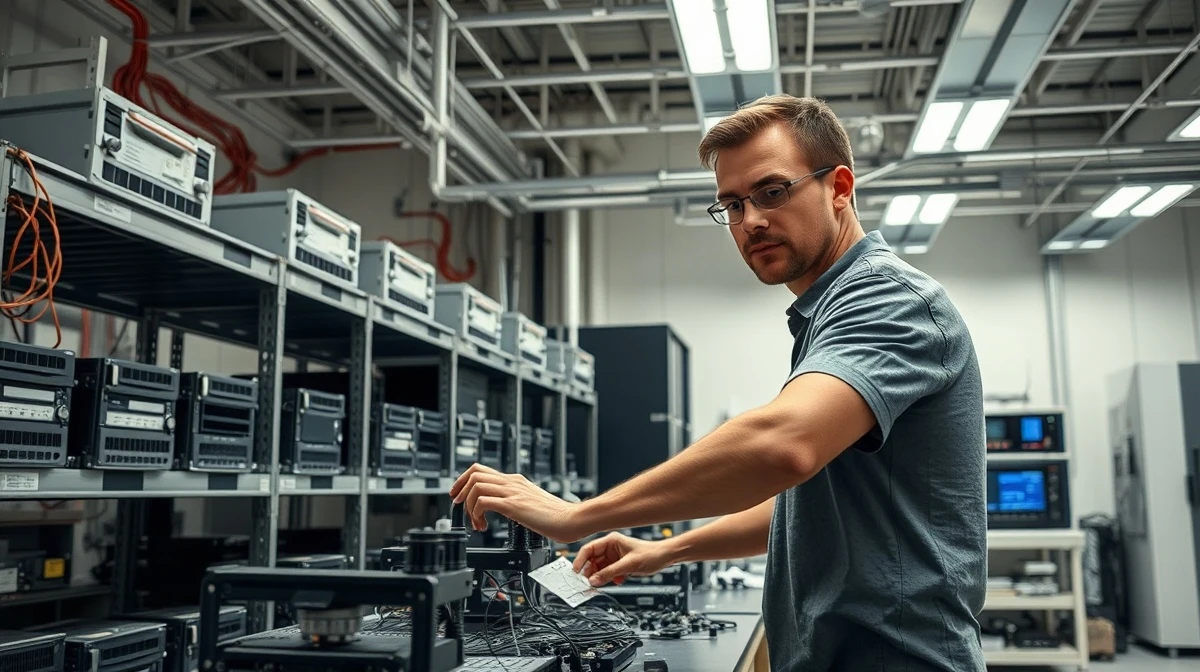
March 22, 2026—Deep within a corporate building in Austin, Texas, a team of engineers works around the clock on silicon that has become central to the artificial intelligence boom. Amazon’s custom chip lab, a legacy of its 2015 acquisition of Annapurna Labs, is the birthplace of the Trainium processor, a key component in major AI systems from Anthropic and, more recently, OpenAI.
The Engine Behind Major AI Deals
Amazon Web Services (AWS) has positioned its Trainium chip as a strategic alternative to Nvidia’s dominant GPUs. The technology’s significance was underscored by a recent, high-profile agreement where AWS became the exclusive cloud provider for OpenAI’s new Frontier agent builder. As part of that deal, Amazon committed to supply OpenAI with two gigawatts of Trainium computing capacity.
This commitment is substantial given existing demand. Anthropic’s Claude AI already runs on over one million Trainium2 chips, according to the company. Amazon’s own Bedrock AI service also relies heavily on Trainium for inference, the process of generating responses from AI models.
“Our customer base is just expanding as fast as we can get capacity out there,” said Kristopher King, director of the Austin chip lab, during a recent tour. He suggested Bedrock could one day rival the scale of AWS’s flagship EC2 compute service.
Inside the Austin Development Lab
The lab itself is an industrial space filled with testing equipment, custom tools, and a welding station for microscopic component repair. It is here that the critical “bring-up” process occurs—the first activation of a new chip prototype to verify its design.
“A silicon bring-up is when you get the chip for the first time, and it’s like a big overnight party. You stay here, like a lock-in,” King explained. The team documented the Trainium3 bring-up, an event that involves solving immediate hardware problems, sometimes with improvised solutions like grinding metal to fit cooling apparatus.
The lab does not manufacture chips; Trainium3 is a 3-nanometer chip produced by TSMC. Instead, the facility focuses on design validation, testing, and the integration of chips into custom “sleds”—trays that house Trainium AI processors and Graviton CPUs for deployment in data centers.
Competing on Performance and Cost
Amazon’s strategy mirrors its classic playbook: identify a high-demand product and build a competitively priced in-house alternative. For AI chips, the historical barrier has been switching costs, as software must be re-architected for different hardware.
AWS engineers say they have reduced that friction. Mark Carroll, the lab’s director of engineering, stated that transitioning models to run on Trainium can require “basically a one-line change, and then recompile.” The chips support the popular PyTorch framework, encompassing many open-source models on platforms like Hugging Face.
The company claims its latest Trainium3 chips, running on specialized Trn3 UltraServers, can reduce costs by up to 50% for comparable performance versus traditional cloud servers. Carroll attributed gains to new Neuron switches that allow every chip in a cluster to communicate, reducing latency. “That’s why Trainium3 is breaking all kinds of records,” he said, particularly in “price per power.”
Proven Scale and Industry Recognition
The scale of Trainium deployment is vast. Amazon reports 1.4 million Trainium chips deployed across all three generations. A cluster known as Project Rainier, which launched in late 2025 with 500,000 chips, is used by Anthropic and is one of the world’s largest AI compute clusters.
Recognition has come from other tech giants. In 2024, Apple’s director of AI publicly detailed how the company used AWS’s Graviton CPU and Inferentia inference chip, while also acknowledging the newer Trainium technology.
Amazon CEO Andy Jassy has highlighted the division’s importance, calling Trainium a multibillion-dollar business for AWS and a key piece of technology he is excited about. The team operates under significant scrutiny, with engineers working 24/7 for weeks during each bring-up cycle to ensure chips are ready for mass production.
Controlling the Full Stack
Amazon’s ambition extends beyond the chips to the entire system. The Austin team also designs the servers, networking components, and a hardware-software virtualization system called Nitro. They have implemented liquid cooling technology for the Trainium3, which recirculates fluid in a closed system to improve energy efficiency.
A short drive from the lab, the team maintains a private data center for quality testing. The environment is severe—ear protection is mandatory against the noise of cooling systems, and the air carries the scent of heated metal. Rows of servers there integrate Graviton CPUs, liquid-cooled Trainium3 chips, and Nitro systems, representing the full stack of Amazon’s custom hardware.
As the AI industry’s demand for compute power continues to surge, Amazon’s decade-long investment in custom silicon is positioning it not just as a cloud landlord, but as a fundamental hardware architect for the next generation of artificial intelligence.
For more information on AWS’s AI and machine learning services, visit the official AWS machine learning page. Details on Anthropic’s partnership with AWS are available in the company’s announcement.
This article was produced with AI assistance and reviewed by our editorial team for accuracy and quality.