
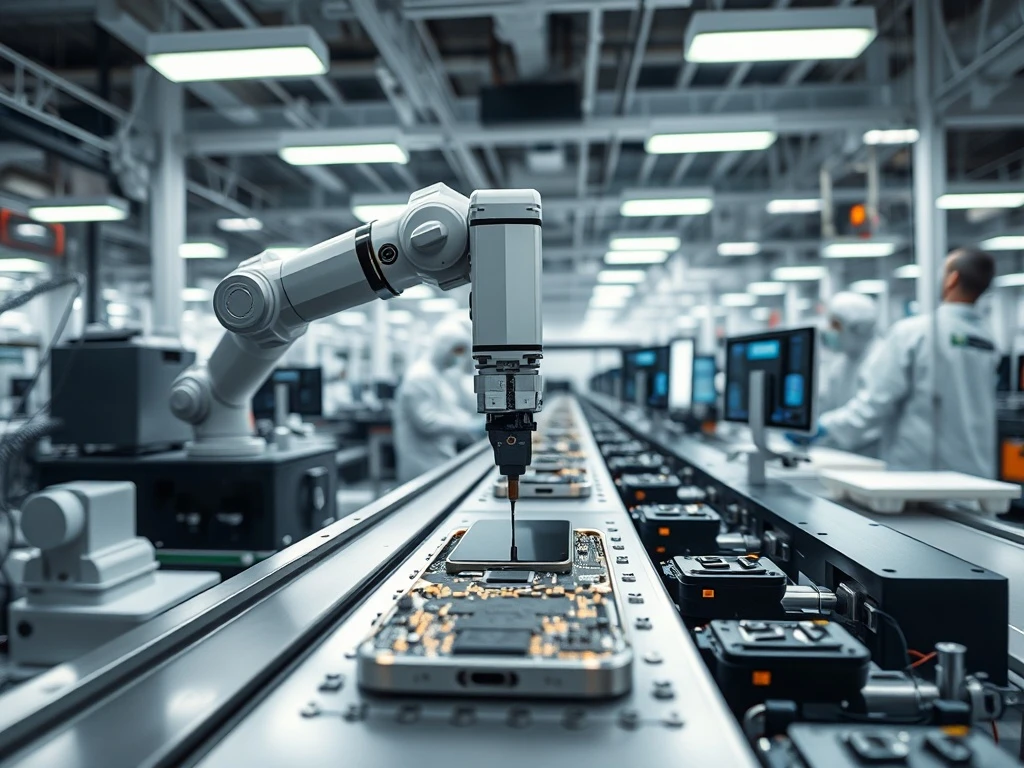
BOSTON, MA — March 10, 2026: Apple Inc. has reached a critical milestone in its global supply chain strategy, with one in every four iPhones now produced in India. According to a Bloomberg report published March 9, 2026, India accounted for approximately 55 million units of the 220-230 million iPhones manufactured worldwide last year. This achievement fulfills a 2022 prediction by JPMorgan and marks the most significant shift in consumer electronics production in a decade. The acceleration stems from Apple’s deliberate, multi-year plan to reduce its heavy manufacturing reliance on China, a strategy that gained urgency amid fluctuating U.S. tariff policies and geopolitical tensions throughout 2025.
Apple’s Strategic Pivot to Indian iPhone Manufacturing
The Bloomberg report, citing supply chain analysts and industry data, confirms Apple now manufactures 25% of its flagship iPhones within India. This represents a dramatic increase from just 5% in 2021. The company moved with particular speed in the last year, initiating production of the entire iPhone 17 lineup in India ahead of its global September 2025 launch. Consequently, Apple CEO Tim Cook stated that the majority of U.S. consumer demand for new iPhones is now fulfilled by devices assembled in India. This operational shift required massive investment in local infrastructure and partner capabilities, primarily through its Taiwanese manufacturing partners Foxconn (Hon Hai Precision Industry) and Pegatron.
Industry experts point to a clear timeline of escalation. Following initial pilot production of older models, Apple began a phased transition of newer designs to Indian plants. The turning point came in early 2025, as U.S.-China trade relations entered a period of renewed uncertainty. “The geopolitical calculus changed overnight,” noted a supply chain strategist familiar with Apple’s operations, who requested anonymity due to client confidentiality. “Diversification was no longer a long-term goal but an immediate operational imperative.” This push was substantial enough to reportedly draw a personal warning from former President Donald Trump to Tim Cook at a business summit in Doha in May 2025, highlighting the high-stakes nature of global tech supply chain realignment.
Quantifying the Impact on Global Supply Chains and Markets
The relocation of a quarter of iPhone production carries profound implications for global trade, local economies, and the tech industry’s risk profile. First, it significantly de-risks Apple’s operations from regional disruptions. Second, it catalyzes India’s ambition to become a “China-plus-one” manufacturing hub for the world. Third, it alters the competitive landscape for electronics component suppliers, who must now establish or scale operations in India.
- Supply Chain Resilience: By distributing production across China, India, Vietnam, and Brazil, Apple has insulated itself from country-specific shocks, whether from trade policy, natural disasters, or health crises. This diversification is now a board-level metric for investor confidence.
- Economic Development in India: The scale of iPhone manufacturing has created hundreds of thousands of direct and indirect jobs, spurred investment in local logistics and component ecosystems, and boosted India’s electronics exports. The government’s Production Linked Incentive (PLI) scheme has been a key enabler.
- Market Access and Growth: Manufacturing locally helps Apple avoid hefty import duties, making iPhones more price-competitive in the Indian market. This is crucial as India simultaneously evolves into a major consumer base.
Expert Analysis and Institutional Perspectives
Tarun Pathak, Research Director at Counterpoint Research, provided critical context on the consumer side. “Apple shipped 14 million units in India last year, a 9% year-over-year increase,” Pathak stated. “Total iPhone sales in the country surpassed $9 billion. This isn’t just a production story; it’s a dual strategy of making iPhones in India for the world, and selling more iPhones to India’s growing premium segment.” Separately, analysts at Bloomberg Intelligence emphasized that Apple’s move pressures rivals like Samsung and Chinese OEMs to similarly deepen their Indian manufacturing commitments to maintain cost competitiveness and market access.
India’s Dual Role: Factory Floor and Frontier Market
The narrative extends beyond factory output. India is rapidly ascending as one of Apple’s most important growth markets. Beyond the 14 million units shipped, Apple is actively cultivating its retail and service ecosystem. The company opened its sixth official Apple Store in India last month and is reportedly in advanced talks to launch Apple Pay in the country later this year. This two-pronged approach—manufacturing hub and consumer frontier—is unique in Apple’s global playbook. No other region outside China and the United States simultaneously serves such a large production and consumption function for the company.
| Metric | 2022 | 2026 (Reported) | Change |
|---|---|---|---|
| iPhone Production Share in India | ~5% | 25% | +400% |
| Estimated Units Made in India | ~10-12M | ~55M | +358% |
| iPhone Sales in India (Units) | ~6.5M | 14M | +115% |
| Apple Retail Stores in India | 0 | 6 | N/A |
What Happens Next: The Roadmap for Apple in India
The current milestone is likely a stepping stone, not an endpoint. Apple’s stated goal is to continue diversifying its supply chain. Industry observers anticipate the proportion of Indian-made iPhones could approach 30-35% by 2028. Key developments to watch include the expansion of component manufacturing locally, moving beyond assembly to more value-added production. Furthermore, the success of the iPhone 17’s “India-first” full lineup production will serve as a template for future models. Any major U.S. policy shifts regarding tariffs or tech trade will directly influence the pace of this transition.
Stakeholder Reactions and Industry Ripples
The reaction within India has been overwhelmingly positive, with government officials hailing it as a validation of national policy. Conversely, the move is watched closely in China, where local suppliers face the prospect of reduced orders. Within the investment community, the shift is viewed as a necessary de-risking that strengthens Apple’s long-term valuation by mitigating single-country concentration risk. Competitors are now forced to reevaluate their own geographic manufacturing footprints, potentially triggering a broader wave of investment across Southeast Asia.
Conclusion
Apple’s achievement of manufacturing 25% of its iPhones in India marks a definitive strategic realignment with global ramifications. It successfully executes a plan set years prior, driven by both proactive diversification and reactive geopolitical pressures. The move solidifies India’s position as a premier global manufacturing hub while unlocking its potential as a premium consumer market. For Apple, it balances operational risk against growth opportunity. For the industry, it sets a new benchmark for supply chain resilience. The coming years will test how deeply Apple can root its ecosystem in India and whether this model can be sustained and scaled as the company navigates an increasingly multipolar world.
Frequently Asked Questions
Q1: What percentage of iPhones does Apple now make in India?
According to a March 2026 Bloomberg report, Apple now manufactures 25% of all iPhones in India. This translates to roughly 55 million units out of a global production of 220-230 million iPhones last year.
Q2: Why did Apple accelerate its move to manufacture iPhones in India?
The shift accelerated in 2025 primarily due to uncertainty in U.S.-China trade relations and evolving tariff rules, pushing Apple to diversify production away from heavy reliance on China. A long-term strategy to tap into India’s growing market and manufacturing incentives also played a key role.
Q3: Which iPhone models are currently made in India?
As of 2026, Apple manufactures the entire iPhone 17 lineup in India. The company has progressively moved production of newer models to India, having started with older models like the iPhone SE and iPhone 13 in prior years.
Q4: How important is India as a sales market for Apple?
India is a crucial growth market. Apple shipped 14 million iPhones there in 2025, a 9% year-over-year increase, with sales exceeding $9 billion. The company has opened six retail stores and is planning to launch services like Apple Pay to deepen its engagement.
Q5: What was JPMorgan’s role in predicting this milestone?
Back in 2022, analysts at JPMorgan predicted Apple could move 25% of its iPhone production to India by 2025. The 2026 report confirms the company has effectively hit that strategic target, validating the earlier forecast.
Q6: How does this affect consumers buying iPhones in the United States?
Apple CEO Tim Cook has stated that the majority of U.S. demand for iPhones is now fulfilled by India-made devices. For consumers, this transition is seamless regarding product quality and availability, but it represents a significant change in the device’s geographic origin.



