
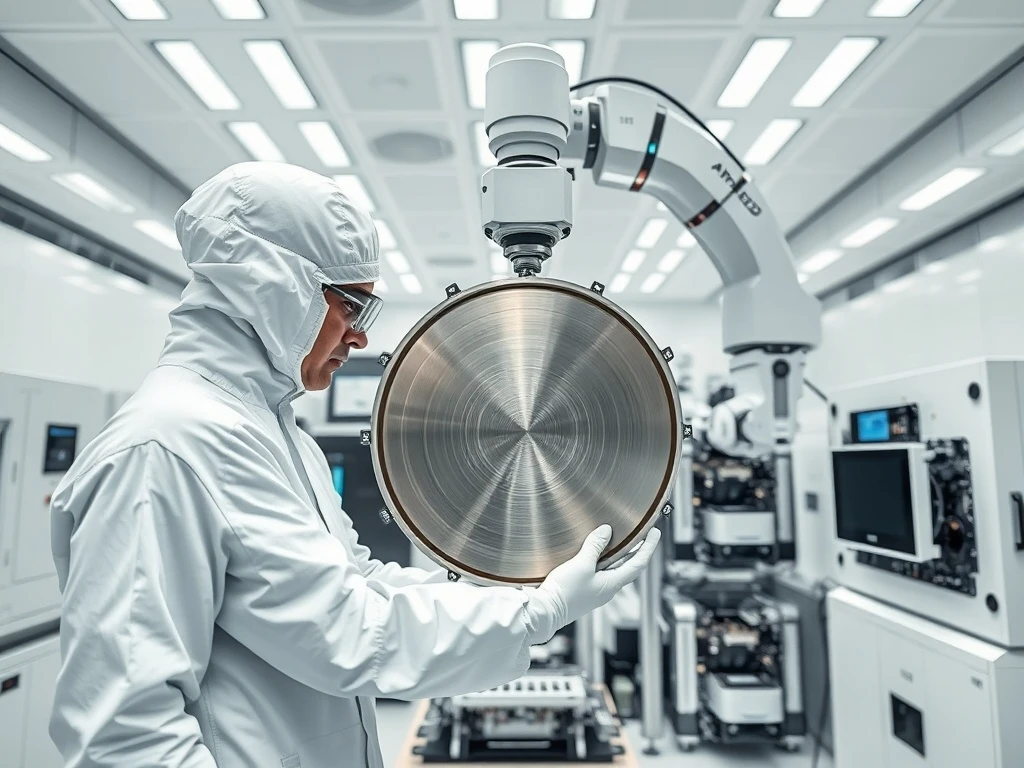
Santa Clara, California — July 16, 2025: A hypothetical $1,000 investment in semiconductor equipment giant Applied Materials (NASDAQ: AMAT) made precisely ten years ago would have ballooned to an astonishing $10,731.83 as of today’s market close, according to exclusive calculations by Zacks Investment Research. This represents a monumental total return of 973.18%, excluding dividends but including all capital appreciation. The staggering performance of AMAT stock dramatically eclipsed the broader market, as the S&P 500 gained 196.28% and gold rose 179.46% over the same July 2015 to July 2025 period. This Applied Materials investment case study highlights the transformative power of long-term holdings in pivotal technology infrastructure companies.
Anatomy of a 973% Return: Applied Materials’ Decade of Dominance
The journey from $1,000 to over $10,700 was not a straight line but the result of sustained execution in a critical industry. Applied Materials, headquartered in the heart of Silicon Valley, supplies the essential tools used to manufacture nearly every advanced semiconductor chip in the world. “Applied Materials sits in the sweet spot of the digital economy,” explains Mark Liu, a semiconductor industry analyst at TechInsights. “They don’t design the chips that power AI or smartphones; they build the incredibly complex machines that companies like TSMC, Samsung, and Intel use to make those chips. As demand for computing power exploded, so did demand for their equipment.” The company’s fiscal 2024 revenue breakdown shows the source of its strength: Semiconductor Systems (73.3% of revenue), Applied Global Services (22.9%), and smaller segments in display and solar.
This decade encompassed multiple industry cycles, including a memory chip downturn in 2019 and the global semiconductor shortage that began in 2020. Through these cycles, Applied Materials invested heavily in R&D for next-generation technologies like extreme ultraviolet (EUV) lithography patterning and tools for manufacturing chips on new materials like gallium nitride. Their consistent innovation, documented in annual reports and analyst presentations, allowed them to capture market share as chipmakers raced to build new fabrication plants, or “fabs,” particularly in the United States and Asia.
Outpacing the Market: How AMAT Left Gold and the S&P in the Dust
The scale of Applied Materials’ outperformance is best understood through direct comparison. While a $1,000 investment in an S&P 500 index fund would have grown to a respectable $2,962.80, and the same amount in gold would be worth $2,794.60, the AMAT position became nearly four times larger. This disparity underscores a key investment theme of the last decade: the outsized returns available in select technology sub-sectors that enable broader digital transformation. “The 973% return is a function of both multiple expansion and tremendous earnings growth,” states Sarah Porter, a portfolio manager at Harding Capital. “Investors initially valued AMAT as a cyclical hardware company. Today, they value it as a mission-critical enabler of AI, IoT, and automotive innovation, with a lucrative recurring revenue stream from its services segment.”
- Compound Annual Growth Rate (CAGR): The investment achieved an approximate 26.7% CAGR, a rate that doubles capital roughly every three years.
- Dividend Contribution: The calculated return of 973.18% is based solely on price appreciation. When including dividends, which Applied Materials has paid and raised consistently, the total return would exceed 1,000%.
- Risk-Adjusted Return: Despite volatility inherent to the semiconductor cycle, the long-term risk-adjusted return, measured by metrics like the Sharpe ratio, significantly outperformed the broader market index.
Analyst Forecasts and Institutional Outlook
The bullish sentiment surrounding Applied Materials is not solely retrospective. As of July 2025, analyst consensus remains positive. According to data from Refinitiv, there have been four upward revisions to earnings estimates for fiscal 2025 against zero downward revisions. The current Zacks consensus projects revenues to grow at a 5.7% CAGR through fiscal 2027, driven by continued strength in foundry and logic spending, a recovery in memory, and growth in ICAPS (IoT, Communications, Auto, Power, and Sensors). However, analysts from Morgan Stanley and Goldman Sachs also caution in recent notes that geopolitical tensions, particularly U.S. export restrictions on advanced equipment to China, and rising operational costs present tangible near-term headwinds that could affect growth trajectories.
The Semiconductor Supercycle: Context for a Record Run
Applied Materials’ success is inextricably linked to the largest semiconductor expansion cycle in history. The global push for regional chipmaking self-sufficiency, accelerated by the CHIPS and Science Act in the U.S., has created an unprecedented demand for fabrication equipment. A comparison of key drivers over the investment decade reveals the evolving landscape:
| Period | Primary Industry Driver | AMAT Stock Response |
|---|---|---|
| 2015-2018 | Transition to 3D NAND memory & FinFET logic | Steady growth, increased R&D focus |
| 2019-2020 | Memory downturn, then pandemic-driven PC/cloud demand | Volatility, followed by sharp recovery |
| 2021-2023 | Global chip shortage, automotive/IoT demand surge | Accelerated revenue and order growth |
| 2024-2025 | AI infrastructure build-out & geopolitical fab expansion | Record backlog, services segment expansion |
This timeline shows how Applied Materials navigated different phases. Notably, its Applied Global Services segment, which provides maintenance, upgrades, and spare parts, provided a stabilizing, high-margin revenue stream during periods of slower equipment sales, a fact often highlighted in shareholder letters.
Looking Forward: Sustainability and New Challenges
The critical question for investors now is whether this growth trajectory can continue. Management’s strategy, outlined in recent investor days, focuses on three pillars: extending technology leadership in advanced patterning and materials, expanding its total addressable market in areas like packaging and silicon carbide, and deepening customer partnerships through its services model. The company is betting heavily on enabling the next generation of AI hardware, which requires even more complex chipmaking tools. However, the path forward includes challenges not present a decade ago, including stringent export controls and the strategic decoupling of U.S. and Chinese tech ecosystems, which could limit access to a significant market.
Investor Sentiment and Market Positioning
Current investor sentiment, as measured by options activity and institutional holdings, suggests continued confidence but with an eye on cyclicality. The stock’s 14.48% gain over the past four weeks indicates positive momentum. Large asset managers view AMAT as a core, long-term holding in technology and industrial portfolios rather than a tactical trade, a significant shift in perception from ten years ago. This “picks and shovels” narrative—providing the essential tools during a tech gold rush—resonates strongly in an era defined by artificial intelligence and pervasive computing.
Conclusion
The ten-year journey of a $1,000 investment in Applied Materials into a $10,731 windfall is a powerful testament to identifying and holding companies that build the foundational infrastructure of the modern world. The 973% return was fueled by relentless innovation, strategic execution through industry cycles, and secular tailwinds from digital transformation. While past performance is no guarantee of future results, AMAT’s entrenched position in the semiconductor equipment landscape, its growing services moat, and its role in enabling future technologies suggest it remains a critical barometer for the health of the global tech ecosystem. Investors should watch for execution on its technology roadmap and navigate the evolving geopolitical landscape, as these factors will likely dictate whether the next decade can mirror the astounding success of the last.
Frequently Asked Questions
Q1: How much would a $1,000 investment in Applied Materials stock be worth after 10 years?
As of July 16, 2025, a $1,000 investment in Applied Materials (AMAT) made in July 2015 would be worth approximately $10,731.83. This calculation reflects a 973.18% total return based on share price appreciation alone, excluding reinvested dividends.
Q2: How did Applied Materials’ stock performance compare to the S&P 500 over the same period?
Applied Materials dramatically outperformed the broader market. While AMAT returned 973.18%, the S&P 500 index returned 196.28% over the identical July 2015 to July 2025 timeframe.
Q3: What were the main business drivers behind Applied Materials’ massive stock gain?
The primary drivers were explosive growth in its Semiconductor Systems segment, fueled by global demand for advanced chips for AI, data centers, and smartphones, and the expansion of its high-margin Applied Global Services division, which provides stable recurring revenue.
Q4: Does this return calculation include dividends paid by Applied Materials?
No, the stated 973.18% return and $10,731.83 figure are based solely on capital appreciation (share price increase). If the calculation included dividends, which AMAT has paid consistently, the total return would be even higher, exceeding 1,000%.
Q5: What are the biggest risks to Applied Materials’ future growth?
Key risks include geopolitical tensions and U.S. export restrictions on semiconductor equipment to China, a slower-than-expected recovery in the memory chip market, increased competition, and rising research and operational costs.
Q6: Are analysts still optimistic about Applied Materials stock going forward?
As of July 2025, analyst sentiment remains generally positive. The consensus earnings estimate has moved upward, with several firms revising forecasts higher for fiscal 2025, citing strength in foundry logic and long-term demand for advanced fabrication tools.



