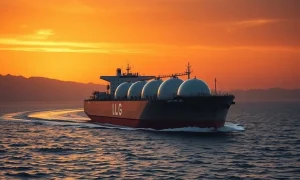
SINGAPORE, March 15, 2026 – Asian currencies face sustained vulnerability to potential energy supply disruptions, according to fresh analysis from Mitsubishi UFJ Financial Group. The bank’s latest research highlights how foreign exchange markets across the region remain exposed to geopolitical risks centered on the Strait of Hormuz. MUFG economists warn that even minor supply chain disturbances through this critical chokepoint could trigger significant energy shock risk for import-dependent Asian economies. Their assessment comes amid renewed tensions in the Persian Gulf and follows recent incidents involving commercial shipping in the area. The analysis specifically examines Asia FX sensitivity to oil price volatility, with several currencies showing concerning correlation patterns.
MUFG’s Analysis of Asia FX Hormuz Exposure
MUFG’s currency strategy team, led by Head of Emerging Markets Research Lee Chen, published their quarterly risk assessment this morning. The report details how approximately 21 million barrels of oil pass through the Strait of Hormuz daily. This volume represents nearly one-third of global seaborne traded oil. Consequently, Asian nations import over 65% of their crude oil requirements through this narrow waterway. The bank’s modeling shows that a 15% sustained increase in Brent crude prices—a plausible scenario following a major Hormuz disruption—could depreciate regional currencies by an average of 3-8% against the US dollar within three months. South Korean won, Indian rupee, and Philippine peso exhibit the highest sensitivity coefficients in their stress tests.
Historical context strengthens these concerns. The 2019 tanker attacks and the 2021-2022 shipping incidents demonstrated how quickly risk premiums embed in Asian asset prices. During the September 2019 Abqaiq–Khurais attack, which temporarily removed 5.7 million barrels per day from global supply, the Korean won fell 2.1% in two trading sessions. The Indian rupee depreciated 1.8%. MUFG’s current analysis suggests market structures have become more, not less, sensitive since those events due to increased regional energy consumption and strategic stockpile limitations.
Quantifying the Energy Shock Risk to Asian Economies
The potential impact extends beyond simple currency depreciation. MUFG’s report outlines a cascade effect beginning with balance of payments pressures. Countries running current account deficits face immediate financing challenges as energy import bills surge. Subsequently, central banks confront the difficult trilemma of managing currency stability, controlling inflation, and sustaining growth. The analysis projects that for every $10 per barrel increase in oil prices, Asia’s aggregate current account balance could deteriorate by 0.4% of regional GDP. This deterioration would not be uniform.
- High-Vulnerability Economies: India, Thailand, and the Philippines show import coverage ratios below eight months. Their currencies typically react most sharply to oil price spikes.
- Moderate-Exposure Economies: South Korea and Taiwan possess larger foreign reserves but have extremely high energy import dependency, exceeding 90% of consumption.
- Net Exporters with Indirect Risk: Malaysia and Indonesia, while net energy exporters, face secondary risks through regional financial contagion and supply chain disruptions affecting their manufacturing exports.
Expert Perspectives on Geopolitical and Market Dynamics
Dr. Arjun Patel, a senior fellow at the National University of Singapore’s Energy Studies Institute, corroborates the core premise of MUFG’s warning. “The geographic concentration of global oil transit cannot be overstated,” Patel stated in a recent seminar. “Asia’s economic miracle was built on secure, cheap energy flows through the Persian Gulf. That security assumption now requires fundamental reassessment.” Patel’s research, cited by MUFG, indicates that alternative shipping routes and pipeline infrastructure remain insufficient to compensate for a prolonged Hormuz closure. The International Energy Agency’s (IEA) 2025 report on oil security, a key external source for this analysis, notes that global spare shipping capacity could only redirect about 40% of Hormuz flows, and with significant time lags and cost penalties.
Comparative Vulnerability of Asian Foreign Exchange Markets
Not all Asian currencies share identical risk profiles. MUFG’s analysis breaks down exposure by examining three key variables: energy import dependency as a percentage of total imports, the adequacy of foreign exchange reserves relative to short-term external debt, and the existing inflationary backdrop which limits central bank policy flexibility. The following table, derived from MUFG’s report and IMF data, illustrates these comparative vulnerabilities for major Asian economies.
| Currency | Energy Import % of Total Imports | FX Reserves (Months of Import Cover) | Current Inflation Rate |
|---|---|---|---|
| Indian Rupee (INR) | 28.5% | 7.8 months | 5.2% |
| South Korean Won (KRW) | 22.1% | 9.2 months | 3.1% |
| Philippine Peso (PHP) | 18.7% | 7.1 months | 4.8% |
| Thai Baht (THB) | 16.3% | 10.5 months | 2.3% |
| Indonesian Rupiah (IDR) | 12.4% | 8.9 months | 3.9% |
Forward-Looking Scenarios and Market Implications
MUFG outlines three primary scenarios for the coming quarters. Their baseline scenario (70% probability) assumes continued low-level tensions with sporadic incidents but no major sustained disruption. In this case, they expect only modest risk premiums in Asian FX. Their adverse scenario (25% probability) involves a significant incident causing a supply disruption of 2-4 million barrels per day for several weeks. This would likely trigger the 3-8% currency depreciations identified in their model. Their severe stress scenario (5% probability) models a prolonged closure, an event they describe as “low probability but catastrophic impact.” For risk managers, the key takeaway is the asymmetric payoff: markets currently price only the baseline scenario, leaving substantial room for repricing if conditions deteriorate.
Regional Policy Responses and Strategic Preparations
Central banks and finance ministries across the region have begun quiet contingency planning. Sources within the Bank of Thailand confirmed to regional media last month that they have updated their FX intervention playbook to include explicit energy shock parameters. Similarly, the Monetary Authority of Singapore has integrated commodity price shocks into its macroeconomic stability framework. However, MUFG analysts note that collective regional action remains limited. There is no coordinated Asian strategic petroleum reserve mechanism akin to the IEA system, and currency swap lines, while expanded since the Asian Financial Crisis, may prove inadequate during a synchronized regional crisis driven by a common external shock.
Conclusion
The energy shock risk emanating from potential Hormuz exposure represents a persistent and under-priced vulnerability for Asia FX markets. MUFG’s analysis provides a crucial, data-driven reminder that geographic and geopolitical realities still dictate fundamental economic risks. While Asian economies have diversified energy sources and built reserves over the past decade, their collective dependence on this single maritime chokepoint remains a critical weakness. Investors and policymakers must monitor not just headline oil prices but also the complex shipping logistics and insurance markets that underpin energy security. The next test may not announce itself with a dramatic blockade but with a gradual tightening of risk premiums as the memory of secure transit fades. Vigilance, rather than alarm, is the prescribed response.
Frequently Asked Questions
Q1: What exactly is the Strait of Hormuz, and why is it so critical for Asia?
The Strait of Hormuz is a narrow sea passage between Oman and Iran, connecting the Persian Gulf with the Gulf of Oman and the Arabian Sea. It is critical because approximately 21 million barrels of oil—about one-third of global seaborne oil trade—pass through it daily. Asian economies, particularly China, India, Japan, and South Korea, depend heavily on these imports for their energy needs.
Q2: How would a disruption at Hormuz directly impact Asian currency values?
A disruption would immediately raise global oil prices. Since Asian nations are net oil importers, their import bills would surge, worsening trade balances. This pressures their currencies to depreciate as demand for US dollars to pay for oil increases. Central banks might then spend reserves to defend their currencies, creating further market volatility.
Q3: Which Asian currencies are most at risk according to MUFG’s analysis?
MUFG identifies the Indian rupee (INR), South Korean won (KRW), and Philippine peso (PHP) as having the highest sensitivity. These economies have high energy import dependency relative to their foreign exchange reserves, leaving them with less policy buffer to absorb an oil price shock.
Q4: Has this risk increased recently, or has it always been present?
The structural risk has always existed due to geographic dependency. However, MUFG argues the risk has become more acute recently due to rising regional energy consumption, limited progress on alternative supply routes, and increased geopolitical tensions in the Persian Gulf that make incidents more likely.
Q5: Are there any historical examples of this type of shock affecting Asian markets?
Yes. During the 2019 attacks on Saudi oil infrastructure, which temporarily reduced global supply by 5.7 million barrels per day, Asian currencies like the Korean won fell over 2% in days. The 2021-2022 shipping incidents also caused brief but sharp spikes in oil prices and corresponding FX volatility.
Q6: What can investors or businesses with exposure to Asia do to manage this risk?
MUFG suggests monitoring key indicators like oil tanker insurance rates in the Gulf, which often spike before broader markets react. Businesses should review hedging strategies for both currency and commodity exposure. Investors might consider the relative resilience of economies with stronger reserve buffers or those less dependent on energy imports.