
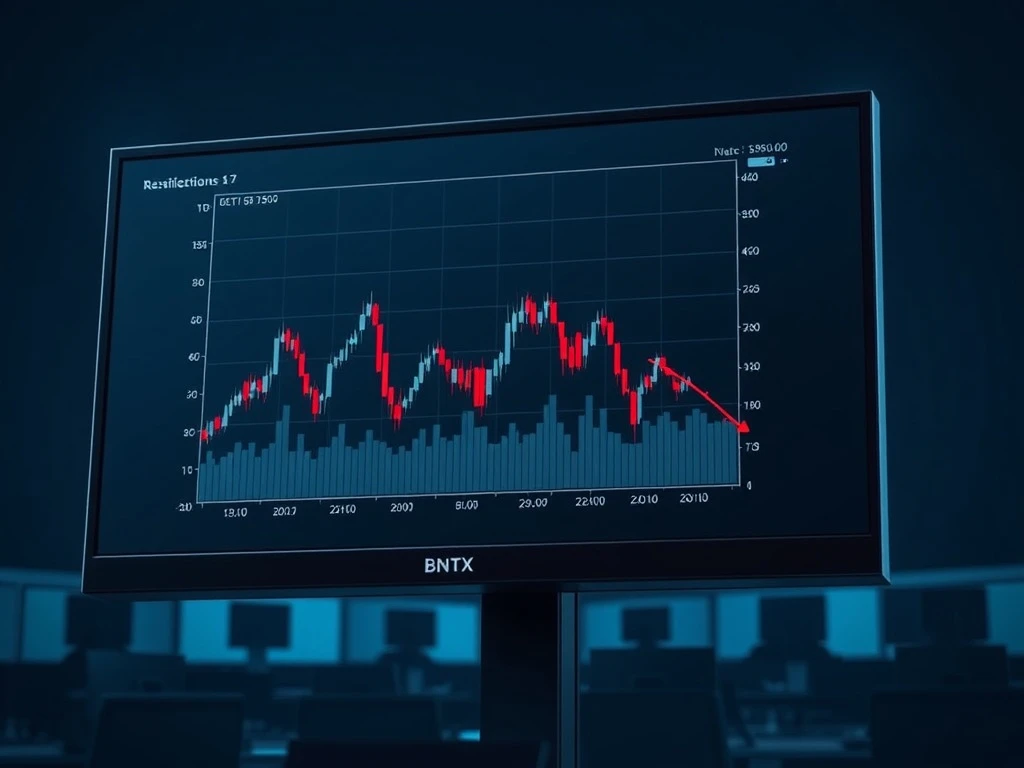
FRANKFURT, Germany — March 10, 2026: Shares of biotechnology firm BioNTech SE (BNTX) entered technically oversold territory during Tuesday’s trading session, a signal that has historically preceded potential rebounds for volatile stocks. The stock’s Relative Strength Index (RSI), a key momentum indicator, plummeted to 18.3, far below the oversold threshold of 30. This development occurred as the share price touched a new 52-week low of $79.52 before closing at $80.52. The sharp move contrasts with the broader market, where the S&P 500 ETF (SPY) maintained an RSI reading of 46.4, squarely in neutral ground. This divergence highlights specific pressures on BioNTech, independent of general market sentiment, and presents a critical moment for investors monitoring extreme momentum shifts.
BioNTech’s Technical Breakdown: Decoding the RSI Signal
The Relative Strength Index (RSI) measures the speed and change of price movements on a scale from 0 to 100. Developed by technical analyst J. Welles Wilder Jr., the indicator identifies overbought conditions above 70 and oversold conditions below 30. An RSI reading of 18.3, as recorded for BNTX on March 10, indicates severe selling pressure that may be exhausting itself. “An RSI this low doesn’t predict a guaranteed bounce, but it does signal that the selling has become extreme and possibly emotional,” explains Michael Hart, a Chartered Market Technician (CMT) at the Market Technicians Association. “For disciplined traders, it shifts the risk-reward calculus, suggesting the downside from current levels may be more limited than the potential upside if sentiment stabilizes.” The stock’s journey over the past year shows a high of $124 and a low now set at $79.52, representing a significant drawdown from its peak.
This technical event did not occur in a vacuum. BioNTech, co-founded by Dr. Uğur Şahin and Dr. Özlem Türeci, transitioned from a niche cancer immunotherapy research firm to a global household name during the COVID-19 pandemic through its partnership with Pfizer. Consequently, its stock became a high-beta play on pandemic trends. In the post-pandemic era of 2024-2026, the company has faced investor scrutiny as it pivots back to its core oncology pipeline, including individualized mRNA cancer vaccines and novel immuno-oncology candidates. The recent heavy selling pressure reflects a complex mix of factors beyond simple chart patterns.
Contextualizing the Sell-Off: Beyond the Chart
The plunge into oversold territory stems from several converging factors. First, the broader biotechnology sector (tracked by ETFs like XBI) has faced headwinds throughout early 2026 due to prolonged Federal Reserve monetary policy and regulatory uncertainties. Second, BioNTech-specific catalysts include the recent clinical data readout for its next-generation COVID-19 vaccine candidate, BNT162b7, which showed efficacy but failed to significantly outperform existing boosters in a crowded market. Third, institutional positioning data from filings reveals several large funds reduced their exposure to pandemic-era winners in Q4 2025, creating sustained selling pressure.
- Sector-Wide Pressure: The SPDR S&P Biotech ETF (XBI) is down approximately 15% year-to-date, creating a negative backdrop for all component stocks.
- Pipeline Transition: Investor patience is being tested as the company’s revenue shifts from high-margin pandemic vaccines to the longer, riskier development cycles of oncology drugs.
- Liquidity and Volatility: As a European-listed stock with a primary American Depository Receipt (ADR) in the U.S., BNTX can experience amplified volatility during cross-market trading sessions.
Expert Analysis on the Oversold Condition
Financial experts emphasize the need for perspective when interpreting extreme RSI readings. Sarah Chen, a portfolio manager at Fidelity Investments specializing in healthcare, notes, “The RSI is a snapshot of momentum, not fundamental value. For BioNTech, the fundamental question remains whether its cancer vaccine platform can deliver commercial success. The oversold condition might create a tactical entry point, but the strategic hold depends entirely on clinical trial outcomes expected later this year.” This view is echoed in a recent research note from Morgan Stanley, which maintained an ‘Equal-Weight’ rating on the stock but acknowledged the technical setup was “washed out.” The note pointed to the company’s strong cash position—over €15 billion as of its last report—as a critical buffer that reduces bankruptcy risk and provides ample funding for its pipeline.
Historical Precedents and Market Psychology
Warren Buffett’s famous adage to “be fearful when others are greedy, and greedy when others are fearful” is often invoked during oversold extremes. Historical analysis of BioNTech’s own chart reveals previous instances where the RSI dipped below 30. For example, in August 2024, the RSI reached 28.5, after which the stock rallied over 20% in the following month. However, past performance is not indicative of future results, and each oversold period has unique fundamental drivers. A comparison with peers in the mRNA and biotechnology space shows divergent technical health.
| Company (Symbol) | Current RSI (Approx.) | 52-Week Performance |
|---|---|---|
| BioNTech SE (BNTX) | 18.3 | -36% |
| Moderna, Inc. (MRNA) | 41.2 | -22% |
| Regeneron Pharmaceuticals (REGN) | 55.0 | +8% |
| SPDR S&P Biotech ETF (XBI) | 35.1 | -15% |
This table illustrates BioNTech’s uniquely weak momentum relative to its closest peer, Moderna, and the broader biotech sector. The disparity suggests company-specific concerns are outweighing general sector malaise.
The Path Forward: Catalysts and Considerations
Attention now turns to near-term catalysts that could arrest the decline or confirm a reversal. The company is scheduled to present detailed Phase 1 data for its individualized neoantigen-specific immunotherapy (iNeST) platform at the American Association for Cancer Research (AACR) annual meeting in April 2026. Positive data could serve as a fundamental anchor for the stock. Furthermore, BioNTech’s Q1 2026 earnings report, due in early May, will provide an update on cash burn and pipeline progress. Analysts will scrutinize management’s commentary on the commercial transition for any signs of accelerated timelines or partnership deals.
Investor Sentiment and Market Mechanics
The options market for BNTX shows a significant skew, with high demand for short-dated put options (bets on further decline) driving up implied volatility. This ‘fear gauge’ in the options market often peaks near market bottoms. Meanwhile, retail investor sentiment on major trading platforms remains overwhelmingly negative, a contrarian indicator some analysts watch. However, value-oriented investors are beginning to scrutinize the balance sheet. With a market capitalization now hovering around $19 billion and over €15 billion in cash and equivalents, the stock is trading near its estimated cash value, implying the market assigns little to no value to its entire pipeline and platform technology—a potentially extreme valuation.
Conclusion
The oversold RSI reading of 18.3 for BioNTech (BNTX) marks a significant technical extreme that demands investor attention. While the indicator flags potential for a relief rally, the underlying investment thesis remains tethered to the company’s challenging transition from a pandemic revenue model to a sustainable oncology-focused biotech. The severe sell-off reflects real concerns about pipeline execution and sector headwinds, but may also have overshot to levels that discount the company’s formidable cash reserve and platform potential. Investors should view the oversold condition not as a standalone buy signal, but as a context-setting event that increases the importance of upcoming clinical data and management execution. The weeks leading to the AACR conference in April will be critical in determining whether this technical low forms a durable bottom.
Frequently Asked Questions
Q1: What does an RSI below 30 mean for a stock like BioNTech?
An RSI below 30 indicates the stock is technically “oversold,” meaning recent selling pressure has been extreme and may be exhausted. It is a momentum signal, not a guarantee of a rebound, but it suggests the risk of further immediate decline may be reduced.
Q2: Why is BioNTech stock under so much pressure in 2026?
The pressure stems from its transition away from high COVID-19 vaccine revenue, sector-wide biotech weakness, and investor impatience with the long development timelines for its core cancer vaccine pipeline. Recent clinical updates have also failed to provide a positive catalyst.
Q3: What are the key dates to watch for BioNTech next?
The next major catalyst is the American Association for Cancer Research (AACR) Annual Meeting in April 2026, where updated clinical data for its cancer vaccines will be presented. The Q1 2026 earnings report in early May will also be closely watched.
Q4: How does BioNTech’s oversold condition compare to the overall market?
It is significantly more extreme. While the S&P 500 (SPY) has a neutral RSI around 46.4, BioNTech’s reading of 18.3 shows company-specific distress far beyond general market trends.
Q5: Does BioNTech have the financial strength to weather this downturn?
Yes. The company reported over €15 billion in cash and equivalents, providing a substantial runway to fund operations and clinical trials for years without needing to raise capital at depressed stock prices.
Q6: Is Warren Buffett’s “be greedy when others are fearful” advice applicable here?
The adage highlights a contrarian mindset. The extreme fear reflected in the oversold RSI and negative sentiment suggests a potential opportunity for risk-tolerant investors, but it must be balanced with rigorous analysis of the company’s fundamentals, not just its stock price action.



