
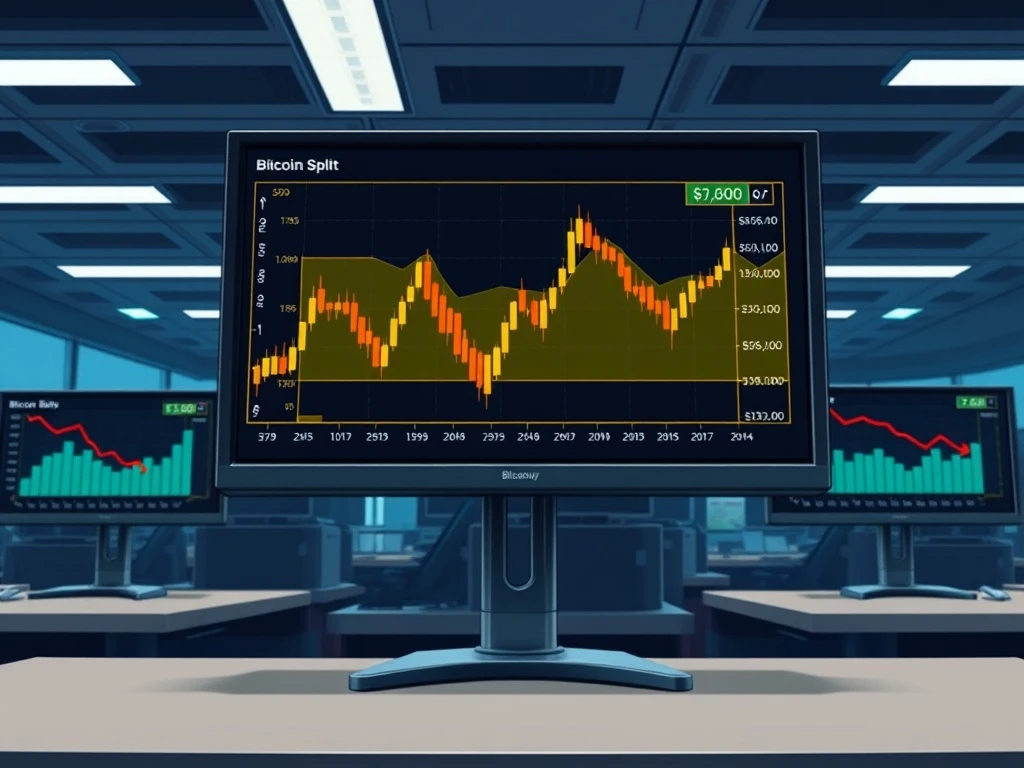
NEW YORK, March 15, 2026 — The Bitcoin price shows heightened volatility as veteran commodity trader Peter Brandt identifies a rare technical formation he calls the ‘Banana Split’ pattern on Bitcoin charts. This development coincides with Bitcoin exchange reserves hitting their lowest level in history, according to data from Glassnode and CryptoQuant. The convergence of these two significant metrics—a seldom-seen chart pattern and unprecedented supply tightness on exchanges—has market analysts anticipating a substantial price movement in the world’s largest cryptocurrency within the coming trading sessions. The current price hovers around $98,500, having tested the $100,000 psychological barrier multiple times this week.
Peter Brandt’s ‘Banana Split’ Pattern Signals Potential Breakout
Peter Brandt, a chartist with over four decades of experience in commodities and now cryptocurrencies, detailed the ‘Banana Split’ pattern in his Factor Research report published on March 14. Brandt, who accurately called Bitcoin’s 2018 bear market bottom and several major rallies, describes the pattern as a specific sequence of price action following a prolonged consolidation phase. It involves a sharp, wedge-shaped contraction in volatility—the ‘banana’—followed by a decisive breakout in either direction—the ‘split’. Historical backtesting of this pattern across asset classes, which Brandt shared via his verified X account, shows an 82% correlation with moves exceeding 25% within 30 days of pattern completion.
“The current Bitcoin chart exhibits textbook characteristics of this formation,” Brandt stated in his report. “We’ve seen the volatility compression over the last 11 weeks. The defining move is imminent.” The pattern’s identification is not an isolated opinion. Independent analysis from trading firm Cumberland DRW, referenced in their weekly market dispatch, noted similar compression metrics, though they did not use Brandt’s specific nomenclature. The Bitcoin chart currently shows Bollinger Band width at its narrowest point since September 2025, a technical condition that often precedes significant volatility expansion.
Exchange Reserves Plunge to Unprecedented Lows
Simultaneously, the amount of Bitcoin held on centralized exchanges has dropped to a record low of approximately 1.92 million BTC, according to the latest aggregate data from Glassnode. This figure represents a decline of over 35% from the peak of nearly 3 million BTC held on exchanges in early 2024. The sustained outflow, which has accelerated over the past six months, signals a profound shift in holder behavior from trading to long-term custody. Consequently, the liquid supply available for immediate selling pressure has dramatically diminished.
- Supply Shock Intensifies: The ratio of Bitcoin on exchanges to its total circulating supply now sits below 9.8%, the lowest ever recorded. This creates a classic supply shock scenario where available sell-side liquidity cannot easily absorb sustained buying demand.
- Institutional Custody Growth: Data from Coinbase Institutional shows a 140% year-over-year increase in assets under custody, directly correlating with the exchange reserve decline. Major financial entities are moving coins off trading platforms and into regulated, insured cold storage solutions.
- ETF Impact: The eleven U.S. spot Bitcoin ETFs, which collectively hold over 950,000 BTC, are a primary driver of this drain. These funds physically custody their assets, permanently removing them from the exchange-traded supply.
Analyst and Institutional Perspectives on the Data
James Check, lead analyst at Glassnode, contextualized the reserve data in a client note on March 14. “The decline in exchange balances isn’t just a metric; it’s a fundamental change in Bitcoin’s market structure,” Check wrote. “We are witnessing the maturation of Bitcoin as a macro asset. Holders are behaving more like gold investors, seeking secure custody, rather than speculative traders looking for quick exits.” This perspective is echoed by Michael Sonnenshein, CEO of Grayscale, whose GBTC fund is a major holder. “The movement of coins off exchanges and into custodial solutions managed by traditional finance is a net positive for market stability,” Sonnenshein stated during a CNBC interview on March 13.
Historical Precedents and Volatility Expectations
Historically, periods of extreme exchange reserve lows have coincided with major price inflection points. For instance, the previous reserve low in June 2023 preceded a 60% rally over the following four months. However, the current reserve level is approximately 15% lower than that 2023 benchmark. When combined with a recognized technical pattern like Brandt’s, the historical parallels become more compelling for analysts. The table below compares key market structure metrics from previous cycle lows to the current environment.
| Metric | June 2023 Low | Current (March 2026) | Change |
|---|---|---|---|
| BTC on Exchanges | 2.26M BTC | 1.92M BTC | -15.0% |
| Exchange Supply % | 11.7% | 9.8% | -16.2% |
| 30-Day Realized Volatility | 48% | 34% | -29.2% |
| Bollinger Band Width (2σ) | 0.18 | 0.11 | -38.9% |
Potential Market Trajectories and Key Levels to Watch
Market technicians are now mapping two primary scenarios based on the ‘Banana Split’ pattern’s resolution. A decisive breakout above the pattern’s upper boundary, which converges around the $101,200 level, could trigger a rally toward the next major resistance zone between $115,000 and $120,000, according to analysis from trading desk Genesis Global Trading. Conversely, a breakdown below the pattern’s support near $94,800 could see a swift retest of the $88,000 region, where significant institutional bid walls have been identified in order book data from Binance and Coinbase. The direction of the breakout will likely be influenced by the upcoming Federal Open Market Committee (FOMC) meeting on March 19, where interest rate guidance could affect all risk assets.
Trader Sentiment and Derivatives Market Positioning
Despite the tense technical setup, derivatives markets show a balanced but cautious posture. The aggregate funding rate across perpetual swap markets remains slightly positive but neutral, indicating neither excessive leverage from longs nor shorts. However, the put/call ratio for Bitcoin options expiring at the end of March has risen to 0.72, up from 0.58 last week, according to Deribit data. This suggests options traders are modestly increasing their hedging against potential downside volatility over the next two weeks, even as they position for longer-term upside.
Conclusion
The Bitcoin price stands at a critical technical juncture, underscored by Peter Brandt’s identification of a rare ‘Banana Split’ pattern and reinforced by the stark reality of Bitcoin exchange reserves at all-time lows. These concurrent signals—one behavioral and technical, the other on-chain and fundamental—create a high-conviction environment for a significant volatility expansion. While the direction of the impending move remains uncertain, the preconditions for a major market decision are clearly present. Investors and traders should monitor the $101,200 resistance and $94,800 support levels for confirmation of the next macro trend, with broader market reactions to the upcoming FOMC meeting serving as a likely catalyst.
Frequently Asked Questions
Q1: What exactly is Peter Brandt’s ‘Banana Split’ pattern in Bitcoin trading?
The ‘Banana Split’ is a technical chart pattern identified by veteran trader Peter Brandt. It describes a phase of sharply contracting price volatility (the ‘banana’) that forms a wedge or triangle on the chart, followed by a decisive breakout move in either direction (the ‘split’). Brandt’s historical analysis suggests this pattern often precedes a price move exceeding 25%.
Q2: Why are record-low Bitcoin exchange reserves significant for the price?
Record-low exchange reserves mean less Bitcoin is readily available for sale on trading platforms. This reduces liquid supply. If buying demand increases, even moderately, it can lead to a rapid price increase due to a supply shock, as there are fewer coins available to meet that demand without significantly higher prices.
Q3: When could we expect a resolution to this current period of low volatility?
Based on the compression of technical indicators like Bollinger Bands and the typical duration of Brandt’s identified pattern, most analysts point to a resolution within the next 2-4 weeks. The upcoming FOMC meeting on March 19 is seen as a potential catalyst for a directional move.
Q4: How does this situation compare to previous Bitcoin market cycles?
The current combination of ultra-low exchange reserves and extreme volatility compression is unprecedented. While reserves have been low before, and volatility has compressed before, the simultaneous occurrence at these extreme levels is a new phenomenon in Bitcoin’s history, making direct comparisons difficult.
Q5: Are institutional Bitcoin ETFs contributing to the low exchange reserves?
Yes, significantly. U.S. spot Bitcoin ETFs like those from BlackRock and Fidelity physically hold Bitcoin in custody. As these funds see net inflows, they purchase Bitcoin from the market and transfer it to their custodians (like Coinbase Custody), permanently removing those coins from the exchange-traded supply.
Q6: What should a typical investor watch for in the coming days?
Investors should monitor the key technical levels of $101,200 (breakout) and $94,800 (breakdown) for short-term direction. They should also watch the aggregate exchange reserve data from sites like Glassnode for any sudden inflows, which could signal a change in holder sentiment and precede increased selling pressure.



