
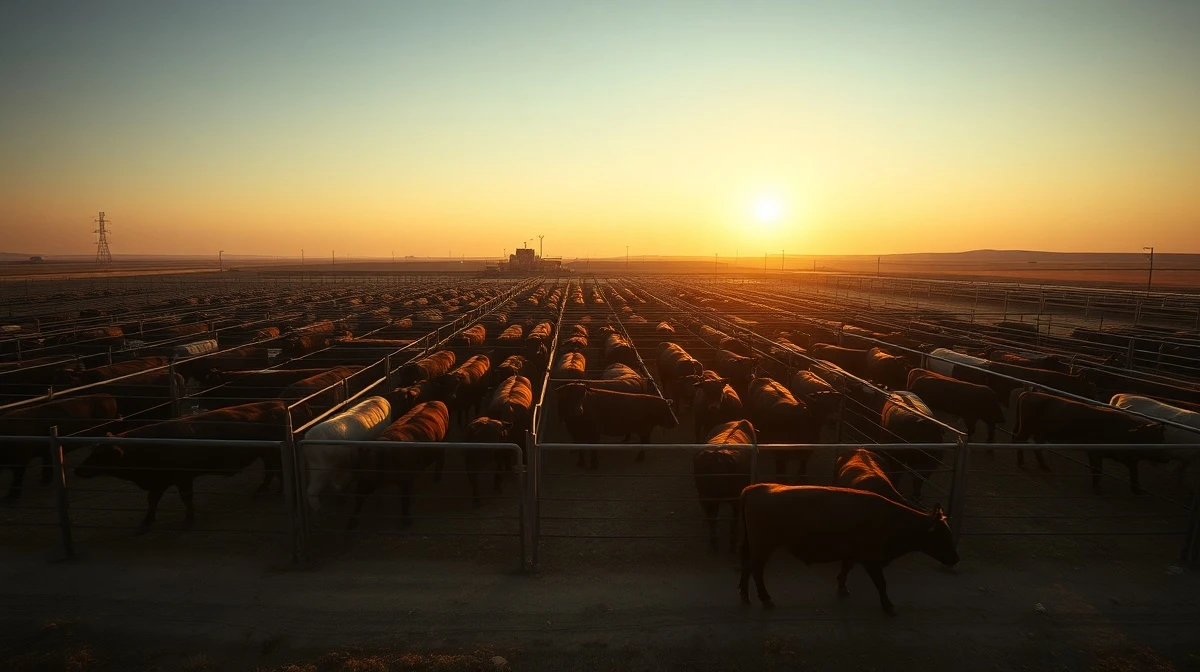
April 9, 2026 — Cattle futures moved higher in Wednesday’s trading session, building on recent strength even as direct cash sales for animals remained elusive and wholesale beef prices softened.
According to settlement data from the CME Group, most live cattle contracts finished in positive territory. The front-month April 2026 contract added 80 cents to close at $249.00 per hundredweight. Gains tapered in deferred months, with the June contract up 12.5 cents to $245.925 and the August contract rising a modest 5 cents to $242.425.
Also read: Cotton Futures End Mixed in Tight Trading
Feeder cattle futures, which represent younger animals destined for feedlots, saw more pronounced increases. The April contract jumped $1.775 to $370.675. The August feeder contract led the complex, climbing $1.90 to settle at $367.95.
Cash Market Holds Its Breath
The futures advance occurred against a backdrop of a quiet cash market. Industry reports indicate no significant direct sales of market-ready cattle were confirmed on Wednesday. This follows last week’s cash trade in a range of $245 to $246 per hundredweight.
Also read: Soybeans Gain as Meal Offsets Oil Price Drop
An attempt to move cattle via an online auction failed to generate a deal. The Central Stockyards Fed Cattle Exchange reported no bids were placed on the 970 head offered. Sellers had set reserve prices, or asking prices, at $250 live. This suggests packers and feeders remain at odds over current value. The lack of cash trade leaves the market without a clear immediate price discovery mechanism, forcing participants to rely more heavily on futures signals.
Beef Demand and Supply Metrics
Data from the U.S. Department of Agriculture painted a mixed picture of downstream demand. The weekly wholesale Boxed Beef report released Wednesday afternoon showed lower prices. The Choice cutout value fell $3.08 to $379.66 per hundredweight. The Select cutout dropped $4.06 to $382.27.
Notably, the report showed an inversion, with Select beef priced $2.61 higher than Choice. This is unusual, as Choice-graded beef typically commands a premium. Market watchers note this can signal tighter supplies of lower-graded meat or specific demand for certain product mixes.
On the supply side, USDA estimated federally inspected cattle slaughter for Wednesday at 109,000 head. The weekly total through Wednesday reached 320,000 head. That figure is down 4,000 head from the prior week and is nearly 30,000 head below the same week in 2025.
The lower slaughter numbers could point to tighter animal supplies. It may also reflect ongoing adjustments by packing plants. The CME Feeder Cattle Index, a benchmark for cash feeder cattle, was calculated at $364.59 for April 7, down 4 cents from the previous day.
What the Market Moves Suggest
The divergence between firm futures and softer wholesale beef prices presents a puzzle. One interpretation is that futures traders are anticipating tighter cattle supplies in the months ahead, bidding up contracts accordingly. The lower weekly slaughter data supports this view.
Conversely, the decline in boxed beef values indicates current demand from retailers and food service may not be solid enough to support sharply higher costs. The inverted Choice/Select spread adds another layer of complexity for packers trying to manage margins.
“The market is in a holding pattern, waiting for cash to break one way or the other,” observed one market analyst, summarizing the sentiment. “Futures are trying to lead, but the physical trade needs to follow for the rally to have legs.”
Key Price Levels and Context
The recent activity follows a period of resilience in cattle markets compared to other livestock, such as hogs. The focus now shifts to when and at what level significant cash trade will resume. The $250 level remains a psychological barrier for sellers, as evidenced by the online auction reserves.
Industry participants are also monitoring broader economic factors, including consumer spending trends as the spring grilling season approaches. Any sustained shift in beef demand will ultimately filter back to the prices paid for live animals.
For traders and hedgers, the immediate question is whether futures can maintain their premium without confirmation from the cash market. A failure to secure higher cash prices could pressure nearby futures contracts. Sustained strength in feeders, however, suggests confidence in longer-term fundamentals for cattle supplies.
Market data for this report was sourced from CME Group and the U.S. Department of Agriculture.

This article was produced with AI assistance and reviewed by our editorial team for accuracy and quality.



