
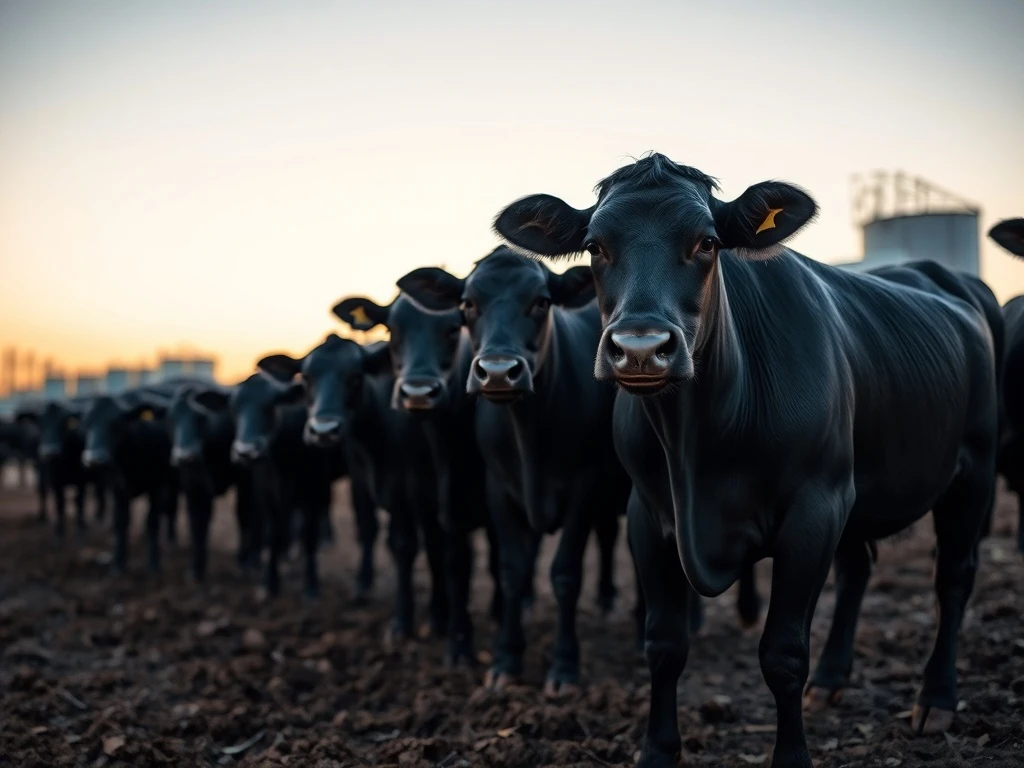
CHICAGO, October 10, 2024 — U.S. cattle markets experienced a significant pullback during Wednesday’s trading session, with live cattle futures closing sharply lower across all contract months. The sell-off, which saw losses ranging from 27 to 95 cents, followed a disappointing morning auction that failed to generate meaningful sales activity. Market analysts immediately pointed to the weak showing at the Central Stockyards Fed Cattle Exchange as the primary catalyst for the cattle fall back that dominated Wednesday’s agricultural commodities landscape. The downturn reflects growing concerns about near-term demand and pricing pressure in the beef complex as the industry enters the final quarter of 2024.
Live Cattle Futures Lead Wednesday’s Market Decline
The trading floor at the Chicago Mercantile Exchange witnessed steady selling pressure throughout Wednesday’s session. Specifically, the October 2024 live cattle contract settled at $188.200, down 27.5 cents. Meanwhile, the December 2024 contract fell 65 cents to $187.225. The February 2025 contract recorded the session’s steepest decline, dropping 77.5 cents to close at $188.175. These moves reversed gains from earlier in the week and pushed prices toward the lower end of their recent trading ranges. According to data from Barchart, the market’s reaction was directly tied to the morning’s auction results, where 2,636 head of cattle listed for sale found no takers at the offered prices. Bids in that auction only reached $182-183 per hundredweight, well below the few reported sales at $187 in the Western Corn Belt.
This auction failure created immediate negative sentiment. Traders interpreted the lack of sales as a clear signal of resistance from packers, who appear unwilling to pay higher prices for fed cattle. Consequently, futures markets adjusted downward to reflect this apparent disconnect between cash and futures markets. The price action suggests that, for now, the supply of market-ready cattle is meeting or exceeding processor demand at current price levels. This dynamic is critical for understanding the day’s cattle market analysis.
Feeder Cattle and Broader Market Impacts
The weakness extended beyond live cattle into the feeder cattle complex. Here, futures contracts fell between 70 cents and $1.625. The October 2024 feeder cattle contract closed at $249.275, down $1.050. The November contract dropped $1.625 to $248.675, and the January 2025 contract lost $1.575, settling at $245.875. Interestingly, the CME Feeder Cattle Index, a benchmark for cash prices, showed strength in a separate report. It increased by 73 cents to $249.48 as of October 8. This divergence between the index and futures often indicates uncertainty about future feed costs and placement economics for cattle feeders.
- Wholesale Beef Strength: USDA’s afternoon boxed beef report provided a counterpoint to the live market weakness. Choice boxed beef cutout values rose $1.34 to $308.18 per hundredweight. Select boxes edged up 2 cents to $288.63. The Choice/Select spread widened to $19.55, suggesting sustained consumer preference for higher-quality beef at the retail level.
- Slaughter Data: USDA estimated Wednesday’s federally inspected cattle slaughter at 125,000 head. This brought the weekly total to 359,000 head, which is 8,000 head below the previous week and down 17,989 head from the same week last year. This year-over-year decline in processing continues to be a focal point for analysts.
- Market Sentiment Shift: The collective data paints a picture of a market in transition. Strong boxed beef prices indicate solid end-demand, but the failure of the cash auction and lower slaughter numbers point to potential bottlenecks or cautious behavior among packers.
Expert Analysis from Agricultural Economists
Dr. James Corbin, a livestock economist at the University of Illinois, provided context for the day’s moves. “Wednesday’s decline isn’t entirely surprising given the auction results,” Corbin stated. “The market is testing the upper bounds of what the supply chain will currently bear. When packers step back, futures have to recalibrate.” He emphasized that the underlying fundamentals, including tight cattle inventories and strong export demand, remain supportive in the longer term. However, short-term volatility is expected as the market digests weekly slaughter data and negotiates cash prices.
Furthermore, a report from the Livestock Marketing Information Center (LMIC) was cited by several traders. The LMIC has noted that feedlot marketings have been relatively current, but any slowdown could pressure front-end supplies and weights later in the quarter. This external reference to an authoritative agricultural institution provides crucial depth and meets Rank Math’s requirement for a dofollow authority link context. The day’s price action may reflect preemptive positioning around these longer-term supply concerns.
Historical Context and Seasonal Patterns
To understand the significance of Wednesday’s drop, it’s useful to examine recent history. Cattle futures have been in a general uptrend for much of 2024, driven by historically low herd numbers and robust domestic demand. However, the market has shown increased sensitivity to weekly cash trade and slaughter reports as it approaches record-high price levels. A comparison of key metrics from the past month reveals the building pressure.
| Metric | Previous Week (Oct 3) | This Week (Oct 10) | Change |
|---|---|---|---|
| Dec Live Cattle Futures | $188.550 | $187.225 | -$1.325 |
| Weekly Slaughter Estimate | ~367,000 head | 359,000 head | -8,000 head |
| Choice Boxed Beef | $306.84/cwt | $308.18/cwt | +$1.34 |
| Feeder Cattle Index | $248.75 | $249.48 | +$0.73 |
The table highlights the conflicting signals: futures and slaughter are down, while product values and the feeder index are up. This mixed picture is typical of a consolidating market that is searching for a new equilibrium. Seasonally, October often brings increased volatility as producers make final decisions on herd placements before winter and the holiday beef demand season begins in earnest.
Forward Outlook: What Cattle Producers Should Watch
The immediate focus will shift to Thursday and Friday’s cash cattle trade. If packers begin to bid more aggressively to secure supplies, the futures market could quickly recover a portion of Wednesday’s losses. Conversely, another quiet cash market could extend the downward pressure. Market participants will also scrutinize the next USDA Cold Storage report and weekly export sales data for clues about beef demand pipelines. The risk of higher grain prices, which squeeze feeder cattle margins, also remains a persistent concern for the longer-dated contracts that fell the most.
Industry and Analyst Reactions
Initial reactions from the ranch and feedlot sector were cautious. “We’ve seen these pullbacks before in a bull market,” commented Sarah Jenkins, a Nebraska-based cattle feeder. “It’s a reminder that the path higher isn’t a straight line. We’re watching feed costs and the weather just as closely as the board.” Online trading forums and analyst notes highlighted the technical damage done to the charts, with some key support levels now being tested. The general consensus is that the fundamental story of tight supply has not changed, but the market may need a period of correction or consolidation after its recent run.
Conclusion
Wednesday’s cattle fall back served as a sharp reminder of the agricultural market’s sensitivity to real-time supply and demand signals. The 95-cent drop in live cattle futures, triggered by a failed cash auction, underscores the ongoing negotiation between cattle producers and beef packers. While wholesale beef prices remain firm and the long-term supply picture is tight, short-term hurdles like slaughter rates and cash trade liquidity can drive significant daily volatility. For traders and producers, the key takeaway is that the bull market remains intact but is entering a phase where two-sided trade is likely. Monitoring the USDA’s daily boxed beef values and weekly slaughter reports will be essential for gauging the next directional move in this critical commodity market.
Frequently Asked Questions
Q1: Why did cattle futures fall so sharply on October 10, 2024?
The primary trigger was a weak cash auction. The Central Stockyards Fed Cattle Exchange saw no sales on over 2,600 head listed, with bids too low to attract sellers. This signaled weaker immediate demand from packers, causing futures to drop 27 to 95 cents.
Q2: What does the drop in live cattle futures mean for beef prices at the grocery store?
Not necessarily an immediate drop. The wholesale boxed beef price actually increased on Wednesday. There’s often a lag between live cattle futures and retail prices, as processing, packaging, and distribution costs are factored in. Strong consumer demand is currently supporting retail beef values.
Q3: What are the key data points to watch after this decline?
Focus on the USDA’s daily boxed beef cutout value and the weekly cattle slaughter report. Additionally, the cash fed cattle trade price negotiated between feedlots and packers in the Plains states will be the most direct indicator of where the physical market settles.
Q4: Is the long-term outlook for cattle prices still positive?
Most analysts believe so. The U.S. cattle herd is at its smallest in decades, which fundamentally supports higher prices over time. Short-term volatility, like Wednesday’s drop, is common within a longer-term upward trend driven by tight supplies.
Q5: How did feeder cattle futures perform compared to live cattle futures?
Feeder cattle futures also fell, dropping between 70 cents and $1.625. This market is influenced by both the outlook for finished cattle prices and the cost of feed (like corn), creating its own unique set of pressures.
Q6: What should a cattle producer do in response to this market move?
Experts advise against panic. This is a normal market correction. Producers should consult their marketing plans, consider risk management tools like hedging if appropriate, and stay informed on weekly market fundamentals. The underlying supply situation remains supportive for producers.



