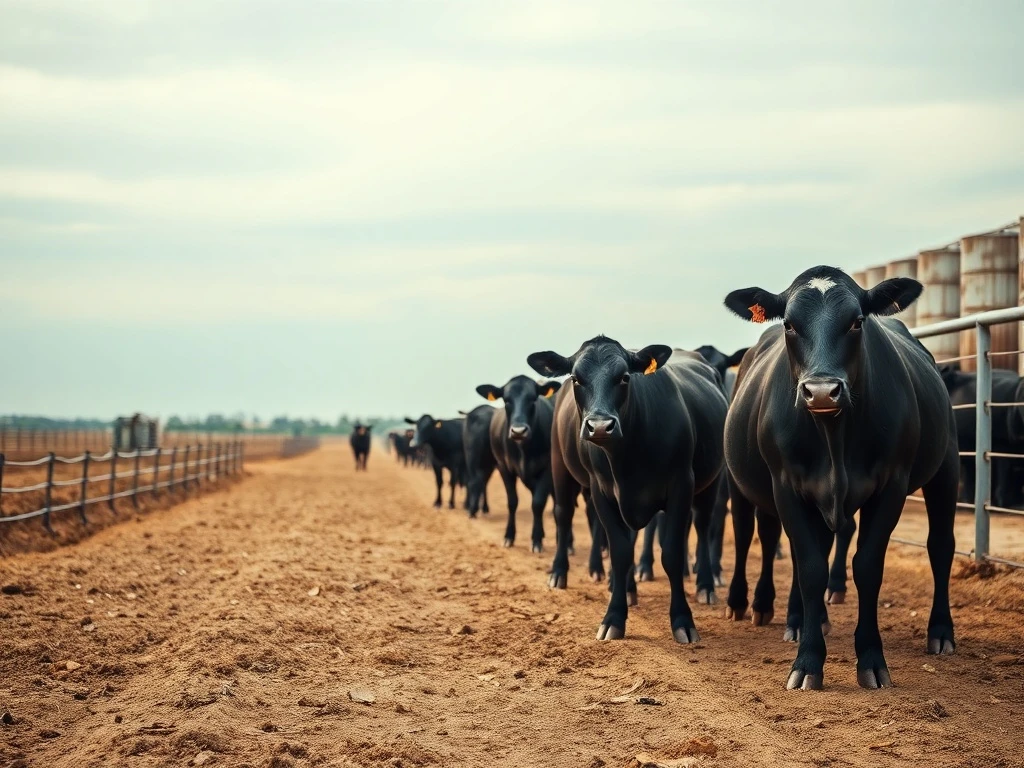
CHICAGO, March 11, 2026 — U.S. livestock markets faced significant downward pressure Wednesday, with front-month live cattle futures tumbling more than $2.00 per hundredweight. The sell-off, centered at the Chicago Mercantile Exchange (CME), reflects a combination of sluggish cash market activity, a declining feeder cattle complex, and concerns over slaughter volumes. Market analysts point to the midday losses of $2.075 to $2.10 in live cattle contracts and steeper $4.50 to $6.60 drops in feeder cattle as a clear signal of near-term bearish sentiment gripping the sector.
Cattle Futures Plunge on Weak Cash Fundamentals
The trading session on March 11, 2026, delivered a stark reminder of the cash market’s influence on futures. April 2026 Live Cattle futures settled at $230.300, down $2.075, while the August contract fell $2.100 to $226.250. This pressure originated directly from the physical trade. The weekly Fed Cattle Exchange online auction reported limited sales, with only 67 head sold at $236.50 using the BidTheGrid method™, a price that failed to inspire confidence. Meanwhile, isolated cash trades emerged at $235 live and $372 dressed, but volume remained conspicuously light. “The cash market is telling the story today,” noted Dr. James Corbin, a livestock economist with the Agricultural & Food Policy Center. “When the futures market sees thin cash volume at these levels, it interprets it as a lack of committed buyer support, leading to the kind of technical selling we’re witnessing.” The CME Feeder Cattle Index compounded the negativity, falling another $0.62 to $365.77 as of March 9.
This decline continues a pattern from the previous week. USDA estimated federally inspected cattle slaughter for Tuesday at 108,000 head, bringing the week-to-date total to 211,000. While steady with the prior week, this figure remains 28,002 head below the same week in 2025. This year-over-year deficit in processing activity directly reduces packer demand for live animals, creating a fundamental oversupply scenario that weighs on prices.
Diverging Signals from the Wholesale Beef Market
In a contrasting development, wholesale boxed beef prices posted gains in the Wednesday morning report. Choice boxed beef cutout values rose $1.27 to $395.94, while Select increased $1.85 to $388.62. Consequently, the Choice/Select spread narrowed to $7.32. Typically, strengthening wholesale values would provide underlying support for live animal prices. However, analysts caution that this relationship can decouple. “Strong boxed beef doesn’t always translate to strong live cattle prices in the short term,” explained Sarah Chen, a senior commodity analyst at Barchart. “If packers are sitting on ample inventories or if the strength is concentrated in specific cuts not reflective of the overall carcass value, the support for the live market can be muted. Right now, the market is prioritizing the clear weakness in cash trade and slaughter numbers.”
- Cash Market Stagnation: Light volume and failed auctions create a negative feedback loop for futures.
- Feeder Cattle Collapse: Sharp declines in feeder futures, down up to $6.60, signal pessimism about future feedlot placements and costs.
- Slaughter Deficit: Processing rates trailing 2025 levels directly suppress packer demand for live inventory.
Expert Analysis on Market Mechanics
The current pressure highlights the complex interplay between futures speculation and physical market realities. According to a market commentary from the Livestock Marketing Information Center (LMIC), the widening basis—the difference between cash and futures prices—often precedes futures adjustments. “The futures market had been holding a premium that the cash market simply couldn’t validate,” the LMIC statement read. “Wednesday’s move is a correction to better align with the demonstrable supply and demand fundamentals on the ground.” Furthermore, external factors like feed grain cost volatility and broader macroeconomic indicators influencing meat demand are also in play, adding layers of uncertainty for traders.
Historical Context and Forward Price Trajectory
To understand the significance of a single-day $2.10 drop, it’s useful to examine recent volatility. The live cattle market has experienced heightened swings in early 2026, reacting to shifting export forecasts and domestic consumer spending data. A comparison of key contract settlements illustrates the day’s damage relative to recent trading ranges.
| Contract | March 10 Settle | March 11 Settle | Net Change |
|---|---|---|---|
| Apr 26 Live Cattle | $232.375 | $230.300 | -$2.075 |
| Jun 26 Live Cattle | $230.200 | $228.125 | -$2.075 |
| Mar 26 Feeder Cattle | $353.350 | $348.850 | -$4.500 |
| May 26 Feeder Cattle | $346.400 | $339.800 | -$6.600 |
The table shows the feeder cattle complex absorbed deeper percentage losses, often a leading indicator for future live cattle supplies as it reflects the cost of animals entering feedlots.
What Cattle Producers and Traders Watch Next
Market participants will immediately turn their attention to the remainder of the week’s cash trade. A significant volume of negotiated cash sales at or above Wednesday’s isolated levels could staunch the bleeding in futures. Conversely, further quiet or lower prices would likely extend the downward pressure. The weekly USDA Livestock Slaughter report, due Thursday, will provide crucial data on whether processing speeds are accelerating to meet, or fall further behind, last year’s pace. Additionally, the monthly USDA Cattle on Feed report, scheduled for later in March, will offer the next major fundamental snapshot of feedlot inventory and placement levels, setting the tone for the spring and summer quarters.
Industry Reaction and Risk Management Strategies
Initial reaction from producer groups emphasized caution. “Days like this underscore the importance of having a risk management plan in place before volatility hits,” said a statement from the National Cattlemen’s Beef Association. Many larger operations utilize hedging strategies through futures and options contracts on the CME to lock in prices for a portion of their expected production. For smaller producers, such sharp moves can significantly impact profitability margins, making forward contracting with local packers or participating in alternative marketing arrangements increasingly attractive tools to manage price uncertainty.
Conclusion
The cattle futures pressure witnessed on March 11, 2026, stems from a definitive breakdown in cash market support amid concerns over slaughter capacity. While wholesale beef prices showed strength, it was insufficient to offset the bearish signals from thin cash trade and a collapsing feeder cattle market. The immediate focus shifts to whether cash sales can gain momentum at current levels and if packers will increase slaughter runs to narrow the year-over-year deficit. For traders and producers alike, the event serves as a potent reminder that in agricultural commodities, futures prices ultimately converge with the tangible realities of the physical supply chain. Monitoring weekly slaughter data and the next Cattle on Feed report will be critical for determining if this is a short-term correction or the beginning of a broader downtrend.
Frequently Asked Questions
Q1: Why did cattle futures drop so sharply on March 11, 2026?
The primary driver was weak cash market activity, with very few cattle sold and prices that failed to meet expectations. This, combined with a significant decline in feeder cattle futures and slaughter numbers running below last year’s pace, created a perfect storm of bearish sentiment.
Q2: How does the drop in feeder cattle affect live cattle prices?
Feeder cattle are younger animals destined for feedlots. A sharp drop in their price indicates lower demand from feedlots, often due to high feed costs or pessimistic outlooks. This reduces future costs for packers and signals expected weaker demand for live cattle down the line, putting downward pressure on live cattle futures.
Q3: What needs to happen for cattle prices to stabilize or recover?
Stabilization requires increased cash trade volume at steady or higher prices, an acceleration in weekly slaughter rates to match or exceed 2025 levels, and sustained strength in the wholesale boxed beef market that translates into stronger packer demand for live inventory.
Q4: What is the Fed Cattle Exchange and why is it important?
The Fed Cattle Exchange is an online auction platform for marketing fed (ready-for-slaughter) cattle. Its results are closely watched as a transparent indicator of real-time cash market value. A weak showing with few sales, as seen Wednesday, is interpreted as a lack of buyer confidence.
Q5: How does this price move impact consumer beef prices?
There is often a lag between live animal price changes and retail beef prices. While falling live cattle costs can eventually reduce input costs for processors and retailers, other factors like processing labor, packaging, transportation, and retail markup influence the final shelf price. Short-term consumer price changes may not be immediately apparent.
Q6: What should a cattle producer do in response to this market move?
Producers should consult with their financial advisor or risk management specialist. Options may include reviewing existing hedge positions, exploring forward contracting opportunities if prices align with cost of production, and closely monitoring feed costs and animal health to maximize efficiency during periods of price pressure.