
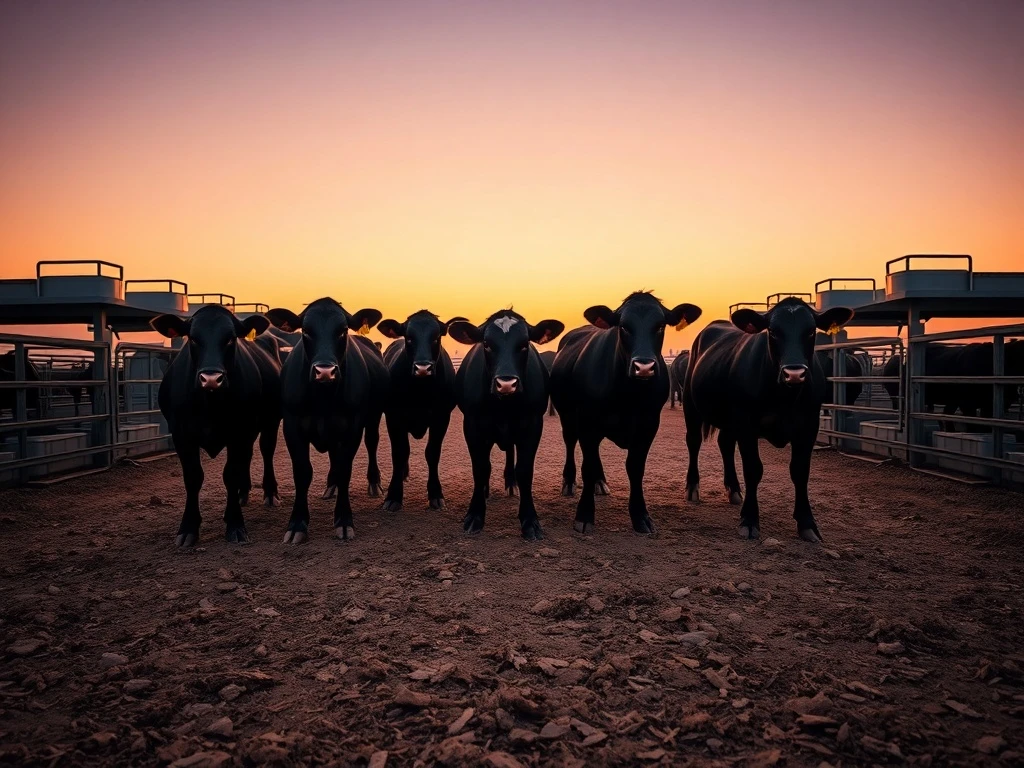
CHICAGO, March 8, 2026 — U.S. cattle markets closed the trading week under significant pressure, with live cattle futures falling sharply in Friday’s session. The sell-off, which saw April contracts drop as much as $4.50, coincided with broad declines across major equity indices, creating a risk-off environment that spilled into agricultural commodities. Cash trade settled at $240 per hundredweight across most regions, showing mixed regional movement. This week’s performance marks a notable reversal from earlier strength, placing renewed focus on supply fundamentals and wholesale demand signals as the industry heads toward the spring quarter.
Cattle Futures Led Lower by Broad Market Sentiment
The Chicago Mercantile Exchange (CME) reported substantial losses across its livestock complex as the closing bell approached on Friday. Specifically, April 2026 live cattle futures settled at $234.575, down $3.950 for the session. Meanwhile, June contracts closed at $231.475, reflecting a $3.800 decline. The downward momentum was not isolated. Analysts at Barchart, which first reported the data, immediately linked the movement to a simultaneous drop in major stock indices. The S&P 500 and Nasdaq both traded lower throughout the afternoon, dampening investor appetite for risk assets including commodities. Consequently, the managed money segment, a key group of speculative traders, reduced its net long position in live cattle futures and options by 4,494 contracts as of Tuesday, according to the latest Commitment of Traders report.
This shift in speculative positioning often precedes short-term volatility. The cash market presented a more nuanced picture. Trade settled firmly at $240 in many areas, though northern regions saw some firming from the prior week. Southern markets experienced slight softening. A handful of sales even reached the $241-$242 range, indicating pockets of resilience. The U.S. Department of Agriculture (USDA) estimated federally inspected cattle slaughter for the week at 521,000 head. This figure sits 58,267 head below the same week last year, a data point that market participants are watching closely for signs of tighter supply.
Feeder Cattle and Wholesale Beef Show Divergent Pressure
The weakness extended decisively into the feeder cattle sector. Futures contracts there fell between $6.97 and $7.42 across the board. The CME Feeder Cattle Index declined another $1.47 to $367.32 on March 5, continuing a recent downtrend. Speculative funds also pared back their net long position in feeder cattle by 206 contracts. The simultaneous pressure on both live and feeder cattle suggests concerns are broadening beyond just immediate slaughter supplies to include the cost and availability of calves for feedlots. This creates a complex cost-pressure scenario for cattle feeders.
- Choice Boxed Beef: Prices edged up 33 cents to $387.22 in the Friday afternoon report, showing modest retail demand support.
- Select Boxed Beef: Conversely, Select boxes fell $1.66 to $378.95, widening the Choice/Select spread to $8.27.
- Market Interpretation: This mixed wholesale picture indicates consumers may be trading down within the beef category, a trend monitored for economic sensitivity.
Expert Analysis from Agricultural Economists
Dr. Sarah Jensen, a livestock economist with the University of Illinois Extension, provided context for the week’s moves. “Friday’s futures decline appears heavily influenced by macro sentiment flowing from equities,” Jensen noted. “However, the underlying fundamentals—namely the year-over-year reduction in slaughter and steady cash trade—haven’t dramatically shifted. The market is grappling with the timing of spring herd placements against current feed costs.” Separately, a market commentary from the Livestock Marketing Information Center (LMIC) highlighted the importance of the upcoming USDA Cattle on Feed report, scheduled for later in March, in providing clearer direction. The LMIC pointed to feed grain price volatility as a persistent headwind for feeder cattle profitability.
Historical Context and Seasonal Cattle Market Patterns
To understand the significance of this week’s pullback, it’s useful to view it within seasonal and historical patterns. March often serves as a transitional period for cattle markets, bridging the gap between winter weather disruptions and the spring grazing season. Price corrections following a rally, like the one that lifted April live cattle $2.35 from the previous Friday, are not uncommon. A comparison of recent weekly closes reveals the market’s search for equilibrium between supply constraints and demand elasticity.
| Contract | March 8 Close | Weekly Change |
|---|---|---|
| Apr ’26 Live Cattle | $234.575 | -$3.950 |
| Jun ’26 Live Cattle | $231.475 | -$3.800 |
| Mar ’26 Feeder Cattle | $355.625 | -$6.975 |
| May ’26 Feeder Cattle | $348.075 | -$7.450 |
Historically, similar corrections in 2024 and 2025 were followed by periods of consolidation before the market established a clearer trend based on second-quarter demand, typically driven by grilling season anticipation. The current price levels, while down for the week, remain elevated compared to the five-year average for early March, underscoring the overall strength of the cattle cycle.
Forward Outlook: Key Factors to Watch Next Week
Market attention now turns to several imminent data releases and physical market developments. First, traders will scrutinize daily slaughter totals and boxed beef cutout values for signs of whether the Friday afternoon weakness in Select beef was an anomaly or the start of a trend. Second, the flow of cattle from feedlots to packing plants will be critical. If the pace remains below year-ago levels, it could provide underlying support that mitigates further futures losses. Finally, broader economic indicators, including consumer sentiment and retail sales data, will be analyzed for clues about beef demand strength heading into Easter and early spring.
Industry Stakeholder Reactions to the Volatility
Initial reactions from industry groups highlighted cautious optimism tempered by realism. A spokesperson for the National Cattlemen’s Beef Association (NCBA) emphasized the long-term fundamentals. “While daily price movements capture headlines, cattle producers are focused on herd health and managing input costs in a dynamic environment,” the statement read. Conversely, some independent cattle feeders expressed concern to trade publications about the rapid erosion in feeder cattle values, which directly impacts their purchase decisions for spring placements. This tension between different segments of the supply chain is a normal feature of a functioning market but adds layers to the price discovery process.
Conclusion
The week ending March 8, 2026, concluded with significant cattle futures losses, driven by a confluence of equity market pressure and technical selling. While the live and feeder cattle complexes both fell sharply, underlying cash trade held relatively firm, and boxed beef prices showed a mixed but not catastrophic picture. The primary takeaway is that the cattle market remains in a state of adjustment, balancing tight supplies against economic crosscurrents. Moving forward, participants should monitor slaughter rates, wholesale demand signals, and key USDA reports. The market’s direction will likely hinge on whether the solid fundamental backdrop of limited supply can outweigh the transient headwinds from broader financial market sentiment.
Frequently Asked Questions
Q1: Why did cattle futures fall sharply on March 8, 2026?
Cattle futures declined primarily due to a risk-off sentiment in broader financial markets, which saw major stock indices drop. This led speculative traders to reduce positions in commodities like livestock. Specific contracts for live cattle fell between $3.80 and $4.50.
Q2: What does the drop in feeder cattle futures indicate?
The steeper decline in feeder cattle futures, down nearly $7.50, signals concern about the cost side of cattle production. It reflects worries over high feed costs and the economics of placing calves into feedlots, potentially impacting future beef supplies.
Q3: What is the next major event that could move the cattle market?
The next scheduled USDA Cattle on Feed report, expected in late March, will be critical. It provides official data on the number of animals in feedlots, offering concrete evidence of future beef supply levels and influencing trader expectations.
Q4: How does the cash market price differ from the futures price?
While futures fell, the cash market—the actual price paid for cattle sold to packers—held at $240 per hundredweight in many areas. This disconnect can occur because futures reflect financial trader sentiment, while cash markets are driven by immediate supply and demand between physical buyers and sellers.
Q5: What is the significance of the Choice/Select beef spread widening?
The widening spread to $8.27, with Choice beef rising and Select falling, suggests consumers may be showing price sensitivity. They might be opting for slightly lower-grade beef, which analysts watch as an early indicator of changing demand patterns in the face of economic uncertainty.
Q6: How does this affect cattle ranchers and beef consumers?
For ranchers, lower feeder cattle prices can squeeze margins if they are selling calves. For consumers, the immediate impact is minimal, but sustained futures weakness could eventually translate to moderating retail beef price inflation, though the process takes months to filter through the supply chain.



