
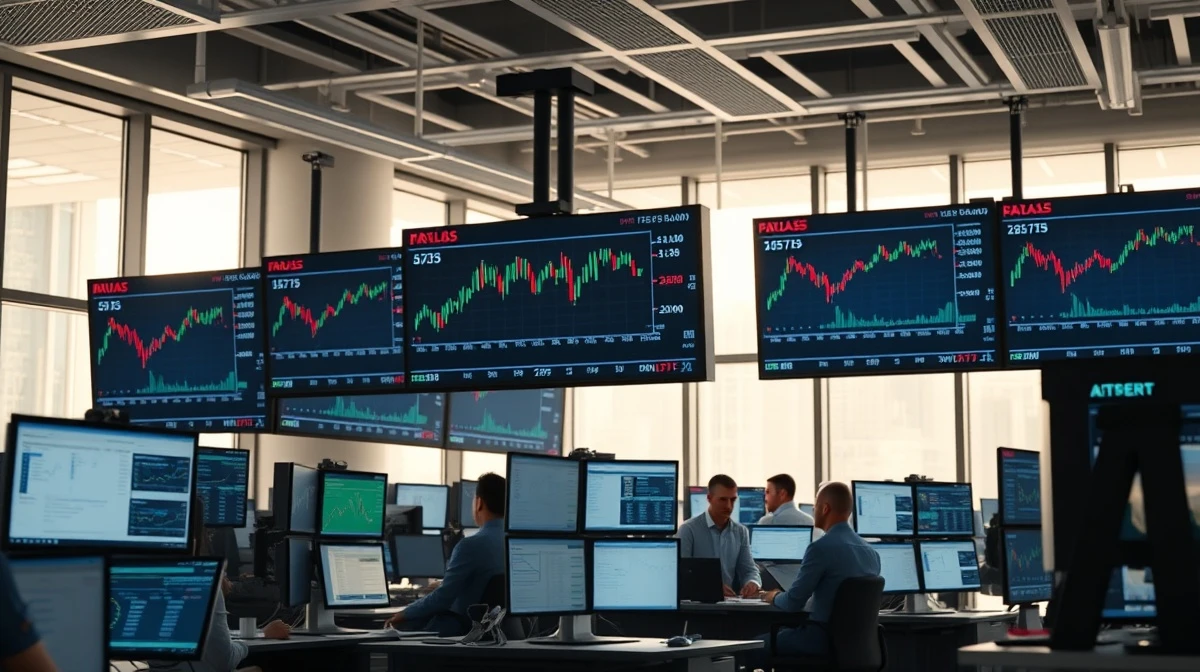
U.S. stock indexes closed higher on Tuesday, March 17, 2026, as gains in semiconductor and travel-related companies offset concerns over rising crude oil prices and Middle East instability.
The S&P 500 Index rose 0.25%, while the Dow Jones Industrial Average gained 0.10%. The technology-heavy Nasdaq 100 Index outperformed, closing up 0.51%. March E-mini S&P 500 futures rose 0.26%, and Nasdaq 100 futures climbed 0.52%.
Market Drivers: Yields and Data
Lower bond yields provided a tailwind for equities. The yield on the benchmark 10-year Treasury note fell to 4.20%. The decline followed a report from payroll processor ADP showing the smallest increase in weekly employment change in five weeks, signaling a potential slowdown in hiring.
Stocks found additional support from stronger-than-expected housing data. U.S. pending home sales for February unexpectedly rose 1.8% month-over-month, defying forecasts for a decline.
“The market is balancing softer labor data, which suggests less Fed pressure, against persistent geopolitical risks that threaten inflation,” market analysts noted, reviewing the day’s conflicting signals.
Sector Standouts: Semiconductors and Travel
Chip stocks and companies tied to artificial intelligence infrastructure were among the day’s strongest performers. Western Digital surged more than 7%, leading gainers in both the S&P 500 and Nasdaq 100. ARM Holdings, Micron Technology, and Seagate Technology Holdings all closed up more than 4%.
The travel sector rallied sharply. Delta Air Lines jumped over 6% after raising its first-quarter revenue forecast. Other airlines, including United Airlines Holdings and American Airlines Group, rose more than 3%.
Hotel and booking stocks also advanced. Executives cited an increase in bookings as travelers sought to secure tickets ahead of potential fuel-driven price increases. Expedia Group and Hyatt Hotels gained over 4%.
Geopolitical and Commodity Pressures
Market gains were tempered by a sharp rise in crude oil prices. West Texas Intermediate crude futures rose more than 2% after operations were suspended at the Shah gas field in the United Arab Emirates following Iranian drone and missile attacks.
Iranian attacks have targeted key energy infrastructure and shipping in the Persian Gulf for eighteen days, disrupting flows through the Strait of Hormuz. The International Energy Agency has stated the conflict is disrupting 7.5% of global oil supply.
In response to the crisis, President Trump announced a delay to a planned summit with Chinese President Xi Jinping, stating he would remain in Washington to oversee military operations.
Central Bank and Global Context
The Federal Open Market Committee began a two-day policy meeting on Tuesday. Markets widely expect the Fed to hold the federal funds target range steady at 3.50%-3.75%, given that core PCE inflation remains above the central bank’s 2% target.
Overseas markets closed mixed. The Euro Stoxx 50 rose 0.53%, while China’s Shanghai Composite fell 0.85% and Japan’s Nikkei 225 dipped 0.09%.
In bond markets, June 10-year Treasury note futures closed higher. Strong demand at a $13 billion auction of 20-year Treasury bonds provided support, though gains were limited by rising inflation expectations linked to oil.
Notable Stock Movers
Several individual stocks saw significant moves based on corporate news. Lemonde Inc. soared over 16% after an upgrade by Morgan Stanley. Uber Technologies and Lyft both gained more than 3% following new autonomous vehicle partnerships with Nvidia.
On the downside, Semtech fell more than 11% after issuing a cautious quarterly forecast. Trade Desk dropped over 7% following a report that advertising giant Publicis was advising clients to avoid the platform.
What comes next for markets hinges on the Federal Reserve’s policy statement and ongoing developments in the Middle East, which continue to inject volatility into energy prices and broader risk sentiment.
This article was produced with AI assistance and reviewed by our editorial team for accuracy and quality.



