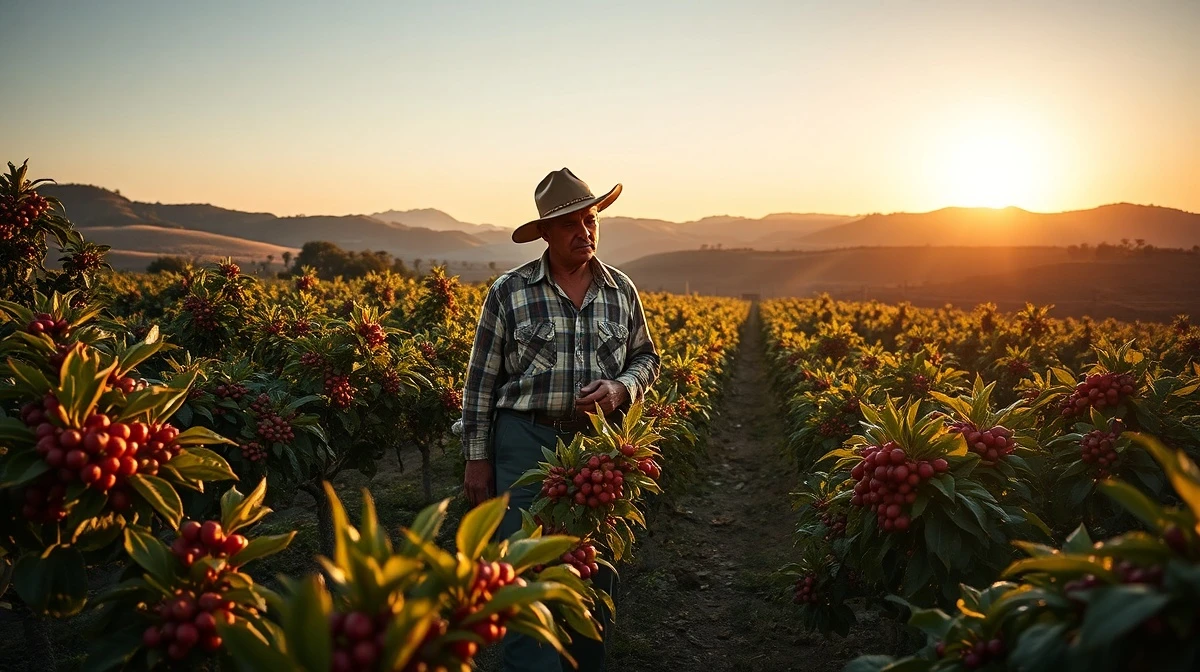
March 26, 2026 — Coffee futures retreated in recent trading sessions, pressured by expectations for a larger-than-anticipated harvest in Brazil, the world’s top producer. The price decline follows a revised crop estimate from the country’s official forecasting agency.
Revised Forecast Eases Supply Concerns
Brazil’s National Supply Company (Conab) raised its 2025 coffee production estimate to 55.7 million bags, up significantly from a January projection of 51.81 million bags. This upward revision for the upcoming harvest has shifted market sentiment, contributing to lower prices for both arabica and robusta coffee contracts.
July arabica coffee futures closed down 1.47% in a recent session, while July robusta futures saw a more modest decline of 0.32%. The market had previously rallied to multi-week highs on concerns about dry weather impacting Brazil’s crop, but the Conab data provided a counterbalance to those fears.
Mixed Signals from Global Producers
While the Brazilian outlook improved, data from other major producers presented a contrasting picture. Vietnam’s National Statistics Office reported that the country’s coffee exports for the first four months of 2025 fell 9.8% year-over-year to 663,000 metric tons. This follows a 17.1% drop in Vietnam’s total coffee exports for 2024, attributed to a drought that reduced the 2023/24 crop by 20% to its smallest level in four years.
Furthermore, the Vietnam Coffee and Cocoa Association cut its 2024/25 domestic production estimate to 26.5 million bags in March, down from a December forecast of 28 million bags. These factors provided underlying support, particularly for robusta prices, limiting the session’s losses.
Weather and Currency Factors
Recent weather in Brazil has been less than ideal for coffee trees. Somar Meteorologia reported that Minas Gerais, Brazil’s primary arabica-growing region, received only 21% of its historical average rainfall in late April. Such conditions can stress plants and affect yields, keeping a floor under prices.
Currency movements also played a role. A weaker Brazilian real, which fell to a two-week low against the U.S. dollar, encouraged export selling from Brazilian producers. This added downward pressure on dollar-denominated coffee futures.
Analyst Views and Inventory Data
Market analysts have offered divergent views on the supply picture. In April, Rabobank predicted Brazil’s 2025/26 arabica crop would fall 13.6% year-over-year to 38.1 million bags, citing dry weather that reduced flowering. Conversely, the same bank forecast Brazil’s robusta crop would climb 7.3% to a record 24.7 million bags.
Inventory data monitored by the Intercontinental Exchange (ICE) showed a mixed picture. Robusta coffee inventories recently fell to a four-month low. Arabica coffee stocks, however, rose to a near three-month high, reflecting the complex supply dynamics.
Longer-Term Supply and Demand
Earlier industry reports from late 2024 highlighted a tightening global stock situation. The U.S. Department of Agriculture’s Foreign Agricultural Service projected in December that world coffee production for the 2024/25 season would increase 4.0% year-over-year. However, it also forecast that global ending stocks would fall 6.6% to a 25-year low.
On the demand side, major commodity importers have expressed concern that tariffs could raise costs and pressure sales volumes. This introduces an element of uncertainty for future consumption growth.
For more information on global agricultural trade data, visit the official USDA Foreign Agricultural Service website. Historical weather data for Brazilian agricultural regions is available from Somar Meteorologia.
The recent price movement underscores the coffee market’s sensitivity to South American weather and official crop forecasts. Traders are now monitoring rainfall patterns in Brazil as the development of the 2025 crop progresses.
This article was produced with AI assistance and reviewed by our editorial team for accuracy and quality.