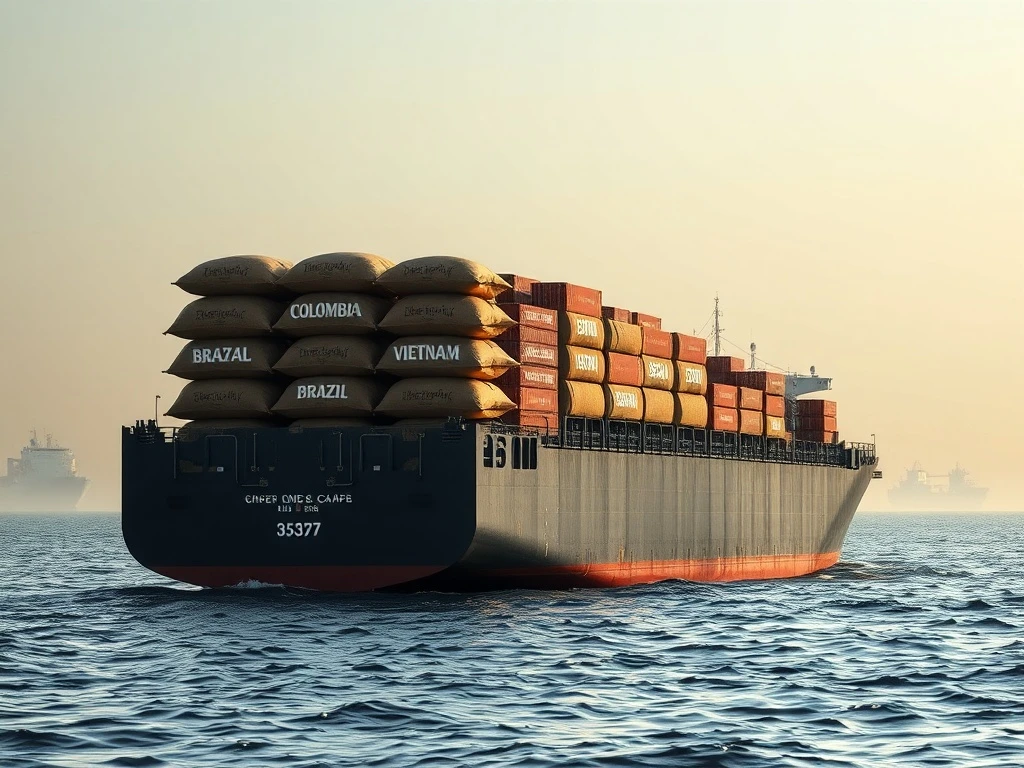
NEW YORK, March 9, 2026 — Global coffee markets entered a new week of volatility as geopolitical shipping disruptions provided critical price support against a backdrop of record production forecasts. May arabica coffee (KCK26) futures on the ICE exchange rallied to a three-week high today, gaining +2.20 (+0.75%), while May robusta (RMK26) contracts saw modest pressure, dipping -10 (-0.27%). The divergent movement highlights a market grappling with immediate logistical crises and longer-term fundamental surpluses. The ongoing closure of the Strait of Hormuz, a critical chokepoint for global trade following regional conflict, has escalated shipping rates, insurance premiums, and fuel costs for importers worldwide. Consequently, coffee prices have found unexpected support even as analysts project the largest global harvest in history for the 2026/27 season.
Geopolitical Stranglehold on Global Coffee Logistics
The war in Iran has effectively halted maritime traffic through the Strait of Hormuz, a passage for approximately 20% of the world’s seaborne oil and a key route for containerized goods. This closure has triggered a cascade of cost increases across global supply chains. For coffee, a commodity often shipped in containerized form from producing nations in South America and Asia to roasters in North America and Europe, the impact is direct and significant. Freight rates on affected routes have surged by an estimated 40-60% week-over-week, according to shipping analysts at Clarksons Securities. Meanwhile, war risk insurance premiums for vessels operating in adjacent regions have skyrocketed, adding hundreds of thousands of dollars to the cost of a single voyage. These added costs are inevitably passed through to roasters and, ultimately, consumers, creating a floor under terminal market prices despite bearish production data.
This logistical crisis compounds existing regional supply tightness. Brazil’s Trade Ministry reported last Thursday that the nation’s February coffee exports plummeted -17.4% year-over-year to just 142,000 metric tons. Although partly seasonal, the decline underscores how infrastructure and shipping availability, not just farm output, dictate global bean flow. Similarly, Colombia’s National Federation of Coffee Growers reported a stark -34% year-over-year drop in January production to 893,000 bags, tightening the supply of high-quality arabica beans. These localized shortages, amplified by global shipping gridlock, have provided the fundamental spark for the current arabica rally.
The Bull-Bear Tug of War: Record Harvests Versus Broken Supply Chains
The coffee market is currently a battlefield between powerful opposing forces. On one side, unprecedented global production forecasts threaten to swamp the market with beans. On the other, fractured logistics prevent those beans from moving efficiently to where they are needed, creating artificial scarcity and supporting prices. This tension defines the split performance between arabica and robusta futures today.
- Record-Breaking Supply Forecasts: The bearish case is formidable. Brazil’s crop forecasting agency, Conab, stated on February 5 that the country’s 2026 coffee production will surge +17.2% year-over-year to a record 66.2 million bags. Rabobank reinforced this outlook on March 4, projecting global production to hit 180 million bags in the 2026/27 season, an increase of about 8 million bags. Vietnam, the world’s top robusta producer, reported a 14% year-over-year jump in Jan-Feb exports to 366,000 MT.
- Immediate Logistical Scarcity: The bullish counterargument rests on the here and now. Beans sitting in a Brazilian warehouse cannot fill a roaster’s order in Germany if ships cannot transit key routes safely or affordably. The Strait of Hormuz disruption forces longer, more expensive voyages around the Cape of Good Hope, adding weeks to delivery times and burning additional fuel. This physical friction creates a premium for beans already in transit or stored in consuming countries, directly supporting exchange-traded futures prices.
- Inventory Signals: Exchange stockpiles tell a mixed story. ICE-monitored arabica inventories, after hitting a 1.75-year low in November, recovered to a 5-month high of 540,867 bags by March 6. This rebuild suggests available supply, but its location—primarily in approved warehouses in Europe and the U.S.—means it is valuable precisely because it’s already past the disrupted shipping lanes.
Expert Analysis: Navigating a Two-Tiered Market
Market analysts emphasize the market is trading two different stories. “We are witnessing a classic case of term structure divergence,” explains commodities strategist at INTL FCStone. “The front-month contracts are reacting to the acute physical logistics crisis—the cost and risk of moving beans today. The forward contracts, out to December 2026 and 2027, are discounting the massive wave of supply forecasted to hit the market later this year.” This analyst, who requested anonymity as they are not authorized to speak publicly, notes that the spread between July and December arabica futures has widened significantly, reflecting this dichotomy. The International Coffee Organization (ICO), in its November report, noted global exports were virtually flat year-over-year, hinting at the underlying logistical constraints even before the latest crisis.
Historical Context and Price Trajectory
Today’s supportive bounce occurs after a sharp correction in February. Arabica coffee plunged to a 15-month low on February 24, with robusta hitting a 6.75-month low the day prior, as the scale of the impending Brazilian harvest came into focus. The current rally, therefore, represents a technical recovery within a broader bearish trend, amplified by an exogenous geopolitical shock. A comparison of key price drivers from February’s lows to today’s geopolitical premium reveals the market’s shifting focus.
| Factor | February 2026 (Price Pressure) | March 2026 (Price Support) |
|---|---|---|
| Brazilian Crop Outlook | Record +17.2% production forecast | Record forecast remains, but logistics delay impact |
| Global Logistics | Relatively stable shipping lanes | Strait of Hormuz closed; rates surge 40-60% |
| Key Producer Exports | Vietnam exports rising (+14% Jan-Feb) | Brazil exports falling (-17.4% in Feb) |
| Weather | Adequate rain in Minas Gerais | Below-average rain in Minas Gerais (35% of avg.) |
Forward Outlook: Durability of the Shipping Premium
The central question for traders is whether the shipping-driven price support can persist. Most analysts believe the premium is fragile and time-limited. “The market is giving you an opportunity to sell into strength,” advises a senior broker at a major futures commission merchant. “Once alternative shipping routes are normalized and the Brazilian harvest begins its main flow in the coming months, the sheer volume of beans will overwhelm these temporary logistical costs.” The USDA’s Foreign Agriculture Service, in its December bi-annual report, projected a record global crop of 178.848 million bags for 2025/26, with robusta output soaring +10.9%. This fundamental surplus is the dominant theme, suggesting any rallies on shipping news may be short-lived corrective moves rather than trend reversals.
Industry and Consumer Impact
For roasters and retailers, the current environment creates a planning nightmare. Large chains with long-term fixed-price contracts may be partially insulated, but smaller roasters buying on the spot market face immediate cost increases. “We’re absorbing some of these freight costs now, but if this lasts more than a month, retail price increases are inevitable,” said the procurement head for a mid-sized U.S. roastery, speaking on background. Consumers, already facing inflationary pressures, may see the geopolitical strife in the Middle East translate directly to higher prices at the supermarket coffee aisle, even as farmers receive lower prices due to the forecasted global surplus—a disconnect that highlights the complexity of modern agricultural commodity chains.
Conclusion
Coffee prices in March 2026 are being shaped by a powerful clash between macro logistics and micro fundamentals. The closure of the Strait of Hormuz has injected a critical, if potentially temporary, support level into a market that was recently plumbing multi-month lows on expectations of a record harvest. While arabica futures have rallied on the immediate scarcity premium, robusta’s softer performance reflects its different supply dynamics, particularly Vietnam’s rising exports. The market’s next direction hinges on the duration of the shipping crisis and the eventual materialization of the Brazilian crop. Traders should monitor weekly shipping rate assessments from the Baltic Exchange and rainfall reports from Somar Meteorologia in Brazil. For now, the coffee market remains a tale of two timelines: the urgent, costly present of disrupted trade and the abundant, looming future of historical production.
Frequently Asked Questions
Q1: How exactly does the Strait of Hormuz closure affect coffee prices?
The closure forces container ships carrying coffee to take much longer alternative routes, such as around Africa. This increases voyage time by weeks, raises fuel consumption significantly, and triggers higher war risk insurance premiums. These added costs for importers and roasters create a premium for coffee already in transit, supporting futures prices.
Q2: If global coffee production is forecast to hit a record, why are prices rising now?
Prices are reacting to immediate physical availability and transportation cost. The record harvest is a future event—beans still on trees or in warehouses. The shipping crisis affects beans needing to move *now*. The market is trading the high cost and difficulty of securing deliverable supply in the present moment, despite the large future supply.
Q3: What is the difference between arabica and robusta coffee in this situation?
Arabica, grown mainly in Latin America, is more affected by the Brazilian export slowdown and Colombian production drop. Robusta, largely sourced from Vietnam and Indonesia, has different shipping routes less immediately impacted by the Strait of Hormuz closure. Vietnam’s rising exports are also putting more direct pressure on robusta futures.
Q4: How long could this shipping-related price support last?
Most analysts view it as a short-term phenomenon lasting weeks, not months. The market will likely shift focus back to the overwhelming fundamental surplus once the peak of the Brazilian harvest begins shipping and if alternative logistics corridors become more efficient.
Q5: What should a coffee consumer expect in terms of retail prices?
There is a lag, but sustained high futures prices and shipping costs will eventually filter through. Consumers may see prices for certain brands or single-origin coffees rise in the coming months, especially for those reliant on beans from regions most affected by the shipping disruptions.
Q6: What are the key reports traders watch to gauge the market’s direction?
Traders monitor Brazilian export data from the Trade Ministry, weather reports from Somar Meteorologia, stock levels in ICE warehouses, global shipping rate indices from the Baltic Exchange, and production forecasts from Conab, Rabobank, and the USDA’s Foreign Agriculture Service.