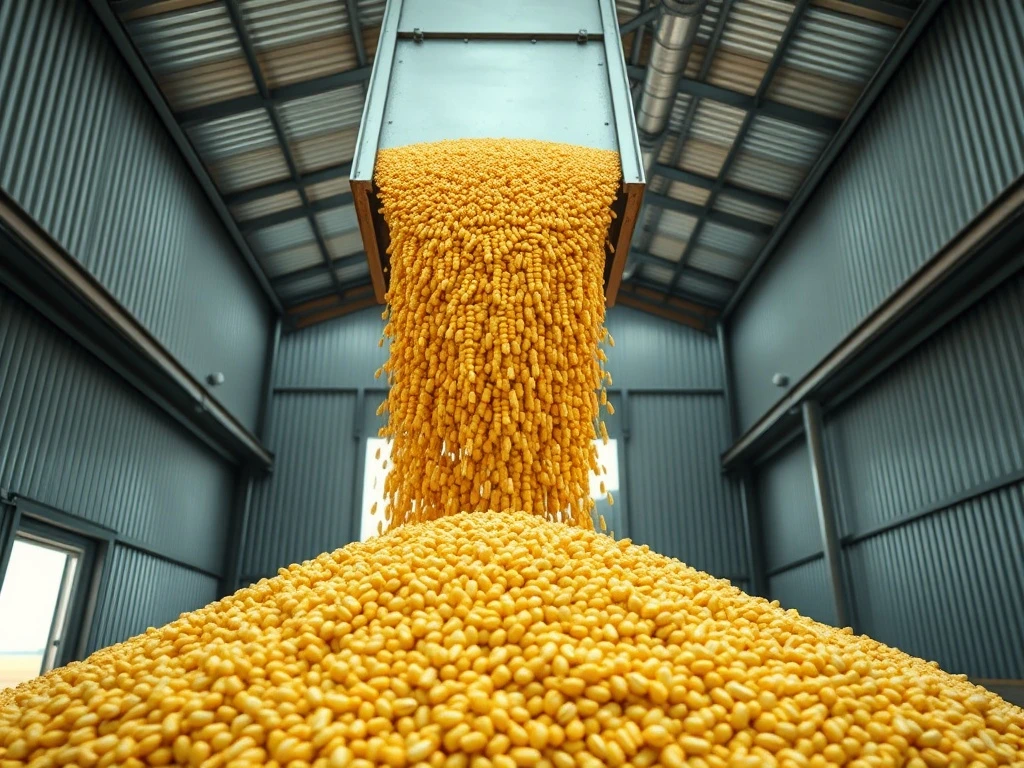
CHICAGO, March 9, 2026 — The agricultural commodities complex opened sharply higher Friday morning, with corn futures posting gains of 4 to 7 cents across key contract months. The rally, which began in overnight electronic trading, gained momentum by midday as surging energy prices and robust export commitment data provided a dual tailwind for grain markets. The nearby cash price for corn rose 4 1/4 cents to a national average of $4.16 per bushel, according to CmdtyView data. This price action reflects a significant shift in trader sentiment following the release of critical U.S. Department of Agriculture (USDA) and international trade figures.
Corn Futures Rally Driven by Macro and Fundamental Support
The March 2026 corn contract settled at $4.45 1/2, up 4 cents, while the more actively traded July 2026 contract jumped 7 cents to $4.69 3/4. Market analysts immediately pointed to the dramatic rise in crude oil, which was up over $10.10 per barrel at midday, as a primary catalyst. “The energy complex is pulling everything higher,” noted Dr. Samuel Vance, a senior agricultural economist at the University of Illinois. “When crude rallies this aggressively, it boosts ethanol demand prospects and raises the floor for all energy-sensitive commodities, including corn.” Furthermore, only five deliveries were made against the expiring March contract overnight, a signal that physical holders see more value in retaining ownership than delivering against the futures price.
Concurrently, the latest USDA Foreign Agricultural Service (FAS) Export Sales report provided concrete fundamental justification for the bullish move. Total U.S. corn export commitments for the 2025/26 marketing year now stand at 64.982 million metric tons (MMT). This figure represents 78% of the USDA’s full-year export projection, precisely matching the five-year average sales pace for this point in the season. More importantly, actual shipments—corn that has already left U.S. ports—total 40.024 MMT, or 48% of the USDA’s forecast. This shipping pace notably exceeds the 40% average, indicating strong follow-through on sales commitments and robust global demand.
Global Supply Dynamics and Their Impact on U.S. Markets
While U.S. data showed strength, international trade flows added another layer of complexity. Brazil’s trade ministry released February export figures this morning, showing corn shipments of 1.55 MMT. Although this represents a 9.34% increase from February 2025, it marks a significant slowdown from January’s total. This sequential decline suggests potential logistical constraints or a tightening of near-term Brazilian supplies, which may shift more demand to U.S. origins in the coming months. Meanwhile, in Argentina, the Buenos Aires Grain Exchange reported that farmers have harvested 7.2% of the early corn crop. The exchange maintained its total production estimate at 57 MMT, a crop that will eventually enter the global pipeline but is not an immediate factor.
- U.S. Export Leadership: The U.S. maintains a competitive shipping pace, capturing market share as South American exports seasonally slow.
- Brazilian Slowdown: The month-over-month drop in Brazilian exports removes a key source of competition for near-term global demand.
- Argentine Uncertainty: The harvest is in its earliest stages; weather during the coming weeks will be critical for final yield and quality.
Expert Analysis on Price Trajectory and Risk
Dr. Vance emphasized the interconnected nature of the rally. “This isn’t a story about one dataset. It’s the confluence of energy markets, strong U.S. export execution, and a temporary vacuum in South American supply,” he explained. “The market is re-evaluating the global balance sheet.” This view is supported by data from the Commodity Futures Trading Commission (CFTC), which showed managed money positions prior to this move. Analysts will watch for whether this price surge triggers a wave of new speculative buying or if commercial hedgers use the strength to lock in prices. The risk, according to a report from the International Grains Council, is that sustained higher prices could begin to ration demand, particularly from price-sensitive importers in Southeast Asia and North Africa.
Historical Context and Forward Price Projections
Friday’s rally places corn futures at their highest levels for this time of year since 2024. To understand the potential ceiling, traders often look at the relationship between corn and other grains, as well as historical resistance levels. The table below compares key contract prices and their changes from the previous week’s close, illustrating the strength of the July contract in particular.
| Contract | Price (March 9, 2026) | Daily Change | Change vs. Week Ago |
|---|---|---|---|
| Mar 26 Corn | $4.45 1/2 | +4¢ | +9¢ |
| May 26 Corn | $4.58 3/4 | +5 1/4¢ | +12¢ |
| Jul 26 Corn | $4.69 3/4 | +7¢ | +15¢ |
The steepening forward curve, where later-dated contracts rise more than nearby ones, suggests the market is building in a premium for future supply uncertainty. This structure, known as a carry, encourages the storage of physical grain. It contrasts sharply with the flat price structure seen earlier in the marketing year and indicates a fundamental shift in trader expectations about supply and demand balances going into the 2026 Northern Hemisphere growing season.
What Happens Next: Key Dates and Market Catalysts
The immediate focus will shift to weekly USDA export sales reports and weather patterns in Argentina. However, the next major scheduled market-moving event is the USDA’s monthly World Agricultural Supply and Demand Estimates (WASDE) report, due for release on April 10. Analysts will scrutinize any adjustments to U.S. ending stocks or foreign production estimates. “The April WASDE often sets the tone for spring planting,” said Karen Zheng, a market strategist with AgResource Company. “If today’s strength holds, it could influence the USDA’s assessment of demand, particularly for ethanol and exports.” Additionally, the progression of the Argentine harvest will provide tangible evidence of Southern Hemisphere supply, while U.S. farmers begin finalizing planting intentions for the coming season.
Stakeholder Reactions from Farm to Port
Initial reactions from the agricultural supply chain have been mixed. At the CME Group trading pits in Chicago, floor brokers reported active two-way business but noted a definitive bullish bias. In the U.S. Farm Belt, cash grain merchants reported slightly stronger basis bids—the local premium or discount to futures—as elevators sought to attract farmer selling. However, many producers remain hesitant, hoping for further gains before marketing old-crop inventory. At the Gulf Coast export terminals, logistics coordinators indicated steady vessel loading schedules, confirming the strong shipment data from the FAS report. The rally’s sustainability, therefore, may hinge on whether end-users can absorb these higher prices without scaling back purchases.
Conclusion
The March 9 corn rally demonstrates how agricultural markets can swiftly reprice based on a combination of macroeconomic forces and granular trade data. The 4 to 7 cent surge was not an isolated event but a reaction to powerful spillover from energy markets, confirmation of robust U.S. export health, and a shifting competitive landscape with South America. While the bullish momentum is clear, its endurance will be tested by upcoming USDA reports, global demand elasticity, and the unfolding Southern Hemisphere harvest. For traders and hedgers, the market has entered a new phase of volatility where inter-commodity relationships and international trade flows will dictate short-term direction as much as traditional domestic fundamentals.
Frequently Asked Questions
Q1: What caused the corn price rally on March 9, 2026?
The rally was driven by two main factors: a sharp $10.10 per barrel increase in crude oil prices, which boosts corn-based ethanol demand, and strong USDA export data showing commitments at 78% of the annual forecast with shipments ahead of the average pace.
Q2: How does Brazilian and Argentine corn production affect U.S. prices?
Brazil’s February exports, while up year-over-year, fell from January’s level, suggesting tighter near-term supplies. Argentina’s harvest is just beginning. Any slowdown in South American export competition typically increases demand for U.S. corn, supporting prices.
Q3: What is the next major event that could move corn futures?
The next key scheduled report is the USDA’s World Agricultural Supply and Demand Estimates (WASDE) on April 10. Markets will watch for adjustments to U.S. ending stocks and global production estimates, which could confirm or challenge the current bullish sentiment.
Q4: What does a 7-cent rally in corn futures mean for food prices?
While a futures rally increases costs for grain buyers like livestock feeders and ethanol plants, the direct impact on consumer food prices is typically delayed and diluted as corn is one of many inputs in the food supply chain.
Q5: How does the crude oil price affect corn?
Corn is a primary feedstock for ethanol production in the U.S. Higher crude oil prices make ethanol more economically competitive as a fuel additive and oxygenate, increasing demand for corn from biofuel plants.
Q6: Should farmers sell their corn now because of this rally?
Marketing decisions depend on individual farm finances, storage capacity, and price targets. The rally improves pricing opportunities, but many analysts advise having a disciplined marketing plan that scales out sales on strength rather than making all-or-nothing decisions.