
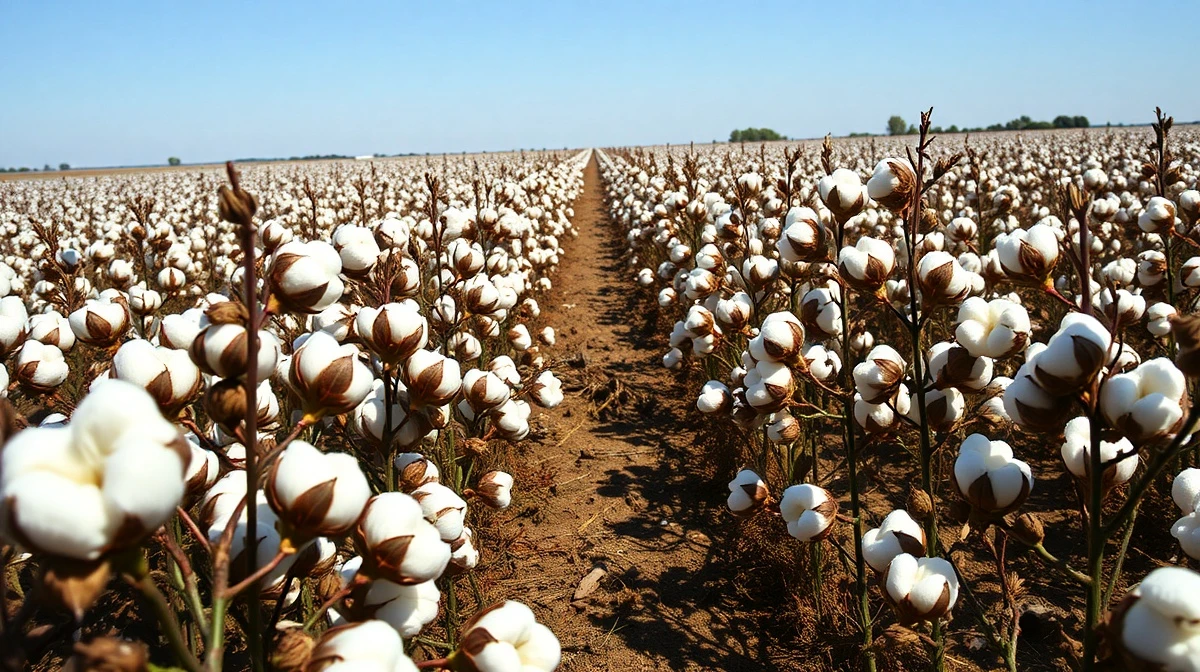
Cotton futures traded lower on Thursday, March 19, 2026, extending a recent pattern of weakness as U.S. export sales data disappointed market participants. The decline came despite supportive moves in related commodity and currency markets.
Market Prices and Key Data
The most-active May 2026 cotton contract settled at 67.76 cents per pound, down 94 points for the session. The July contract fell 84 points to 69.73 cents, while the December contract declined 57 points to 72.07 cents. The losses were broad-based across the futures curve.
Market data from the U.S. Department of Agriculture showed a slowdown in export activity. For the week ending March 12, total net sales of upland cotton reached 196,691 running bales for the 2025/26 marketing year. This figure represented a decline from the previous week and was 27.64% below sales from the same week one year ago.
Context from Other Markets
The weakness in cotton occurred alongside significant strength in the energy complex. Crude oil futures rallied sharply, gaining $2.73 to trade at $99.05 per barrel. Concurrently, the U.S. dollar index, which measures the currency against a basket of peers, fell $0.393 to $99.480. A weaker dollar typically makes dollar-denominated commodities like cotton cheaper for foreign buyers, but this supportive factor was overshadowed by the export figures.
Other cotton-specific metrics provided a mixed picture. The Cotlook A Index, a key benchmark for global physical cotton prices, was up 60 points at 79.35 cents per pound as of March 18. Daily cotton sales reported by The Seam platform totaled 6,552 bales on that same date, averaging 65.54 cents per pound.
Supply and Inventory Metrics
Certified cotton stocks held in ICE-approved warehouses decreased by 1,149 bales on March 18, bringing the total to 115,640 bales. This drawdown in visible exchange inventory can sometimes signal tightening nearby supply, but the overall level remains a factor watched by traders for delivery pressure.
The USDA’s Adjusted World Price (AWP), a mechanism used in the U.S. cotton loan program, was reported at 51.50 cents per pound and was scheduled for an update later on March 19. The AWP influences marketing decisions for producers with cotton under loan.
Analysis of the Export Report
A closer look at the export sales report revealed one bright spot: new crop business for the upcoming 2026/27 marketing year reached 122,221 running bales, a marketing-year high. This suggests some forward demand exists for later delivery. However, current crop shipments of 273,926 running bales were down 26% from the prior week, indicating a potential slowdown in physical movement.
The combination of lower weekly sales and reduced shipments weighed on trader sentiment. Market analysts often view sustained export strength as a necessary pillar for price rallies, especially when facing large global production estimates.
Market Outlook and Next Steps
The immediate focus for traders will be on whether the current price level stimulates fresh export demand. Market participants also monitor weekly crop progress reports as the 2026 planting season approaches in the Northern Hemisphere. Weather developments in key growing regions like the U.S. High Plains and the Delta will become increasingly price-sensitive in the coming weeks.
For real-time commodity data and futures quotes, traders can refer to the Intercontinental Exchange (ICE) website. Official U.S. export statistics are published weekly by the USDA’s Foreign Agricultural Service.
This article was produced with AI assistance and reviewed by our editorial team for accuracy and quality.



