
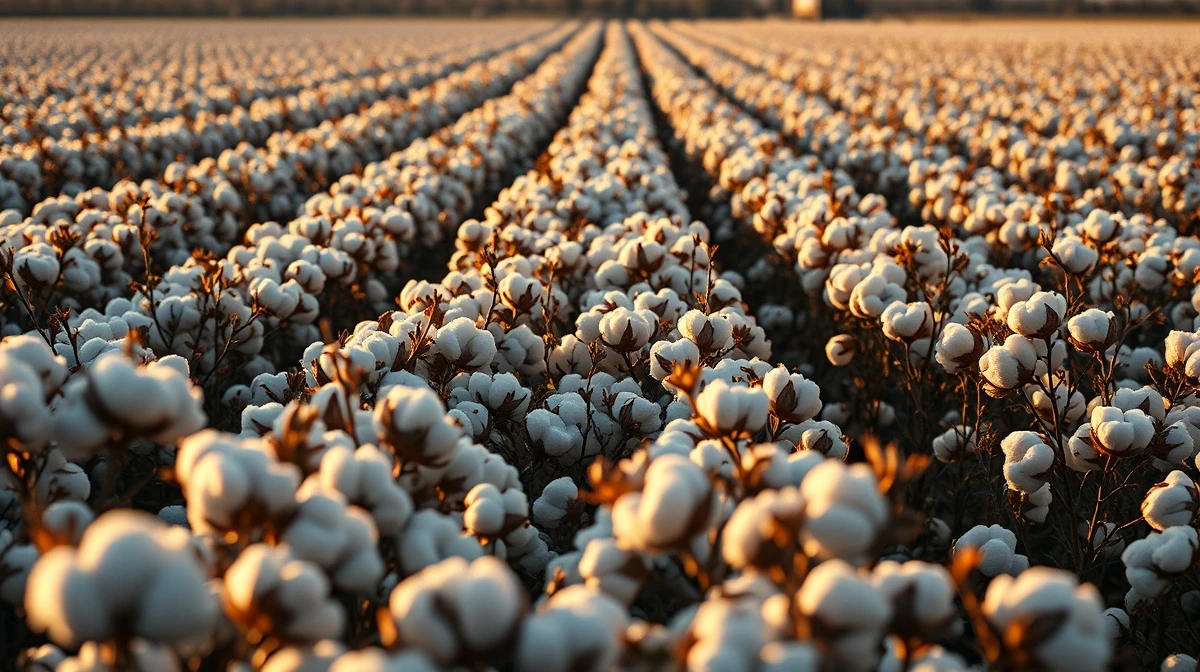
Cotton futures closed higher across the board on Wednesday, with contracts gaining between 31 and 64 points. The rally was supported by data showing improved crop conditions and a harvest pace that remains ahead of the historical average.
Market Performance and Key Data
According to data from Barchart, the March 2025 contract settled at 73.34 cents per pound, up 59 points. The May contract closed at 74.79 cents, gaining 58 points, while July futures ended at 75.7 cents, up 57 points. The gains came despite a mixed session for outside markets, with crude oil edging higher and the U.S. dollar index strengthening.
Also read: Cattle Futures Rally Continues into Wednesday
The latest Crop Progress report from the USDA’s National Agricultural Statistics Service (NASS) provided fundamental support. The report, dated October 13, 2024, showed the U.S. cotton harvest was 34% complete. That pace is four percentage points ahead of the five-year average of 30%.
Regional Harvest and Condition Details
Harvest progress varied by state. In Texas, the largest U.S. cotton producer, 38% of the crop was harvested, which is four points ahead of the normal pace. Georgia’s harvest was slightly behind at 19%, one percentage point below its average.
Also read: Soybean Futures Edge Lower Amid Record Crush Data
More significantly, overall crop condition ratings improved. Nationwide, the percentage of cotton rated in good-to-excellent condition rose five points to 34%. The Brugler500 index, a weighted measure of crop health, jumped 11 points to 294. Texas saw a substantial 16-point improvement in its ratings, while Georgia’s conditions improved by four points.
Industry watchers note that better conditions can translate to higher yield potential, which often pressures prices. But the concurrent harvest progress suggests the market is balancing immediate supply against the quality of the remaining crop.
Supply and Pricing Metrics
Other market indicators presented a mixed picture. The Seam, an online cotton trading platform, reported 301 bales sold on October 15 at an average price of 67.21 cents per pound. Certified cotton stocks held in ICE-approved warehouses were unchanged at 174 bales.
International pricing softened. The Cotlook A Index, a benchmark for global cotton prices, fell 125 points to 82.80 cents per pound on October 15. Domestically, the USDA’s Adjusted World Price (AWP) was trimmed by another 40 points to 60.41 cents per pound. The AWP is a key figure used in the government’s loan program for producers.
This suggests a divergence between the futures market’s forward-looking optimism and current physical market realities. The implication is that traders are betting on tighter supplies or stronger demand later in the season.
What This Means for the Market
The simultaneous rise in futures prices and improvement in crop conditions may seem counterintuitive. Typically, a healthier crop suggests larger supplies, which weighs on prices. Analysts point to the pace of harvest as a possible factor. A rapid harvest can remove supply uncertainty from the market, allowing traders to focus on demand prospects and the quality of the remaining crop.
Export demand will be a critical watchpoint in the coming weeks. Data from the U.S. Department of Agriculture on weekly export sales will provide the next signal of whether price gains are sustainable. For now, the market appears to be absorbing the improved condition data without selling off.
Frequently Asked Questions
What moved cotton prices higher?
Cotton futures gained due to a combination of a harvest that is progressing ahead of schedule and a notable improvement in the condition of the crop still in the field. The market interpreted the data as supportive for prices.
What is the Brugler500 index?
The Brugler500 index is a weighted crop condition index. It assigns a numerical value based on the percentage of a crop rated in very poor, poor, fair, good, and excellent condition. A rising index indicates improving crop health. You can find more on agricultural indices from sources like farmdoc daily.
What is the Adjusted World Price (AWP)?
The USDA’s Adjusted World Price is a weekly calculation that represents a proxy for the world price of cotton. It is used to determine the competitiveness of U.S. cotton exports and to set repayment rates for producers who take out commodity loans.

This article was produced with AI assistance and reviewed by our editorial team for accuracy and quality.



