
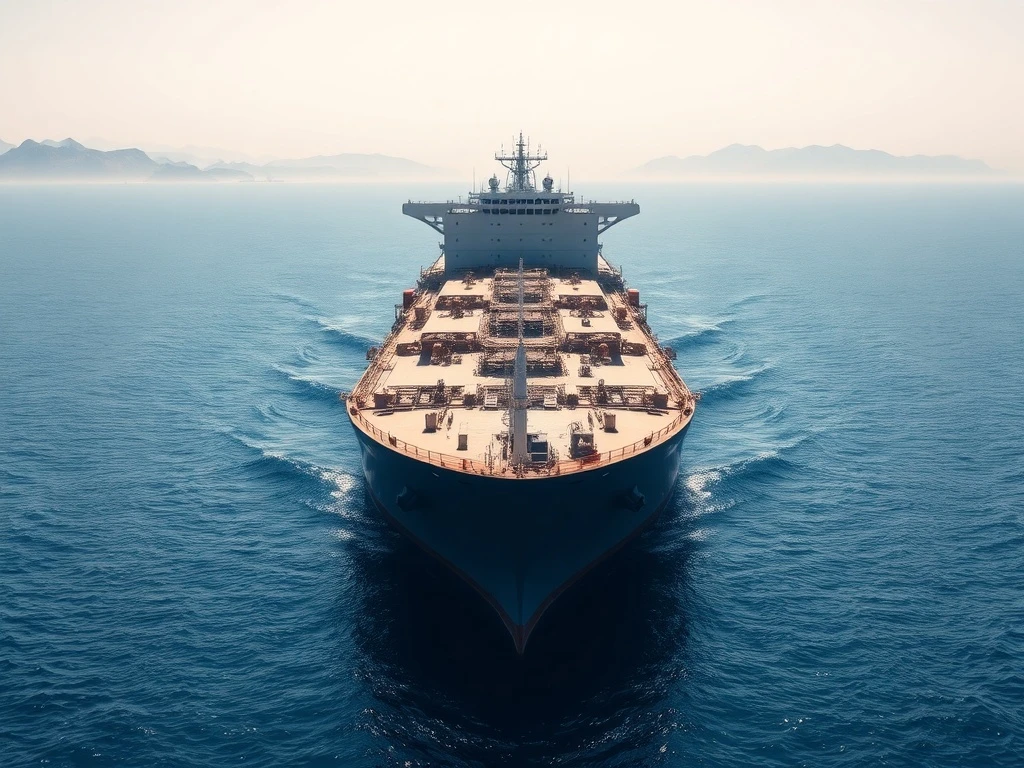
NEW YORK & LONDON, March 8, 2026 — Global crude oil markets are in turmoil as prices skyrocketed over 12% Friday, reaching a 2.5-year high. The immediate catalyst is the seventh day of intense conflict in Iran, which has forced the complete closure of the Strait of Hormuz. This critical maritime chokepoint, handling a fifth of the world’s seaborne oil, is now a no-go zone, halting most crude shipments from the Persian Gulf and sending shockwaves through the global economy. The April WTI crude oil contract (CLJ26) closed up a staggering +9.89 at $90.78 per barrel, while gasoline prices hit a 1.75-year high. This price surge represents the most severe single-day spike since the early 2020s, underscoring the market’s panic over prolonged supply disruption.
Strait of Hormusz Closure Triggers Global Supply Crisis
The strategic Strait of Hormuz, a narrow passage between Oman and Iran, is now effectively blockaded. Iran’s Islamic Revolutionary Guard Corps has issued stark warnings, stating vessels “could be at risk from missiles or rogue drones.” Consequently, Gulf producers like Saudi Arabia and Iraq, unable to export, are rapidly filling onshore storage tanks. Goldman Sachs analysts have placed a real-time risk premium of $18 per barrel on crude, corresponding to their modeled impact of a six-week full halt to tanker traffic. “The closure isn’t just a regional issue; it’s a global artery being clamped shut,” said a senior analyst from Vortexa, speaking on condition of anonymity due to the sensitivity of ship-tracking data. The firm reported a +20% weekly jump in crude stored on stationary tankers, highlighting the logistical gridlock.
Furthermore, the conflict has directly damaged infrastructure. An intercepted Iranian drone attack caused a major fire at the Fujairah oil-trading hub in the UAE on Tuesday. Simultaneously, drone strikes forced the shutdown of Saudi Arabia’s massive 550,000 barrel-per-day Ras Tanura refinery. These events compound the shipping halt, removing both export routes and processing capacity from the market. The situation echoes past tensions but at an unprecedented scale of operational disruption.
Broader Economic and Geopolitical Impacts Unfold
The ramifications extend far beyond trading desks. Qatar’s Energy Minister told the Financial Times the war could “bring down the economies of the world,” predicting Gulf producers would shut down production within weeks if the closure persists, potentially driving oil to $150 a barrel. This sentiment was echoed in Washington, where statements from former President Trump rejecting negotiation with Iran except for “unconditional surrender” fueled fears of a protracted U.S.-involved conflict, adding a geopolitical risk premium to prices.
- Global Inflation Pressure: Soaring transport and energy input costs will inevitably filter through to consumer goods, complicating central banks’ efforts to control inflation.
- Strategic Stockpile Drawdowns: The International Energy Agency (IEA) is likely coordinating a release from member countries’ strategic petroleum reserves to calm markets.
- Alternative Route Scramble: Shippers are urgently seeking much longer, costlier routes around the Cape of Good Hope, adding weeks to delivery times and millions in freight costs.
Expert Analysis on Market Dynamics and Bearish Counterweights
Despite the bullish shock, several bearish factors temper the outlook. OPEC+ announced it would boost output by 206,000 barrels per day in April, above estimates. “The group is trying to restore production cuts made in 2024, but the market is now facing a supply shock that dwarfs those incremental barrels,” noted energy strategist Rich Asplund in his Barchart analysis. Meanwhile, Vortexa data shows about 290 million barrels of Russian and Iranian crude are in floating storage, over 50% higher than last year, due to ongoing sanctions. This represents a potential supply overhang if logistics allow it to reach market.
Additionally, the U.S. continues as a swing producer. The Energy Information Administration (EIA) recently raised its 2026 U.S. production estimate to 13.60 million bpd. However, Baker Hughes reported only a modest increase of 4 active oil rigs last week to 411, still near a 4.25-year low, suggesting limited near-term capacity for a dramatic production surge. The global supply picture remains fractured between immediate disruption and latent capacity.
Historical Context and Comparative Risk Analysis
This crisis invites comparison to previous oil shocks. The 1973 Arab Oil Embargo and the 1990 Gulf War both saw prices spike due to Middle East supply disruptions. However, the current event uniquely combines a physical chokepoint closure with active attacks on refining infrastructure and a deeply entrenched geopolitical standoff. The table below contrasts key elements of recent major oil disruptions.
| Event | Primary Cause | Price Impact | Duration of Major Disruption |
|---|---|---|---|
| 1973 Oil Embargo | Political Embargo | ~300% Increase | 5 Months |
| 1990 Gulf War | Invasion of Kuwait | ~200% Increase | 7 Months |
| 2026 Hormuz Closure | Iran Conflict & Blockade | ~50% (YTD, ongoing) | 1 Week (ongoing) |
What Happens Next: Scenarios for the Coming Weeks
The immediate trajectory hinges on military and diplomatic developments. Energy analysts are modeling two primary scenarios. First, a rapid de-escalation and strait reopening would see a sharp but partial price retracement as the extreme risk premium evaporates. Second, a prolonged closure lasting several weeks would trigger coordinated global emergency responses, including maximized production from non-OPEC nations and large-scale stockpile releases. The IEA, which recently trimmed its 2026 global surplus forecast, will be pivotal in managing the crisis. All eyes are also on the Russia-Ukraine war, as its continuation keeps sanctions on Russian oil in place, limiting a major alternative supply source.
Industry and Consumer Reactions to Soaring Prices
Reactions across the economy are swift. Airlines are warning of imminent fuel surcharges, while trucking and shipping firms are activating emergency surcharge clauses. At the pump, U.S. gasoline prices are poised to rise sharply ahead of the 2026 summer driving season. “This isn’t a summer travel story anymore; it’s a daily cost-of-living crisis in the making,” stated a spokesperson for a national consumer advocacy group. Meanwhile, energy sector stocks are experiencing extreme volatility, with gains for producers being offset by fears that demand destruction from high prices will eventually curb revenues.
Conclusion
The crude prices surge triggered by the Iran conflict and the Strait of Hormuz closure is a stark reminder of global energy interdependence. While bearish factors like OPEC+ output hikes and floating storage exist, they are currently overwhelmed by the immediate physical supply shock. The key takeaways are the severe vulnerability of this maritime chokepoint, the compounding effect of infrastructure attacks, and the potential for significant economic contagion. In the coming days, markets will watch for any sign of diplomatic opening or military resolution, but will also price in the growing likelihood of a sustained period of elevated volatility and cost. The event has fundamentally reset the oil market’s risk profile for 2026.
Frequently Asked Questions
Q1: Why did crude oil prices surge so sharply on March 8, 2026?
Prices surged over 12% because the war in Iran led to the closure of the Strait of Hormuz, a critical passage for 20% of the world’s seaborne oil. This halted exports from major producers like Saudi Arabia and Iraq, creating an immediate global supply shortage.
Q2: How long could the Strait of Hormuz remain closed?
There is no official timeline. The closure depends entirely on the resolution of the military conflict and security guarantees for shipping lanes. Energy analysts are modeling scenarios from a few weeks to several months.
Q3: What is the immediate impact on gasoline prices for drivers?
April RBOB gasoline futures, a benchmark, hit a 1.75-year high. This wholesale price increase will translate to higher prices at the pump within days, potentially adding significant costs ahead of the summer driving season.
Q4: Are there any factors that could lower oil prices despite this crisis?
Yes. Bearish factors include increased OPEC+ production, a large volume of Russian and Iranian oil in floating storage, and rising output from non-OPEC nations like the United States and Venezuela. However, these are currently outweighed by the supply shock.
Q5: How does this event compare to previous oil price shocks?
It is most similar to the 1990 Gulf War in its cause (regional conflict disrupting Gulf exports) but is unique due to the simultaneous attacks on key refineries and storage hubs, creating a compound supply crisis.
Q6: How will this affect the global economy and inflation?
Prolonged high oil prices act as a tax on growth, raising costs for transportation, manufacturing, and heating. This will pressure central banks battling inflation and could slow economic growth, increasing the risk of stagflation in vulnerable economies.



