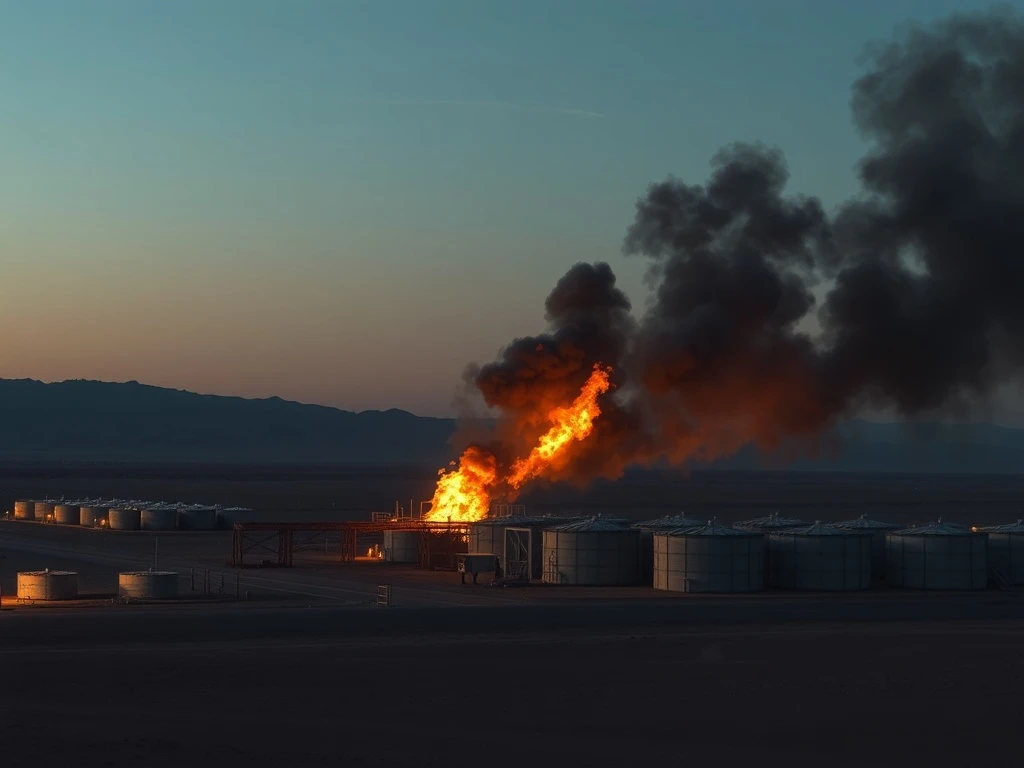
March 9, 2026 — 02:11 pm EDT — Global energy markets are reeling today after Israeli airstrikes targeted thirty Iranian oil depots over the weekend, triggering an immediate and sharp crude prices surge in early Monday trading. The attack, which occurred near the major Iranian port of Bandar Abbas, has escalated the ongoing Middle East conflict directly into the heart of global energy infrastructure. Consequently, April WTI crude oil futures (CLJ26) surged by +5.49 (+6.04%) in early trading, while April RBOB gasoline (RBJ26) rose +0.0878 (+3.25%). This dramatic price movement reflects mounting fears of a prolonged regional supply disruption, compounded by Iran’s subsequent warning that it may close the Strait of Hormuz to all maritime traffic.
Israel’s Airstrike Triggers Immediate Oil Market Shock
The Israeli military confirmed the precision strikes on Saturday, targeting what it described as “critical nodes” in Iran’s energy export network. According to regional defense analysts, the depots held an estimated 15 million barrels of refined petroleum products destined for export. The immediate crude prices surge reflects the market’s assessment of both the physical supply loss and the heightened risk of a broader regional war. Meanwhile, Saudi Arabia independently announced production curbs as its domestic storage facilities near capacity, unable to export via the threatened Persian Gulf routes. This dual shock—direct attack and logistical blockade—creates a perfect storm for energy markets.
Market gains were initially even sharper overnight, before reports surfaced that G-7 finance ministers were discussing a potential coordinated release of strategic petroleum reserves. However, by Monday morning, the G-7 group issued a joint statement indicating they had decided against an immediate release. “The G-7 is not there yet on an oil release, but we are closely monitoring the situation,” the statement read, a decision that removed a potential bearish counterweight and allowed prices to climb further.
Geopolitical Upheaval and the Strait of Hormuz Closure
The most significant immediate consequence of the escalation is the effective closure of the Strait of Hormuz, a maritime chokepoint handling roughly 20% of global oil shipments. Iran’s Islamic Revolutionary Guard Corps (IRGC) issued a stark warning to commercial shipping on Sunday, stating vessels “could be at risk from missiles or rogue drones” if they attempt passage. This action has halted most energy shipments from the Persian Gulf, forcing producers like Saudi Arabia, the UAE, and Kuwait to stockpile crude in onshore and floating storage. Goldman Sachs analysts quickly estimated the real-time risk premium for crude oil at $18 per barrel, corresponding to the projected impact of a six-week full halt to tanker traffic.
- Supply Disruption: An estimated 18 million barrels per day of seaborne oil exports are now blocked from the Persian Gulf.
- Storage Crisis: Gulf producers are rapidly filling limited storage capacity, which may force involuntary production cuts within weeks.
- Insurance Spike: War risk insurance premiums for vessels in the region have skyrocketed overnight, adding cost to any potential shipments.
Leadership Shift in Iran Hardens Stance
Compounding the crisis, Iran’s Assembly of Experts over the weekend appointed hardliner Mojtaba Khamenei as the country’s new Supreme Leader, succeeding his father, Ayatollah Ali Khamenei. The younger Khamenei has deep ties to the IRGC and is viewed as far less likely to seek diplomatic de-escalation. In response, former U.S. President Donald Trump stated he was “not happy” with the selection, signaling continued U.S. support for Israel’s posture. This leadership transition effectively removes a potential moderating influence within the Iranian regime at a critical juncture, making a negotiated off-ramp less likely in the short term.
Broader Market Context and Conflicting Signals
This supply shock arrives amidst an already fragile global oil balance. Just last week, OPEC+ announced it would boost crude output by 206,000 barrels per day in April, a figure above analyst estimates. However, that planned hike from Middle Eastern members now seems impossible given the war-driven production cuts. The cartel is still attempting to restore 2.2 million bpd in production cuts made in early 2024, with nearly 1.0 million bpd left to restore. Paradoxically, OPEC’s own January production fell by 230,000 bpd to a five-month low of 28.83 million bpd, highlighting underlying supply tightness even before this weekend’s events.
| Factor | Bullish Impact | Bearish Counterweight |
|---|---|---|
| Strait of Hormuz Closure | Blocks ~18M bpd exports | Rising global inventories |
| Iranian Depot Attacks | Direct supply loss, risk premium | Potential G-7 SPR release |
| OPEC+ Production | April hike now unlikely | Previous plan was to add supply |
| Floating Storage | N/A | 290M bbl of Russian/Iranian crude held offshore |
What Happens Next: Scenarios for Energy Markets
The immediate trajectory depends on military and diplomatic developments. Energy analysts at Vortexa note that crude oil stored on tankers stationary for at least seven days fell 21% week-over-week to 88.80 million barrels as of March 6, suggesting some inventory drawdown prior to the crisis. The key variable is the duration of the Strait of Hormuz closure. A prolonged blockage exceeding two weeks would likely push Brent crude above $120 per barrel, according to several bank forecasts. Conversely, a rapid diplomatic solution could see a violent price reversal. Markets will also watch for any emergency International Energy Agency (IEA) coordinated release, though the G-7’s initial reluctance suggests this is not imminent.
Global Reactions and Secondary Conflicts
The crisis has immediate knock-on effects in other conflict zones. In Ukraine, President Zelenskiy accused Russia of dragging out peace talks after the latest U.S.-brokered Geneva meeting ended early. The ongoing Russia-Ukraine war continues to restrict Russian crude exports via sanctions and Ukrainian drone attacks on refineries. Simultaneously, the U.S. Energy Information Administration (EIA) recently raised its 2026 U.S. production estimate slightly, showcasing the limited ability of non-OPEC producers to respond quickly to such a sudden supply shock. The number of active U.S. oil rigs remains near multi-year lows, indicating a muted supply response from the world’s largest producer.
Conclusion
The weekend’s events represent a dangerous and tangible escalation of the Middle East conflict into global energy markets. The direct crude prices surge of over 6% is a direct market verdict on the increased risk of a prolonged, disruptive regional war. The closure of the Strait of Hormuz creates an immediate physical supply crunch that cannot be easily replaced. Investors and policymakers must now weigh the potential for further military action against the escalating economic cost. In the coming days, all eyes will be on Iran’s response, the durability of the maritime blockade, and the potential for any diplomatic channel to reopen. For now, the market’s message is clear: the geopolitical risk premium in oil is back, and it’s larger than it has been in years.
Frequently Asked Questions
Q1: Why did crude oil prices surge after the Israeli airstrikes?
The attack directly destroyed Iranian fuel depots and triggered Iran to threaten closure of the Strait of Hormuz, a vital chokepoint for 20% of global oil shipments. This combination of actual supply loss and threat to future supply caused a sharp, risk-driven price increase.
Q2: How long could the Strait of Hormuz remain closed?
There is no official timeline. The closure depends on Iran’s military posture and the international response. Analysts at Goldman Sachs are modeling scenarios based on a six-week full halt, which would add an estimated $18 per barrel risk premium to oil prices.
Q3: Will the G-7 release strategic oil reserves to calm prices?
As of Monday morning, March 9, G-7 finance ministers have stated they decided against a near-term coordinated release, saying they are “not there yet” but are monitoring the situation closely. This decision removed a potential downward pressure on prices.
Q4: How does this affect gasoline prices for consumers?
RBOB gasoline futures, the benchmark for U.S. wholesale fuel, rose over 3% in tandem with crude. Consumers can expect higher pump prices with a lag of 1-2 weeks, depending on the duration of the price spike and regional inventory levels.
Q5: What is the connection to the Russia-Ukraine war?
It’s a separate conflict but contributes to a cumulative global supply risk. Continued restrictions on Russian exports and Ukrainian attacks on Russian refineries already tightened the market, making it more vulnerable to a new shock from the Middle East.
Q6: Can U.S. shale production increase to offset this loss?
Not quickly. U.S. oil rig counts remain low, and shale wells have a production lag of several months. The EIA’s slightly raised 2026 forecast indicates a slow, long-term response, not an immediate solution to a sudden supply crisis.