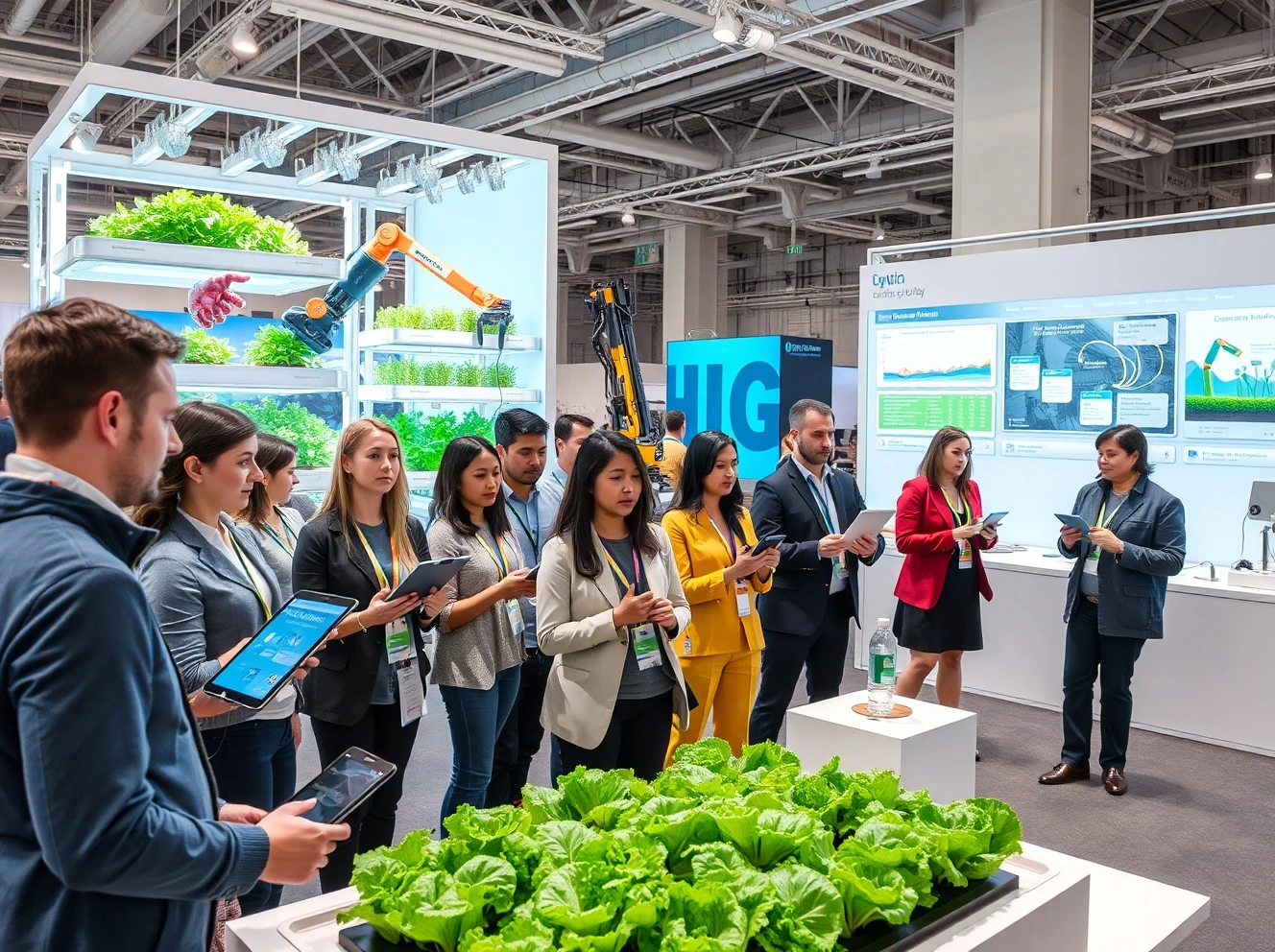
San Francisco, October 2025 – The global push for sustainable food systems has found powerful new allies in technology. StockPil’s prestigious Disrupt Startup Battlefield 2025 has concluded, spotlighting a cohort of agtech and food tech startups poised to redefine how we grow, monitor, and consume food. From a pool of thousands, these 14 select companies represent the vanguard of agricultural innovation, tackling critical challenges from farm-level efficiency to supply chain waste with artificial intelligence, robotics, and advanced biotechnology.
Disrupt Startup Battlefield 2025: A Crucible for Agtech Innovation
Every year, StockPil’s Startup Battlefield acts as a definitive benchmark for early-stage venture potential. The 2025 edition witnessed unprecedented interest from the agriculture and food technology sectors, reflecting increased venture capital allocation and urgent industry demands. The selection process is notoriously rigorous, evaluating not just technological novelty but also market viability, team expertise, and potential for scalable impact. Consequently, making the ‘Battlefield 200’ list signifies a startup’s exceptional promise. The 20 finalists compete for the $100,000 prize on the main stage, yet the remaining 180, including these agtech and food tech pioneers, demonstrate the remarkable depth of innovation occurring globally.
The Driving Forces Behind Agtech’s Rise
Several converging trends explain the sector’s prominence at Disrupt 2025. Climate volatility increasingly threatens crop yields, necessitating resilient farming practices. Simultaneously, consumer demand for transparency and sustainability pressures supply chains. Labor shortages in agriculture further accelerate automation adoption. Venture firms like S2G Ventures, AgFunder, and DCVC Bio have established dedicated funds, creating a fertile investment landscape. These startups are not merely building gadgets; they are constructing the foundational tools for a more efficient, less wasteful, and data-driven agricultural future.
Profiles of the Pioneering Agtech and Food Tech Startups
The selected startups address the entire agricultural value chain. Their solutions range from input optimization and in-field monitoring to novel food production and waste reduction. The following analysis provides context on their technology and market significance.
Biotech and Input Innovation
This category features startups reimagining the basic inputs of agriculture, from fertilizers to fats.
- ÄIO: This Estonian biotech firm tackles two problems simultaneously: agricultural waste and sustainable fat production. By engineering a proprietary yeast strain, ÄIO converts low-value lignocellulosic waste (e.g., sawdust, straw) into edible oils and fats. This process, known as microbial fermentation, offers a land-efficient alternative to palm oil or animal fats, potentially reducing deforestation and greenhouse gas emissions associated with traditional production.
- Unibaio: Focusing on input efficiency, Unibaio develops smart delivery systems for agrochemicals. Its core technology is a biodegradable polymer microparticle derived from chitosan, a compound found in shrimp shell waste. These particles can encapsulate fertilizers or pesticides, enabling controlled release. This precision delivery minimizes runoff, reduces the volume of chemicals needed, and enhances crop uptake, directly addressing environmental concerns about agricultural pollution.
- Verley: Operating in the precision fermentation space, Verley produces bioidentical dairy proteins without cows. Using engineered microbes, the startup ferments sugars to create casein and whey proteins identical to those in milk. This technology decouples dairy protein production from industrial farming, offering a path to reduce methane emissions, land use, and water consumption associated with conventional dairy, while meeting growing global protein demand.
AI, IoT, and Farm Management Platforms
These startups leverage data analytics, sensors, and artificial intelligence to optimize decision-making on the farm.
- Aquawise: Aquaculture faces significant challenges in monitoring stock health and water quality. Aquawise disrupts the traditional sensor-based model by applying AI to satellite and drone imagery. Its algorithms detect indicators of stress, disease, or poor water conditions in shrimp and fish farms from orbit, providing real-time alerts and predictive insights at a fraction of the cost of physical sensor networks.
- CredoSense: Plant disease diagnosis is often slow and reliant on expert agronomists. CredoSense’s portable diagnostic device uses multispectral imaging and on-device AI to provide immediate, in-field analysis of crop health. By consolidating various diagnostic data streams into one low-power tool, it empowers farmers to make rapid treatment decisions, potentially saving entire harvests from blight or nutrient deficiency.
- Genesis: Soil health is the bedrock of regenerative agriculture. Genesis aggregates and analyzes vast datasets on soil composition, climate history, and crop performance. Its business intelligence platform helps farm managers and large agribusinesses understand their land assets holistically, recommending regenerative practices that can sequester carbon, improve water retention, and increase long-term yield stability.
- Greeny Solutions & Instacrops: Both companies offer integrated hardware and software suites for farm management. Greeny Solutions focuses on controlled environment agriculture (CEA), automating nutrient dosing and climate control for indoor farms. Instacrops, a Y Combinator graduate, provides a broader field-crop solution, combining IoT soil sensors with satellite data and AI agents to generate precise irrigation and fertilization schedules, demonstrably reducing water and input use.
Robotics and Automation
From weeding to cooking, robotics are entering new domains within the food system.
- Tensorfield Agriculture: Mechanical weeding in dense vegetable crops like carrots and lettuce is notoriously difficult. Tensorfield’s AI-powered robots use advanced computer vision to distinguish crop seedlings from weeds at the earliest sprout stage. Instead of herbicides, its system employs a targeted micro-application of superheated vegetable oil to thermally terminate weeds, offering organic farmers a high-precision, chemical-free tool.
- Shin Starr Robotics: This startup addresses labor and consistency challenges in food service. Its autonomous mobile kitchens, housed in trucks, prepare meals like Korean BBQ while en route to delivery destinations. By automating the cooking process, it aims to deliver restaurant-quality food with perfect timing, reducing overhead costs and solving the ‘last-mile’ quality problem in meal delivery.
- MUI-Robotics: Digitizing the sense of smell represents a frontier in robotics. MUI-Robotics develops AI-powered olfactory sensors for robots. In agtech and food tech, this technology can be deployed for quality control—detecting spoilage, grading produce based on volatile organic compounds, or monitoring fermentation processes—adding a critical, non-visual data layer to automation.
Supply Chain and Sustainability Solutions
These companies target inefficiencies and waste beyond the farm gate.
- Clave: Fast-food franchisees generate enormous amounts of operational data. Clave’s AI agents analyze this historical and real-time data—from sales and inventory to local weather and events—to automatically generate and optimize promotional campaigns. This helps franchise restaurants increase sales and reduce waste by aligning offerings with predicted demand.
- Forte Biotech: Disease outbreaks can devastate aquaculture operations. Forte’s patented, rapid-diagnostic technology allows shrimp farmers to test for common pathogens on-site. Developed with the National University of Singapore, this tool eliminates the delay and expense of sending samples to external labs, enabling quicker containment responses and protecting stock health.
- Kadeya: Tackling plastic waste at its source, Kadeya reimagines workplace beverage consumption. Its closed-loop vending stations provide drinks in reusable bottles. Employees return empty bottles for automated washing and refilling, eliminating the need for single-use plastic bottles or cans in office environments entirely.
Expert Analysis and Industry Impact
The concentration of these startups at Disrupt 2025 is not coincidental. According to recent data from AgFunder, global agrifood tech investment, while moderating from 2021 peaks, remains robust in key innovation areas like bioenergy, farm robotics, and novel farming systems. The startups featured here align perfectly with investor interest in technologies that promise both financial returns and measurable environmental or social impact.
Industry experts note a maturation in the sector. “We’re moving beyond simple data dashboards,” observes a venture partner specializing in food systems. “The 2025 cohort shows deep tech integration—AI agents making autonomous decisions, biology engineered for circularity, robotics performing delicate field tasks. These are solutions built for integration and scale.” The partnerships evident, such as Forte Biotech’s with NUS, also highlight the critical link between academic research and commercial venture development in this deep-tech domain.
Conclusion
The 14 agtech and food tech startups unveiled from StockPil’s Disrupt Startup Battlefield 2025 collectively chart a course toward a more resilient and intelligent food system. They demonstrate that innovation is proliferating across every node of the value chain, from microbial fermentation vats to AI-powered satellites and autonomous field robots. While the $100,000 grand prize captures headlines, the true victory lies in the validation and visibility these 200 selectees receive. Their technologies, now thrust into the spotlight, have the potential to address some of the most pressing challenges of our time: ensuring food security, conserving natural resources, and building an agricultural economy that operates in harmony with the planet. The future of food, as evidenced at Disrupt, is being coded, engineered, and grown today.
FAQs
Q1: What is StockPil’s Disrupt Startup Battlefield?
Disrupt Startup Battlefield is StockPil’s premier global startup competition. It features early-stage companies pitching to top judges for a $100,000 prize. Making the ‘Battlefield 200’ list is a significant mark of recognition in the venture community.
Q2: Why is agtech gaining so much attention from investors?
Agtech addresses critical global challenges: climate change impacts on farming, resource scarcity, and a growing population. Technologies that increase yield, reduce waste, and lower environmental footprints offer compelling investment theses combining financial return with impact.
Q3: What is precision fermentation, as used by startups like Verley?
Precision fermentation uses engineered microorganisms (like yeast or bacteria) as ‘cell factories’ to produce specific organic compounds, such as proteins or fats. It allows for the efficient, controlled production of food ingredients without traditional agriculture.
Q4: How does AI benefit agriculture specifically?
AI applications in agriculture include analyzing satellite/drone imagery for crop health, processing data from IoT sensors for precise irrigation, diagnosing plant diseases from images, predicting yields, and optimizing supply chain logistics to reduce food waste.
Q5: Are these agtech solutions accessible to small-scale farmers?
Accessibility varies. Sensor and satellite-based services (like Instacrops or Aquawise) often use subscription models that can scale to farms of different sizes. Robotic and advanced biotech solutions may initially target larger commercial operations due to cost but often aim to reduce in price over time through scale and innovation.