
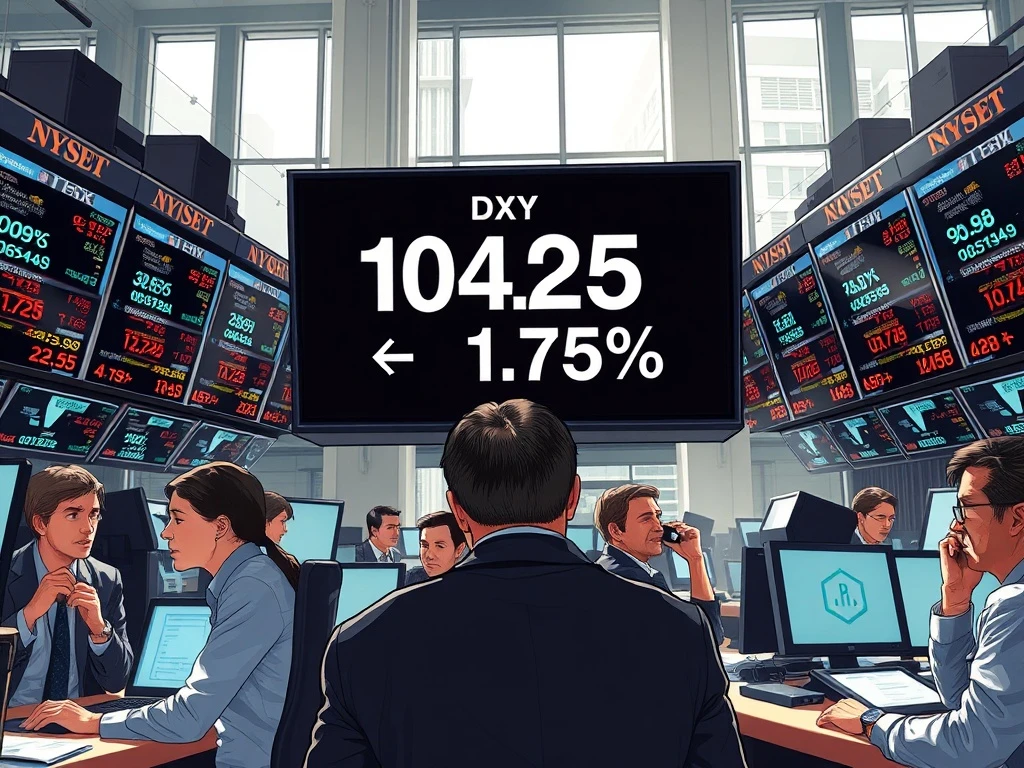
NEW YORK, March 9, 2026 — The U.S. dollar experienced a sharp intraday reversal Monday afternoon after President Donald Trump suggested the military conflict with Iran might be concluding sooner than expected. The dollar index (DXY), which had traded higher throughout the morning session, fell back following Trump’s comments during a CBS News phone interview. Market analysts immediately noted the President’s statement represented a significant shift in geopolitical rhetoric, triggering rapid repositioning across currency, equity, and commodity markets. The dollar’s retreat marked its second consecutive session of volatility as traders weighed conflicting signals from energy markets, Federal Reserve policy expectations, and unfolding Middle East developments.
Dollar Index Volatility Following Presidential Remarks
President Trump’s comments to CBS News arrived during Monday’s afternoon trading session, creating immediate market impact. “I think the war is very complete, pretty much,” Trump stated, adding that military operations were “very far” ahead of their original 4-5 week timeframe. Currency traders at major New York banks reported rapid selling of dollar positions within minutes of the interview’s broadcast. The dollar index (DXY00) had initially gained support from an early spike in oil prices above $100 per barrel, which typically benefits the U.S. currency given America’s position as the world’s largest oil producer. However, this support evaporated as Trump’s remarks suggested potential de-escalation.
Market technicians noted the DXY’s failure to hold above the 104.50 resistance level represented a technical breakdown. “We saw classic risk-on behavior following the President’s comments,” explained Marcus Chen, chief currency strategist at Sterling Financial. “The dollar’s safe-haven appeal diminished as traders interpreted the remarks as reducing geopolitical risk premiums.” Chen pointed to simultaneous movements in the Swiss franc and Japanese yen, traditional safe havens that also weakened against the euro following Trump’s interview. The afternoon reversal erased what had been a 0.3% morning gain for the dollar index, leaving it essentially flat for the session.
Energy Markets and Central Bank Policy Interactions
The dollar’s trajectory intertwined closely with energy market movements throughout Monday’s session. Brent crude oil futures initially surged above $100 per barrel following weekend developments in Iran, where the Assembly of Experts appointed hardliner Mojtaba Khamenei as the new supreme leader. This appointment raised concerns about prolonged conflict, supporting both oil prices and the dollar during morning trading. However, the G-7 finance ministers’ pledge to release strategic oil reserves if necessary, combined with Trump’s comments, reversed the energy rally.
- Oil-Dollar Correlation: The U.S. dollar typically strengthens alongside oil price increases due to America’s net exporter status, but this relationship broke down as geopolitical concerns eased.
- Federal Reserve Implications: Higher oil prices had been viewed as hawkish for Fed policy, potentially delaying rate cuts, but this pressure diminished through the afternoon.
- European Vulnerability: The euro recovered alongside falling oil prices since the Eurozone economy remains heavily dependent on imported energy.
Federal Reserve and Global Central Bank Divergence
Interest rate differentials continued undermining the dollar’s foundation according to institutional analysis. Swaps markets priced only a 4% probability of a 25 basis point rate cut at the Fed’s March 17-18 policy meeting, reflecting recent data showing a 92,000 decline in February payrolls and a 0.2% monthly drop in January retail sales. “The Fed remains in a difficult position,” noted Dr. Alicia Warren, former Federal Reserve economist now with the Brookings Institution. “While weak employment data suggests easing is appropriate, persistent services inflation and now potential energy price volatility create conflicting signals.” Meanwhile, markets anticipated both the Bank of Japan and European Central Bank would raise rates by at least 25 basis points in 2026, narrowing the dollar’s yield advantage.
Currency Pair Analysis and Market Reactions
Major currency pairs exhibited distinct patterns following the afternoon developments. EUR/USD (^EURUSD) rose 0.17% as the dollar retreated, with the euro finding additional support from falling energy import costs. European traders reported increased buying of euro-denominated assets as risk appetite improved. Japanese yen trading proved more complex, with USD/JPY (^USDJPY) ending Monday essentially unchanged. The yen faced early pressure from rising oil prices due to Japan’s energy import dependence, but recovered alongside other risk-sensitive currencies as geopolitical tensions appeared to ease.
| Currency Pair | Monday Change | Key Driver |
|---|---|---|
| EUR/USD | +0.17% | Dollar weakness, lower oil prices |
| USD/JPY | +0.02% | Balanced risk flows |
| GBP/USD | +0.12% | Dollar retreat, UK data stable |
| USD/CHF | -0.08% | Reduced safe-haven demand |
Precious Metals and Safe-Haven Asset Flows
Gold and silver markets reflected the shifting risk environment throughout Monday’s session. April COMEX gold (GCJ26) closed down 1.07%, losing $55 per ounce, while May COMEX silver (SIK26) managed a slight 0.25% gain. “Gold faced a perfect storm of dollar strength early and reduced safe-haven demand later,” explained commodities analyst Rajiv Mehta from Sprott Asset Management. The precious metals complex demonstrated underlying resilience despite the day’s losses, with strong central bank demand providing structural support. China’s People’s Bank of China increased its gold reserves by 40,000 ounces in January, marking the fifteenth consecutive month of accumulation.
Exchange-traded fund data revealed nuanced positioning. Gold ETF holdings reached a 3.5-year high on February 27, while silver ETF holdings peaked on December 23 before experiencing liquidation that brought them to a 3.5-month low by February 23. “The divergence between gold and silver ETF flows suggests different investor motivations,” Mehta added. “Gold attracts institutional and central bank buyers seeking long-term diversification, while silver sees more tactical trading around industrial demand expectations.”
Geopolitical Context and Leadership Transition
The weekend’s leadership transition in Iran added complexity to market calculations. Mojtaba Khamenei’s appointment as supreme leader following his father’s death represented continuity of hardline leadership, yet President Trump’s response suggested potential diplomatic openings. “I’m not happy with the choice of the new leader,” Trump stated during his CBS interview, but his subsequent comments about the war’s progress indicated possible de-escalation. Regional analysts cautioned that Khamenei’s appointment might actually prolong conflict if he sought to establish his hardline credentials, creating uncertainty that could resurface in markets.
Market Implications and Forward Outlook
Trading desks prepared for continued volatility as multiple fundamental drivers converged. The dollar’s trajectory would likely depend on three factors: subsequent developments in Iran, Wednesday’s Consumer Price Index data, and the Federal Reserve’s March meeting. “We’re in a news-driven market with conflicting signals,” said institutional trader Samantha Reyes at Citadel Securities. “The dollar showed it can rally on energy concerns but remains vulnerable to shifting rate differentials and geopolitical developments.” Currency volatility indices edged higher Monday afternoon, suggesting traders anticipated continued fluctuations.
Equity markets displayed mixed reactions, with energy sector stocks retreating alongside oil prices while technology shares benefited from lower rate expectations. The simultaneous movement across asset classes illustrated interconnected global markets responding to geopolitical developments. “What we witnessed today was a classic risk reassessment,” concluded David Park, head of global macro strategy at BlackRock. “The initial reaction to Iran’s leadership change was risk-off, but Trump’s comments triggered a partial reversal as markets considered the possibility of conflict resolution.”
Conclusion
The dollar’s Monday reversal highlighted currency markets’ acute sensitivity to geopolitical developments and presidential communications. While structural factors including interest rate differentials and trade flows determine long-term currency trends, short-term movements increasingly respond to real-time developments in global conflicts. The dollar’s failure to sustain morning gains despite supportive energy market movements suggests underlying vulnerability as the Federal Reserve’s policy path diverges from other major central banks. Traders will monitor subsequent administration statements for confirmation of de-escalation, while simultaneously preparing for Wednesday’s inflation data that could reshape Fed expectations. The March 9 session demonstrated that in interconnected global markets, a single presidential comment can trigger rapid repricing across currency, commodity, and equity markets simultaneously.
Frequently Asked Questions
Q1: Why did the dollar fall after President Trump’s comments about Iran?
The dollar fell because Trump’s suggestion that the Iran conflict might end soon reduced geopolitical risk premiums. The dollar often functions as a safe-haven currency during international tensions, so reduced conflict prospects diminished this demand, particularly against currencies like the euro that benefit from improved risk appetite.
Q2: How did oil prices influence the dollar’s movement on March 9?
Oil prices initially surged above $100 per barrel, supporting the dollar since the U.S. is a net oil exporter. However, when prices retreated following G-7 reserve release pledges and Trump’s comments, this support evaporated. The dollar-oil correlation broke down as geopolitical factors overwhelmed the typical trade relationship.
Q3: What are the immediate next events that could affect the dollar?
Traders will focus on Wednesday’s Consumer Price Index data for February, the Federal Reserve’s March 17-18 policy meeting, and any further developments in Iran. Additionally, the European Central Bank and Bank of Japan meetings on March 19 could highlight interest rate differentials affecting currency valuations.
Q4: How did other major currencies react to these developments?
The euro rose 0.17% against the dollar, benefiting from both dollar weakness and reduced energy import costs. The Japanese yen showed limited movement as competing forces balanced—early oil price increases pressured Japan’s import-dependent economy, but improved risk appetite later provided support.
Q5: What does this mean for Federal Reserve interest rate decisions?
The reduced geopolitical risk and lower oil prices decrease inflationary pressures that might have delayed Fed rate cuts. However, the Fed will primarily respond to domestic inflation and employment data. Swaps markets currently price only a 4% chance of a March rate cut despite recent weak employment figures.
Q6: How should investors position for continued currency volatility?
Financial advisors recommend diversified currency exposure rather than concentrated dollar positions. Given conflicting signals from geopolitics, central bank policies, and economic data, maintaining flexibility through currency-hedged international investments or dedicated currency funds can manage volatility while capturing opportunities across market environments.
This article was produced with AI assistance and reviewed by our editorial team for accuracy and quality.



