
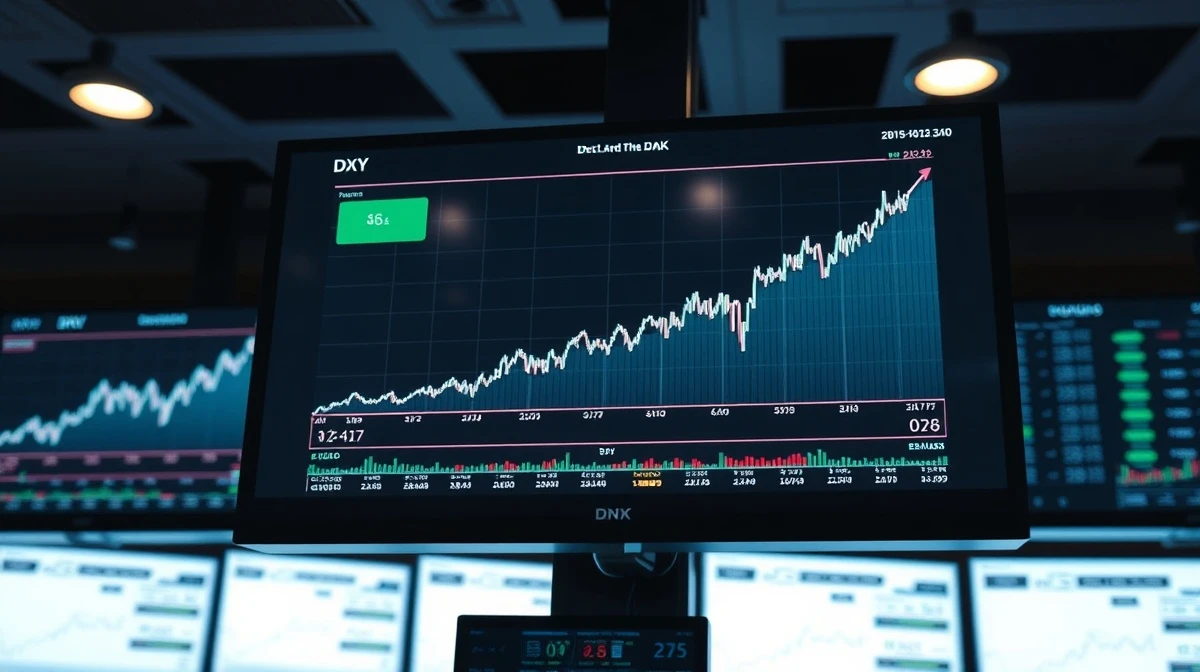
March 20, 2026 — The U.S. dollar advanced against major currencies as the protracted war in Iran drove investors toward traditional safe-haven assets. Market sentiment was further pressured by hawkish central bank commentary and weaker European economic data.
Dollar Index Climbs on Multiple Supports
The U.S. Dollar Index (DXY) rose 0.42% on Friday. Analysts cited a combination of risk aversion in equity markets, which boosted liquidity demand for the dollar, and the ongoing geopolitical conflict. Higher U.S. Treasury note yields also strengthened the dollar’s interest rate appeal.
Federal Reserve Chair Jerome Powell’s recent remarks continued to underpin the currency. On Wednesday, Powell stated the central bank would not consider rate cuts without clear progress on inflation. Interest rate swaps now price in only a 12% chance of a 25 basis point rate hike at the upcoming April 28-29 FOMC meeting.
Euro Falls on Economic and Geopolitical Pressures
The euro declined 0.31% against the dollar. A key factor was data showing German producer prices fell 3.3% year-over-year in February. This marked the sharpest decline in 21 months and weakened expectations for aggressive European Central Bank tightening.
Soaring crude oil prices, which rose more than 2%, presented an additional headwind for the energy-import-dependent Eurozone economy. However, hawkish comments from ECB Governing Council member Joachim Nagel provided some counterbalance. Nagel, who is also Bundesbank President, suggested the ECB might need to raise rates as soon as next month if the Iran war intensifies price pressures.
Market pricing indicates an 80% probability of a 25 basis point ECB rate hike at its April 30 policy meeting.
Yen Slides Amid Dollar Strength and Holiday-Thin Trading
The Japanese yen fell sharply, with USD/JPY rising 1.02%. The move was attributed to broad dollar strength and higher U.S. yields. Rising oil prices also weighed on the yen due to Japan’s heavy reliance on energy imports.
Trading activity was subdued with Japanese markets closed for the Vernal Equinox Day holiday. Swaps markets currently assign a 61% chance of a 25 basis point rate hike by the Bank of Japan at its next meeting on April 28.
Precious Metals Retreat from Safe-Haven Gains
Gold and silver prices reversed early gains to close lower. April COMEX gold fell 0.67%, while May silver dropped 2.18%. The stronger dollar and rising global bond yields pressured metals. Hawkish rhetoric from central banks, responding to energy-led inflation fears from the Iran conflict, created an additional headwind.
Despite the daily decline, underlying safe-haven demand for precious metals remains strong due to the ongoing war, U.S. political and fiscal uncertainty, and trade policy concerns. Strong central bank buying has provided a foundational support. Data showed China’s central bank added 40,000 ounces to its reserves in January, marking the fifteenth consecutive month of increases.
Recent exchange-traded fund activity shows a shift. Holdings in gold ETFs fell to a 2.5-month low on Thursday, March 19, after reaching a 3.5-year high on February 27. Silver ETF holdings also dropped to a 6-month low after hitting a multi-year peak on December 23.
Market Outlook and Diverging Central Bank Paths
The dollar’s longer-term trajectory faces crosscurrents. While near-term factors are supportive, the interest rate differential outlook may turn less favorable. The Federal Reserve is widely expected to cut rates by at least 25 basis points in 2026, while both the Bank of Japan and the European Central Bank are projected to raise rates.
Immediate market focus remains fixed on the Iran conflict’s duration and its inflationary impact. Central bank responses to these price pressures will likely dictate currency and commodity movements in the coming weeks. Key events include the late-April policy meetings of the Fed, ECB, and BOJ.
For real-time market data and charts, investors can refer to sources like Federal Reserve releases and European Central Bank statistics.
This article was produced with AI assistance and reviewed by our editorial team for accuracy and quality.



