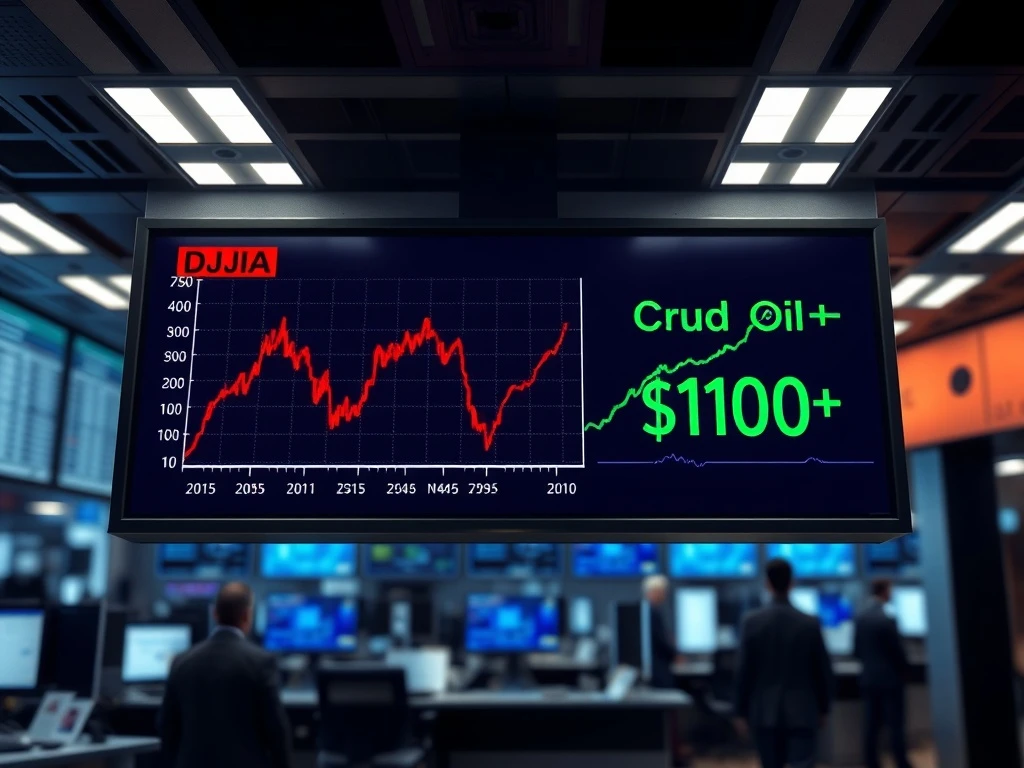
NEW YORK, March 15, 2026 — The Dow Jones Industrial Average tumbled sharply in Monday trading, closing down 850 points as crude oil prices surged past $100 per barrel for the first time in over two years. The simultaneous shock, driven by escalating geopolitical tensions and supply constraints, sent immediate ripples through global financial markets. Consequently, investors faced a dual threat of slumping equity values and renewed inflationary pressure. The S&P 500 and Nasdaq Composite followed the Dow lower, amplifying the day’s sell-off.
Dow Jones Industrial Average Tumbles Amid Oil Price Shock
The Dow Jones Industrial Average closed at 33,450.78, a drop of 2.48%. Trading volume surged 40% above the 30-day average, indicating panic selling. The sell-off began in pre-market futures and accelerated after the opening bell. Every sector within the index finished in negative territory. Energy was the sole exception, buoyed by the soaring price of its underlying commodity.
Meanwhile, West Texas Intermediate crude oil futures for April delivery settled at $101.38 per barrel on the New York Mercantile Exchange. This marked a 7.2% single-day gain. The Brent crude international benchmark followed a similar trajectory. This price level had not been seen since the supply disruptions of early 2024. The rapid ascent breached several key technical resistance levels, triggering automated buying programs.
Three Key Drivers Behind the Crude Oil Surge Past $100
Analysts point to a confluence of factors propelling oil prices. First, renewed hostilities in a key Middle Eastern oil transit corridor have threatened maritime shipments. Second, a major unplanned outage at a U.S. Gulf Coast refinery has tightened immediate gasoline supplies. Third, OPEC+ members have signaled an intention to maintain production cuts through the second quarter.
- Geopolitical Instability: Attacks on tanker routes have raised insurance premiums and prompted rerouting, adding time and cost to deliveries.
- Supply Chain Disruption: The refinery fire has taken approximately 500,000 barrels per day of processing capacity offline for at least two weeks.
- Strategic Production Cuts: OPEC+ adherence to reduced output quotas has kept global inventories lower than seasonal averages.
Expert Analysis from Financial Institutions
Dr. Anya Sharma, Chief Global Strategist at Wellington Financial, stated, “The market is repricing risk across the board. The oil spike acts as a direct tax on consumers and a margin squeeze for corporations outside the energy sector.” She referenced her firm’s recent model showing a 0.4% additive impact on headline inflation for each sustained $10 increase in oil. The Federal Reserve Bank of New York’s real-time GDP tracker also showed a downward revision following the morning’s data.
Furthermore, a report from the International Energy Agency (IEA), released last Thursday, warned of a “fragile balance” in global oil markets for Q2 2026. The IEA cited stronger-than-expected demand growth in emerging Asia and declining strategic petroleum reserve levels among major consuming nations.
Historical Context and Market Comparison
This event echoes previous episodes of oil-driven market stress. The current volatility index (VIX) spiked to 28, its highest level this year. However, it remains below the peaks seen during the 2022 energy crisis. The relationship between oil prices and equity markets has been complex, often shifting from correlation to inverse correlation based on the root cause of the oil move.
| Event | Oil Price Peak | Dow Jones Max Drawdown |
|---|---|---|
| 2022 Russia-Ukraine Conflict | $123.70 | -12.5% |
| 2024 Red Sea Disruptions | $95.20 | -8.2% |
| Current March 2026 Spike | $101.38 (to date) | -2.5% (to date) |
What Happens Next: Federal Reserve and Corporate Outlook
The immediate focus turns to the Federal Reserve’s policy meeting next week. Market-implied probabilities for a rate cut in May have plummeted from 65% to 30% since Friday. “The Fed’s path just got murkier,” noted Michael Chen, a fixed-income strategist at Barclays, in a client note. “Sticky energy prices complicate the ‘last mile’ of inflation fighting.” Several major airlines and freight companies have announced they are reviewing fuel surcharges.
Consumer and Industry Reactions
The American Automobile Association reported a national average gasoline price increase of 12 cents per gallon overnight. Consumer sentiment surveys, like the University of Michigan’s preliminary reading, are being closely watched for a reaction. The Trucking Association issued a statement highlighting the immediate impact on logistics costs, which are typically passed through with a lag. Conversely, shares of major oil producers and drillers rallied sharply, with the Energy Select Sector SPDR Fund (XLE) up 5.7%.
Conclusion
The Dow Jones Industrial Average tumble alongside the crude oil surge past $100 a barrel underscores the fragile interplay between commodity shocks and financial stability. The primary impacts are clear: reignited inflation fears, pressured consumer spending, and a more constrained Federal Reserve. Investors should monitor weekly oil inventory reports, geopolitical developments, and upcoming corporate earnings guidance for Q2. The market’s next direction hinges on whether oil prices stabilize or continue their ascent, making energy the critical variable for the spring economic outlook.
Frequently Asked Questions
Q1: Why did the Dow Jones drop so sharply on March 15, 2026?
The Dow Jones Industrial Average tumbled due to a rapid surge in crude oil prices past $100 per barrel. This spike raised fears of renewed inflation, potentially delaying Federal Reserve interest rate cuts and squeezing corporate profit margins, which triggered a broad market sell-off.
Q2: What does oil above $100 mean for everyday consumers?
Consumers will see higher prices at the gasoline pump, likely within days. It also increases costs for transportation, heating, and goods that require shipping, contributing to broader inflationary pressure on household budgets.
Q3: How might the Federal Reserve respond to this oil price shock?
The Fed is now less likely to cut interest rates in the near term. Policymakers will view sustained high oil prices as a threat to their inflation target, potentially leading to a “higher for longer” stance on interest rates.
Q4: Are there any investment sectors that benefit from high oil prices?
Yes, the energy sector typically benefits directly. This includes companies involved in oil exploration, production, refining, and oilfield services, whose revenues and profits rise with the price of crude.
Q5: How does this event compare to the 2022 oil price spike?
While the price level is similar, the context differs. The 2022 spike was driven by a sudden, massive supply shock from war. The current surge involves a mix of geopolitical risk, specific supply outages, and maintained production cuts, with global inventories in a different position.
Q6: What should stock market investors watch in the coming week?
Investors should monitor weekly U.S. crude oil inventory data, statements from OPEC+ officials, and any developments in the Middle Eastern conflict. Additionally, guidance from major non-energy corporations on how they are managing cost pressures will be critical.