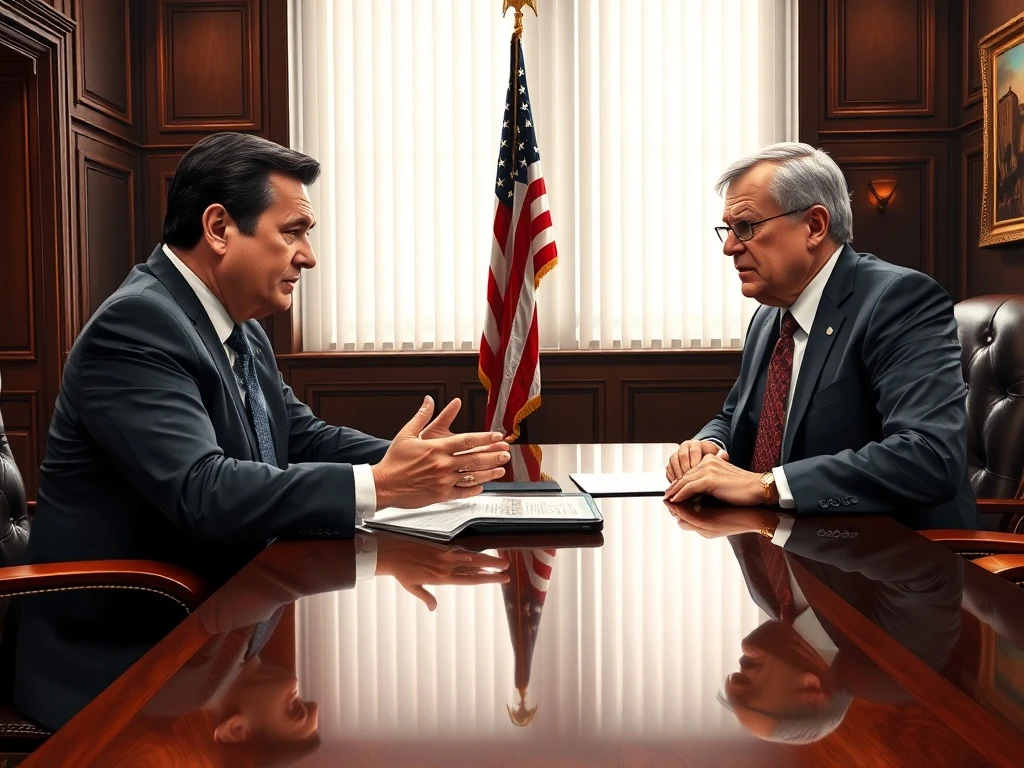
WASHINGTON, D.C. — In a sharp escalation of tensions over federal spending, Transportation Secretary Michael Duffy publicly rebuked Senate Majority Leader Chuck Schumer on Thursday, February 26, 2026, telling him to “get off the political bandwagon.” The extraordinary comment, delivered during a press briefing at the Department of Transportation headquarters, centers on a deepening stalemate over the Department of Homeland Security (DHS) funding bill. This critical appropriations package, which must pass by March 6 to avoid a partial agency shutdown, has become the latest flashpoint in a divided Congress. Secretary Duffy, whose department’s operations are deeply intertwined with DHS on supply chain and infrastructure security, framed the impasse as a threat to national safety.
Duffy’s Direct Rebuke and the Core of the DHS Funding Standoff
Secretary Duffy’s remarks followed a morning statement from Senator Schumer’s office criticizing the White House’s proposed DHS budget as “fiscally irresponsible” and “divorced from operational realities.” Duffy, a former state governor known for a blunt speaking style, did not mince words in response. “Leader Schumer needs to get off the political bandwagon and come to the table with serious solutions,” Duffy stated, his voice firm. “We have 168 hours until a shutdown that would hamper border security, FEMA readiness, and Coast Guard operations. This isn’t a game.” The DHS funding standoff specifically hinges on a $4.3 billion discrepancy between the administration’s request and the Senate Appropriations Committee’s latest draft. The contested funds are primarily earmarked for cybersecurity upgrades for critical transportation infrastructure and additional personnel for the Transportation Security Administration (TSA).
Historical context reveals this is not an isolated incident. The current deadlock mirrors the 2023 and 2025 year-end funding fights, which both resulted in short-term continuing resolutions. However, the involvement of a Cabinet secretary directly challenging a top congressional leader in such personal terms marks a significant intensification. According to a 2025 Government Accountability Office (GAO) report, stopgap funding measures cost the DHS an estimated $195 million annually in planning inefficiencies and contract delays. “Every time we operate under a CR, we lose momentum on long-term security projects,” a senior DHS official, speaking on background, confirmed to our publication.
Immediate Impacts on Security and Transportation Operations
The potential consequences of a funding lapse are both immediate and severe. A DHS contingency plan, published as required by law, outlines that over 40% of its workforce—including many TSA agents and Coast Guard personnel—would be deemed “excepted” and required to work without pay. Non-essential training, maintenance, and technology procurement would halt. For the Department of Transportation, the ripple effects are direct. “Our ports, air traffic control coordination with TSA, and hazardous materials tracking systems are joint operations,” Secretary Duffy explained. The standoff threatens to delay three major port security grant programs and the rollout of new cybersecurity protocols for pipeline operators, initiatives jointly managed by DOT and DHS.
- Border Security: Planned technology upgrades at ports of entry, including new cargo scanning systems, would be postponed.
- Aviation Security: TSA hiring for the peak summer travel season would freeze, potentially leading to longer security lines at major airports by June.
- Emergency Preparedness: FEMA’s ability to pre-position supplies for the upcoming hurricane season would be curtailed, relying on depleted stockpiles.
Expert Analysis: A Dangerous Precedent
Dr. Eleanor Vance, a senior fellow at the nonpartisan Center for Presidential and Congressional Studies, views the public clash as symptomatic of a deeper dysfunction. “When Cabinet secretaries feel compelled to personally call out congressional leaders, it signals a complete breakdown in the traditional, behind-the-scenes appropriations process,” Vance stated. She points to data showing that the average time to pass annual appropriations bills has increased from 4.2 months in the 1990s to over 8.5 months in the current decade. “This chronic lateness forces agencies into reactive, crisis-management mode, which is antithetical to effective homeland security,” she added. Vance’s research, cited in a recent Journal of Homeland Security article, correlates funding instability with a 15–20% reduction in the completion rate of multi-year security infrastructure projects.
Broader Context: A History of Budgetary Brinkmanship
This confrontation fits a persistent pattern of last-minute budgetary negotiations that have defined the past several congressional sessions. The table below compares key elements of recent homeland security funding fights, illustrating a trend toward shorter-term solutions and increasing political friction.
| Fiscal Year | Final Bill Passage Date | Days Past Deadline | Primary Sticking Point |
|---|---|---|---|
| 2023 | December 23, 2022 | 83 | Border wall funding vs. technology |
| 2024 | March 9, 2024 | 160 | ICE detention bed mandates |
| 2025 | December 20, 2024 (via CR) | N/A (CR until Feb) | Cybersecurity funding levels |
| 2026 (Current) | Pending (Deadline: March 6) | N/A | TSA/Infrastructure security funding |
Unlike previous years, the current political bandwagon rhetoric suggests the debate is becoming more about electoral positioning than policy substance. Both parties are maneuvering ahead of the midterm elections, with each side aiming to blame the other for any security lapses or travel disruptions that may arise from the impasse. This dynamic makes finding a compromise before the March 6 deadline particularly challenging.
What Happens Next: The Path to a Resolution
The immediate path forward involves the House and Senate appropriations committees resuming negotiations this weekend. Key staffers from both parties indicated that the framework for a deal exists, but the political will to accept it remains in question. The most likely outcome, according to Capitol Hill insiders, is another short-term continuing resolution (CR) lasting 30 to 45 days. This would push the final decision closer to the Easter recess, creating even more pressure. However, Secretary Duffy and DHS leadership have publicly opposed another CR, arguing it merely “kicks the can” and perpetuates operational uncertainty. A bipartisan group of senators from coastal and border states is reportedly drafting a letter urging leadership to prioritize a full-year bill, citing constituent concerns about port and border security.
Stakeholder Reactions: Industry and Labor Weigh In
Reactions from affected industries have been swift and concerned. The Airports Council International – North America issued a statement warning that “funding instability directly translates to security vulnerability.” Meanwhile, the union representing over 45,000 TSA officers called the situation “demoralizing” and warned of increased attrition if agents face another period of working without a guaranteed paycheck. Conversely, some fiscal conservative groups have applauded Senator Schumer’s stance, framing it as necessary oversight of executive branch spending requests. This spectrum of reactions underscores the high stakes and complex political calculations surrounding the DHS funding standoff.
Conclusion
Transportation Secretary Michael Duffy’s direct challenge to Senator Chuck Schumer has thrown a high-intensity spotlight on a critical DHS funding standoff with tangible deadlines. The dispute transcends typical budgetary squabbles, touching the core of national security coordination between the DOT and DHS. While the political theater of telling a leader to “get off the political bandwagon” captures headlines, the underlying issue is a systemic failure to fund homeland security in a stable, predictable manner. The coming week will test whether political rhetoric gives way to pragmatic compromise. The security of the nation’s borders, transportation systems, and emergency response capabilities hangs in the balance, awaiting a resolution that moves beyond continuing resolutions and political point-scoring.
Frequently Asked Questions
Q1: What exactly did Transportation Secretary Duffy say to Senator Schumer?
On February 26, 2026, during a press briefing, Secretary Duffy explicitly told Senate Majority Leader Chuck Schumer to “get off the political bandwagon” and come to the table with serious solutions to the Department of Homeland Security funding impasse.
Q2: What happens if the DHS funding bill isn’t passed by March 6?
The Department of Homeland Security would enter a partial shutdown. Over 40% of its workforce, including many TSA agents and Coast Guard members, would be required to work without pay, while non-essential operations like new technology procurement and non-emergency maintenance would halt.
Q3: What is the main point of disagreement in the DHS funding standoff?
The core disagreement centers on approximately $4.3 billion, primarily for cybersecurity upgrades for critical transportation infrastructure and hiring additional TSA personnel. The Senate appropriations draft differs from the White House request on the scale and allocation of these funds.
Q4: How does a Department of Transportation shutdown differ from a DHS shutdown?
While DOT has its own separate appropriations, its operations are deeply linked with DHS. A DHS funding lapse would directly impact joint programs like port security grants, air traffic control coordination with TSA, and pipeline cybersecurity, causing significant operational delays for DOT.
Q5: Have there been similar funding fights in recent years?
Yes. Funding for DHS has been contentious for several fiscal years, often leading to last-minute deals or continuing resolutions. The current fight is notable for the public, personal nature of the criticism between a Cabinet secretary and a top Senate leader.
Q6: How does this affect average travelers and citizens?
If the standoff leads to a shutdown or prolonged uncertainty, travelers could eventually see longer TSA security lines at airports. More broadly, it could delay projects meant to enhance security at ports and borders and hamper FEMA’s preparedness for natural disasters.