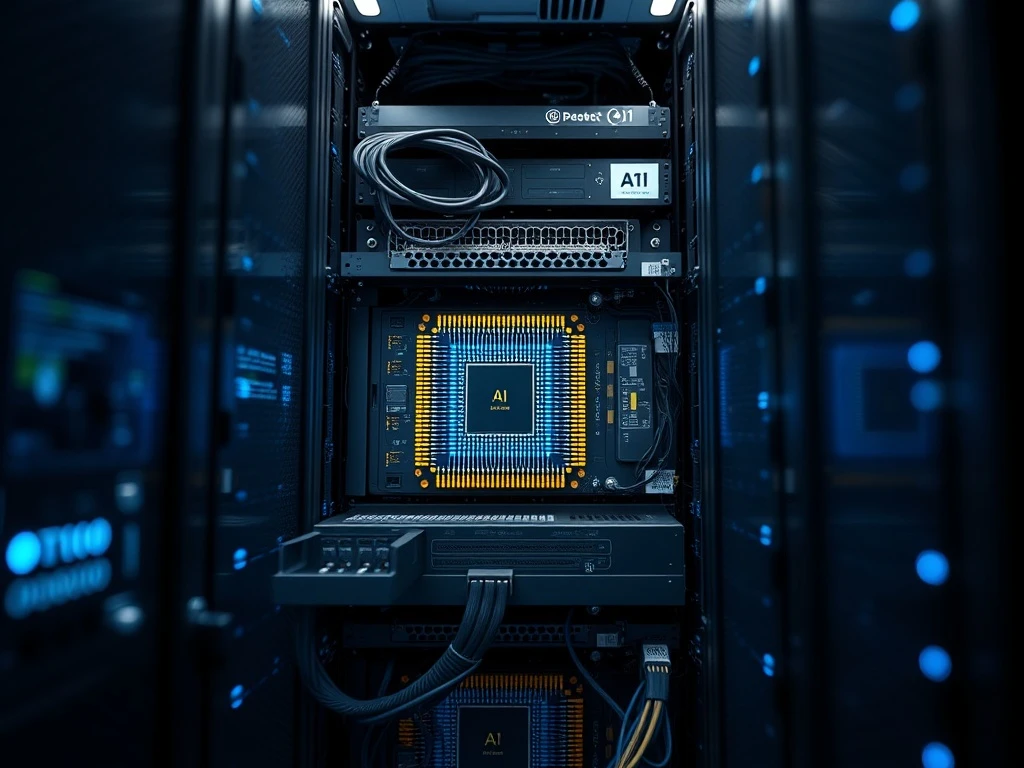
San Francisco, CA — June 9, 2026: The race to build the foundational hardware for artificial intelligence has a new, well-funded contender. Eridu, an AI networking startup founded by veteran entrepreneur Drew Perkins, officially emerged from stealth today with a colossal $200 million Series A funding round. The investment, led by Socratic Partners and legendary investor John Doerr, signals intense venture capital belief that the next major hurdle for AI advancement lies not in raw compute power, but in how AI chips communicate. Perkins, whose career spans foundational internet protocols to billion-dollar optical network exits, is betting his new company can redefine data center architecture for the age of large language models.
Eridu’s Mission: Rethinking Networks for an AI World
The genesis of Eridu traces directly to a conversation between Drew Perkins and OpenAI CEO Sam Altman in early 2023. “Sam told me that what enabled AI and ChatGPT was just enormous amounts of compute,” Perkins recounted in an exclusive interview. “At the time, I think he meant 4,000 GPUs, but now we’re talking about millions of GPUs.” That discussion crystallized a critical insight for Perkins: the relentless scaling of AI models would soon hit a wall, not due to a shortage of chips, but because of the inefficient, legacy networking systems connecting them. Today’s data centers add network capacity by stacking more external switch boxes, creating data “hops” that increase latency and power consumption—a tangible delay between a user’s prompt and an AI’s reply.
By late 2023, Perkins partnered with co-founder Omar Hassen, a veteran chip designer from Broadcom and Marvell. Together, they founded Eridu in 2024 with a blank-slate mandate. “What we needed to do was come up with a brand-new way of thinking about how you build networks and build network equipment, network chips, and the entire thing,” Perkins stated. Their approach is silicon-first: designing new chips that integrate networking functions directly, thereby reducing reliance on external, tiered optical connections. Eridu plans to sell complete systems intended to occupy the same rack space as traditional gear from companies like Arista Networks, but with radically different internal architecture.
The $200M Bet on Solving a Critical Bottleneck
The sheer size of Eridu’s Series A—bringing total funding to $230 million—underscores the scale of the problem it aims to solve. The round ignited a “VC frenzy,” according to Perkins, after Wen Hsieh of Matter Venture Partners and subsequently John Doerr, who had backed Perkins’ previous ventures, committed. Other investors include Hudson River Trading, Capricorn Investment Group, and corporate venture arms from TSMC, MediaTek, and Bosch. Perkins declined to confirm if Eridu has achieved a $1 billion+ “unicorn” valuation but noted it is “comparable to others raising this much in a Series A” and that he wants his 100 employees to “do well on their stock options.”
The funding addresses a stark performance gap Perkins identified. “GPU compute and memory bandwidth are improving by roughly 10x per year, while data center switches from Broadcom, Marvell, Cisco, etc. are still only improving 2–3x every 2–3 years,” he explained. This divergence creates a growing bottleneck. Eridu’s proposed solution involves a switch that consolidates functions on-chip. “So now I’m saving a ton of power, I’m saving a ton of cost, and then my network is much more reliable because the optics are the least reliable part of the network,” Perkins argued.
- Performance Gap: AI compute hardware advances 10x faster than networking hardware.
- Power & Cost Efficiency: Integrated on-chip networking slashes latency, power draw, and component count.
- Market Timing: Funding coincides with history’s largest data center build-out, specifically for AI.
Expert Perspective: A Veteran Tackling a New Frontier
Industry analysts point to the founders’ deep experience as a key differentiator in a sector often dominated by software-centric AI startups. “Drew Perkins isn’t just another founder chasing an AI trend,” said Rajesh Ghai, Managing Director for Communications Infrastructure at equity research firm CFRA. “He has a four-decade track record of inventing and commercializing the actual plumbing of the internet, from PPP to optical switching. When someone with that pedigree says networking is the next AI bottleneck, the industry listens.” This sentiment is echoed by the caliber of investors, particularly John Doerr, whose early bets on Google and Amazon lend considerable authority to the venture.
Positioning in the Competitive AI Hardware Landscape
Eridu enters a fiercely competitive arena. It does not manufacture the AI GPUs themselves, dominated by Nvidia, AMD, and custom silicon from cloud giants. Instead, it targets the connective tissue between them. Its potential competitors include established networking chip giants like Broadcom and Marvell, as well as system vendors like Cisco and Arista Networks. However, Eridu’s thesis is that these incumbents are constrained by legacy architectures not designed for the unique, massive parallel communication patterns of AI training clusters.
| Company | Focus | Approach to AI Networking |
|---|---|---|
| Eridu | AI-Optimized Networking Systems | New silicon-first architecture, integrating networking on-chip |
| Broadcom / Marvell | General-Purpose Networking Chips | Iterative improvements on existing switch ASIC designs |
| Nvidia | AI Compute & Full Stack (InfiniBand) | Proprietary InfiniBand networking for its GPU clusters |
| Arista Networks | Cloud & Data Center Networking | Software-driven networking on merchant silicon |
The company’s success hinges on proving its integrated systems offer a decisive performance-per-watt and cost advantage over the incumbent “more boxes” approach. If it can, Eridu positions itself at the heart of the trillion-dollar AI infrastructure build-out.
What’s Next for Eridu and the AI Infrastructure Race
With capital secured, Eridu’s immediate focus is execution. The company will scale its engineering team to advance its chip and system designs from prototype to production-ready hardware. Industry observers will watch for partnerships with major cloud providers (AWS, Google Cloud, Microsoft Azure) or large AI labs, as these entities are the primary customers for cutting-edge data center technology. Perkins’ history of successful exits—Lightera to Ciena, Infinera’s IPO and sale to Nokia—sets high expectations. However, the technical challenge is formidable, requiring breakthroughs in chip design, systems integration, and software.
Industry Reactions and Strategic Implications
The funding has reverberated through the semiconductor and venture capital communities. “This round is a bellwether,” commented a partner at a competing venture firm who asked not to be named. “It validates that smart money sees AI infrastructure as a layered investment thesis. After GPUs and memory, networking is the obvious next layer to explode.” For existing hardware vendors, Eridu represents both a potential partner and a future competitor. Its backing by TSMC’s venture arm suggests a close collaboration with the world’s leading chip fab, a crucial relationship for manufacturing its custom silicon.
Conclusion
The launch of Eridu with a $200 million Series A is more than a single startup’s milestone; it is a significant marker in the evolution of AI hardware. By focusing on the networking bottleneck identified through Drew Perkins’ direct dialogue with AI pioneers, the company brings rare engineering depth to one of the field’s most pressing problems. While technical execution risks remain, the combination of veteran founders, top-tier investors, and a clearly defined market need makes Eridu a startup to watch closely. Its progress will offer a clear gauge of whether AI’s breakneck advancement can be sustained by re-engineering the fundamental architecture of the data center itself.
Frequently Asked Questions
Q1: What specific problem is Eridu’s AI networking technology trying to solve?
Eridu aims to eliminate the data communication bottleneck between AI chips (GPUs) in large-scale data centers. Current networks add latency and power drain by routing data through multiple external switches; Eridu integrates networking functions directly onto the chip to accelerate communication.
Q2: Why is Drew Perkins’ background significant for this startup?
Drew Perkins helped create foundational internet protocols (PPP) and has founded and sold multiple successful networking hardware companies. His decades of experience in building physical network infrastructure provide a credible foundation for tackling AI’s complex hardware challenges.
Q3: Who are Eridu’s main competitors?
Primary competitors include established networking chip designers like Broadcom and Marvell, as well as system vendors like Cisco and Arista Networks. Eridu differentiates by designing from scratch for AI workloads, not adapting general-purpose networking tech.
Q4: How will Eridu’s technology affect the end-user experience with AI?
For end-users, more efficient AI networking could lead to faster response times from AI applications (like chatbots), lower operational costs for AI service providers, and enable the training of even larger and more capable AI models.
Q5: What does John Doerr’s involvement signal about Eridu’s potential?
John Doerr is a legendary venture capitalist with early, landmark investments in Google and Amazon. His participation signals that top-tier investors believe AI infrastructure is a critical and potentially massive new investment frontier, lending significant credibility to Eridu’s mission.
Q6: What is the next major milestone for Eridu after this funding?
The next steps involve scaling engineering, moving from chip design to production tape-out with a partner like TSMC, and securing design wins or partnerships with major cloud providers or AI labs to validate its technology in real-world data centers.