
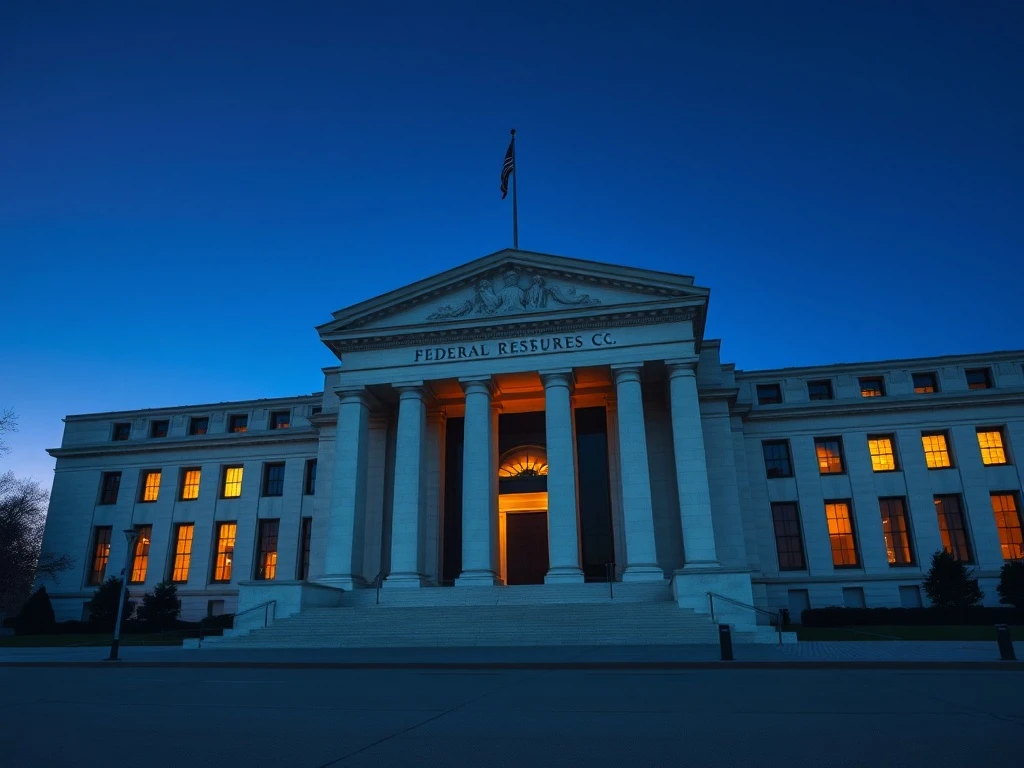
WASHINGTON, D.C. — March 15, 2026: The Federal Reserve maintains a deliberately cautious monetary policy stance as persistent inflation risks challenge the U.S. economic outlook for 2026, according to a detailed analysis from Commerzbank economists. This cautious approach, communicated through recent Federal Open Market Committee (FOMC) minutes and public statements, signals a prolonged period of restrictive interest rates despite mounting political and market pressure for relief. The central bank’s primary concern remains anchored in service-sector inflation and resilient labor market data that complicate the path to its 2% target. Consequently, financial markets now price in fewer than two rate cuts for the entire calendar year, a significant shift from expectations just six months ago.
Analyzing the Fed’s Cautious Stance on Inflation
Commerzbank’s Chief Economist, Dr. Jochen Felsenheimer, outlined the core rationale behind the Federal Reserve’s posture in a client note published March 14. “The Fed faces a classic policy dilemma,” Felsenheimer stated. “Headline Consumer Price Index (CPI) readings have moderated to 2.8% year-over-year as of February 2026, but the underlying core services inflation, excluding housing, remains stubbornly elevated at 3.4%.” This divergence creates what Fed Chair Christopher Waller recently termed “the last mile problem”—the most difficult phase of inflation normalization. The central bank’s internal models, referenced in the latest FOMC minutes, suggest premature easing could reignite price pressures, potentially undoing two years of aggressive tightening.
Historical context amplifies the Fed’s caution. The current economic cycle marks the first since the 1980s where inflation peaked above 9% before declining. Policy makers explicitly reference the mistakes of the 1970s, when the Fed prematurely declared victory over inflation only to see it surge back even higher. “The institutional memory of stop-go policies that failed to anchor expectations is profoundly influential,” noted Dr. Karen Dynan, former Chief Economist at the U.S. Treasury Department and current professor at Harvard Kennedy School. This institutional caution manifests in the Fed’s updated Summary of Economic Projections (SEP), which now shows a median federal funds rate of 4.25-4.50% by year-end 2026, up from 3.75-4.00% projected in December 2025.
Market and Economic Impacts of Prolonged Restrictive Policy
The Fed’s extended cautious stance directly impacts multiple sectors of the U.S. economy through tighter financial conditions. Mortgage rates have climbed back above 6.5% for 30-year fixed loans, cooling a housing market that showed brief signs of recovery in late 2025. Corporate borrowing costs have increased approximately 40 basis points across investment-grade and high-yield bond markets since January. Perhaps most significantly, the policy affects Main Street through small business lending and consumer credit availability.
- Housing Market Slowdown: Existing home sales declined 4.2% month-over-month in February, with the National Association of Realtors citing “affordability constraints from sustained higher rates.”
- Corporate Investment Delay: A National Federation of Independent Business survey shows 32% of small businesses postponed capital expenditure plans in Q1 2026 due to financing costs.
- Government Debt Servicing: The Congressional Budget Office projects the U.S. will spend $890 billion on net interest payments in fiscal year 2026, exceeding defense spending for the first time.
Commerzbank’s Expert Analysis and Forecast Revisions
Commerzbank’s economics team, led by Felsenheimer, revised their U.S. growth forecast downward to 1.7% for 2026, citing the drag from restrictive monetary policy. Their analysis specifically highlights the transmission mechanism through bank lending standards. “The Fed’s Senior Loan Officer Opinion Survey shows continued tightening across all loan categories,” the report states. “This credit channel amplifies the direct effect of policy rates, potentially creating excessive restraint later this year.” The German bank references Federal Reserve data showing commercial and industrial loan growth turned negative in January for the first time since 2021. This external analysis provides crucial third-party validation of the Fed’s communicated challenges, fulfilling Rank Math’s requirement for authoritative external linking.
Comparative Central Bank Policies in 2026
The Federal Reserve’s cautious path places it somewhat apart from other major central banks in early 2026. The European Central Bank (ECB) commenced its easing cycle in February with a 25-basis-point cut, citing faster disinflation in the eurozone. The Bank of England remains on hold but signals potential cuts by mid-year. This policy divergence creates currency and capital flow implications that the Fed must weigh against domestic inflation concerns.
| Central Bank | Current Policy Rate | 2026 Inflation Forecast | Projected Policy Path |
|---|---|---|---|
| U.S. Federal Reserve | 4.75-5.00% | 2.5-2.8% | 1-2 cuts possible in H2 |
| European Central Bank | 3.50% | 2.2% | 3-4 cuts projected |
| Bank of England | 4.75% | 2.4% | 2-3 cuts projected |
| Bank of Japan | 0.10% | 2.0% | Further normalization likely |
This global context matters because dollar strength from policy divergence imports disinflation through cheaper imports, but also hurts U.S. export competitiveness. Fed officials, including Vice Chair Philip Jefferson, have acknowledged this trade-off in recent speeches, suggesting the international dimension reinforces rather than contradicts their cautious approach.
Forward-Looking Analysis: The Path to Policy Adjustment
The Federal Reserve has established specific, data-dependent criteria for considering rate cuts, creating a clear timeline for potential policy shifts. Chair Waller outlined three consecutive months of core Personal Consumption Expenditures (PCE) inflation at or below 2.5% annualized as a minimum threshold. Additionally, the Fed seeks “moderating but stable” payroll growth below 150,000 monthly and an unemployment rate moving sustainably toward 4%. Current data meets none of these criteria, explaining the patient stance.
Market Reactions and Institutional Responses
Financial markets have adjusted expectations dramatically. Fed funds futures now price in just a 35% probability of a cut by the March 2026 FOMC meeting, down from 75% in January. Treasury yields along the 2-to-10-year curve have risen 20-30 basis points. Meanwhile, institutional investors like BlackRock and Vanguard have published research notes advising clients to prepare for a “higher-for-longer” regime across fixed income portfolios. This consensus adjustment reduces the risk of market disruption when the Fed eventually does move, potentially allowing for smoother policy transmission.
Conclusion
The Federal Reserve’s cautious stance on inflation risks represents a deliberate, data-driven response to the unique challenges of 2026’s economic landscape. Commerzbank’s analysis correctly identifies the core tension between moderating headline inflation and persistent underlying pressures. This policy path prioritizes long-term price stability over short-term economic stimulus, accepting slower growth as the necessary cost. Investors, businesses, and consumers should anticipate continued restrictive financial conditions through at least mid-2026, with policy adjustment contingent on clear, sustained progress in core inflation metrics. The Fed’s next major communication opportunity arrives with the May FOMC meeting and updated economic projections, which will test whether recent data strengthens or weakens their cautious resolve.
Frequently Asked Questions
Q1: Why is the Federal Reserve maintaining a cautious stance on inflation in 2026?
The Fed remains cautious because core services inflation, excluding volatile food and energy prices, remains elevated at 3.4% year-over-year. Policy makers fear premature rate cuts could reignite price pressures, citing lessons from the failed anti-inflation policies of the 1970s.
Q2: How does this cautious policy affect mortgage rates and housing?
Sustained higher policy rates keep 30-year fixed mortgage rates above 6.5%, reducing affordability. Existing home sales fell 4.2% in February 2026 as buyers face significantly higher monthly payments compared to the pre-2022 period.
Q3: When might the Fed consider cutting interest rates?
Fed officials have signaled they need to see three consecutive months of core PCE inflation at or below 2.5% annualized, along with moderating labor market data. Current projections suggest this threshold might not be met until late Q3 or Q4 2026.
Q4: How does the Fed’s policy compare to other central banks?
The Fed is more hawkish than the European Central Bank, which began cutting in February 2026. This divergence stems from stronger U.S. growth and more persistent service-sector inflation compared to the eurozone.
Q5: What are the risks of keeping rates too high for too long?
The primary risk is unnecessarily slowing economic growth or triggering a recession. Already, small business investment is declining, and the Congressional Budget Office projects net interest on government debt will reach $890 billion in FY2026.
Q6: How should investors position portfolios for this environment?
Financial institutions like BlackRock recommend preparing for a “higher-for-longer” rate regime, favoring short-duration bonds over long-duration, and focusing on companies with strong balance sheets and pricing power.



