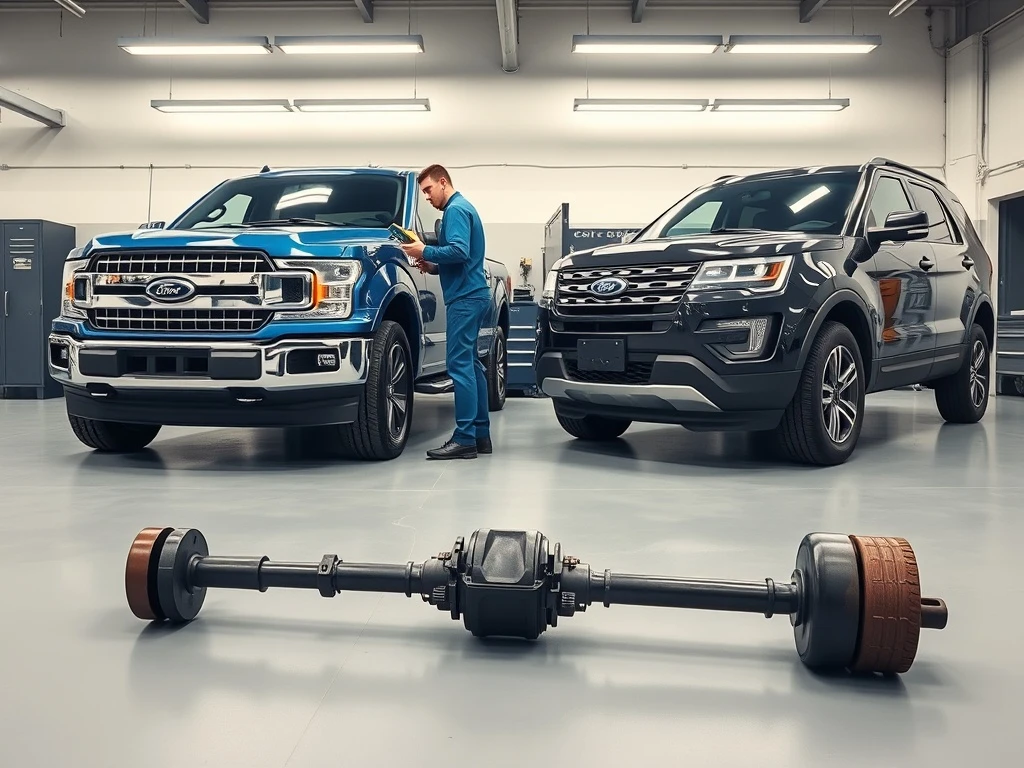
DEARBORN, Mich. — February 24, 2026 — Ford Motor Company has initiated two major safety recalls affecting more than 615,000 vehicles in North America. The urgent actions address potentially catastrophic defects in windshield wiper systems and rear driveshafts. Consequently, the National Highway Traffic Safety Administration (NHTSA) has published official recall notices. Owners of certain 2021-2023 Ford F-150, Explorer, and Lincoln Aviator models must contact dealers immediately. These Ford vehicle recall campaigns stem from component failures that could severely compromise driver visibility and vehicle control.
Scope and Details of the Ford Safety Recalls
The larger of the two recalls encompasses approximately 515,000 vehicles. Specifically, it targets 2021-2022 Ford F-150 and Ford Expedition models, plus 2021-2022 Lincoln Navigator SUVs. According to NHTSA Safety Recall Report 26V-123, a faulty windshield wiper motor may fail. “The wiper motor’s internal printed circuit board can experience a high-resistance electrical short,” the report states. This short can cause the wipers to operate unexpectedly, become inoperative, or overheat. Ford’s investigation, which began in late 2025 after field reports, traced the issue to a specific supplier’s motor batch. The company has linked at least 22,000 warranty claims and 615 reports of wiper failure directly to this defect.
Separately, Ford is recalling about 100,000 2023 Ford Explorer and Lincoln Aviator SUVs. The problem involves a rear driveshaft that may not have been properly heat-treated during manufacturing. This deficiency can lead to a brittle driveshaft. Under high torque loads, the component could fracture and separate from the vehicle. A detached driveshaft causes an immediate and total loss of motive power. Furthermore, it can strike the road surface or other components, creating a significant hazard for following traffic. Ford identified this issue through its supplier’s quality audit in January 2026.
Immediate Safety Risks and Owner Impacts
These defects present clear and present dangers. A sudden wiper failure during heavy rain or snowstorm directly creates a driveshaft failure of forward visibility. This scenario drastically increases collision risk. “A loss of wiper function while driving in adverse weather conditions can significantly increase the risk of a crash,” the NHTSA report concludes flatly. The driveshaft issue poses a different but equally severe threat. A fracture could strand drivers in high-speed traffic lanes or cause a loss of vehicle control during acceleration.
- Loss of Critical Visibility: Wiper failure can occur without warning, leaving drivers blinded in rain, snow, or sleet.
- Sudden Loss of Power: A broken driveshaft immediately disables the vehicle’s drivetrain, creating a roadside emergency.
- Secondary Collision Hazard: A separated driveshaft becomes a projectile, endangering other motorists.
Owners will experience inconvenience and potential downtime. Ford will notify affected owners by first-class mail starting March 15, 2026. Until repairs are complete, owners of vehicles with the wiper defect are advised to avoid driving in inclement weather. For the driveshaft recall, Ford recommends avoiding aggressive acceleration.
Official Response and Expert Analysis
Ford has issued a formal statement acknowledging the recalls. “The safety of our customers is our highest priority,” said Maria Rodriguez, Ford’s Director of North American Safety Communications. “We are moving quickly to provide our dealers with the parts and repair instructions needed to fix these vehicles at no cost to owners.” The company has already begun shipping replacement wiper motor assemblies and new rear driveshafts to its dealer network.
Automotive safety expert Dr. Aris Thompson of the Center for Automotive Safety (CAS) provided context. “This is a significant recall due to the high volume and the direct nature of the safety defects,” Thompson noted. “The wiper motor issue is particularly concerning because it’s an electronic failure that owners cannot easily detect beforehand. It underscores the growing complexity of vehicle electrical systems and the corresponding need for robust supplier quality controls.” Thompson referenced NHTSA data showing that component failures in critical systems like visibility and drivetrains are leading factors in recall initiations.
Historical Context and Industry Comparison
This automotive safety recall event fits a broader industry pattern. Major manufacturers have faced similar large-scale recalls for critical components in recent years. The table below compares the scale and nature of recent significant North American recalls.
| Manufacturer | Year | Vehicles Recalled | Primary Defect |
|---|---|---|---|
| Ford | 2026 | ~615,000 | Wiper Motor / Driveshaft |
| General Motors | 2025 | ~740,000 | Faulty Brake Control Module |
| Stellantis (Jeep) | 2024 | ~380,000 | Fuel Pump Failure |
| Toyota | 2023 | ~1.2 million | Potential Airbag Non-Deployment |
The Ford recalls are notable for addressing two unrelated but serious mechanical issues simultaneously. This situation often indicates heightened internal scrutiny or a response to regulatory pressure. The NHTSA investigation process typically begins with owner complaints logged in its public database. A pattern of complaints triggers a Preliminary Evaluation, which can escalate to an Engineering Analysis and ultimately, a manufacturer-initiated recall.
Next Steps for Ford and Vehicle Owners
Ford’s immediate path involves a massive logistical operation. The company must produce and distribute hundreds of thousands of replacement parts. Dealers will prioritize repairs based on part availability and risk level. Owners can check if their vehicle is included by visiting the NHTSA recalls website (www.nhtsa.gov/recalls) and entering their 17-character Vehicle Identification Number (VIN). Alternatively, they can contact their local Ford or Lincoln dealer.
Stakeholder Reactions and Market Response
Initial reactions from consumer advocacy groups have been measured. The Consumer Federation of America praised the recall’s swift announcement but urged expedited repairs. “The proof will be in how quickly parts arrive at dealerships,” a spokesperson stated. On financial markets, Ford’s stock showed minimal movement following the announcement, suggesting analysts had anticipated the recall costs. However, industry observers note that the financial impact, including parts, labor, and potential loaner vehicles, will likely exceed $150 million. This figure does not account for potential reputational damage or future liability.
Conclusion
The dual Ford vehicle recall of over 615,000 trucks and SUVs highlights persistent challenges in modern automotive manufacturing and supply chain quality control. The wiper motor and driveshaft defects present unambiguous safety threats that demand immediate owner action. Ford has taken the responsible step of initiating these recalls proactively, working within the NHTSA framework. Affected owners must heed the warnings, check their VIN, and schedule prompt repairs. The coming weeks will test Ford’s logistical capability to execute these fixes efficiently and restore customer confidence in these popular models.
Frequently Asked Questions
Q1: Which specific Ford models are included in these recalls?
The wiper motor recall includes 2021-2022 Ford F-150 pickups, Ford Expedition, and Lincoln Navigator SUVs. The driveshaft recall includes 2023 Ford Explorer and Lincoln Aviator SUVs. Approximately 615,000 vehicles are affected in total.
Q2: What should I do if I own one of these vehicles?
First, confirm your vehicle is included by checking your VIN on the NHTSA website or with a dealer. Ford will mail official notices starting March 15. Contact your local Ford or Lincoln dealer to schedule a free repair. Avoid driving in heavy weather (wiper recall) or aggressive acceleration (driveshaft recall) until fixed.
Q3: Are these defects linked to any accidents or injuries?
As of the recall filing, Ford is aware of several hundred reports of wiper failure but has not linked the defect to any crashes or injuries. For the driveshaft, the company is aware of three reports of component failure but no related accidents. The recall is preventative to eliminate the risk.
Q4: How long will the repair take at the dealership?
Ford estimates the wiper motor replacement will take about 1.5 hours of labor. The driveshaft replacement is a more involved procedure, estimated at 3-4 hours. Dealers may provide a loaner vehicle if the repair requires the vehicle to stay overnight.
Q5: How does this recall compare to other major automotive recalls?
While large, this recall is not unprecedented. It is smaller in scale than some recent airbag or engine-related recalls that affected millions. Its significance lies in addressing two separate, critical mechanical failures simultaneously, which is less common.
Q6: Will this recall affect the resale value of my Ford vehicle?
Once the recall repair is completed and documented, the impact on resale value is typically minimal. An open, unrepaired recall, however, can significantly reduce a vehicle’s value and complicate its sale, as most states require disclosure and many lenders won’t finance unrepaired recalled vehicles.