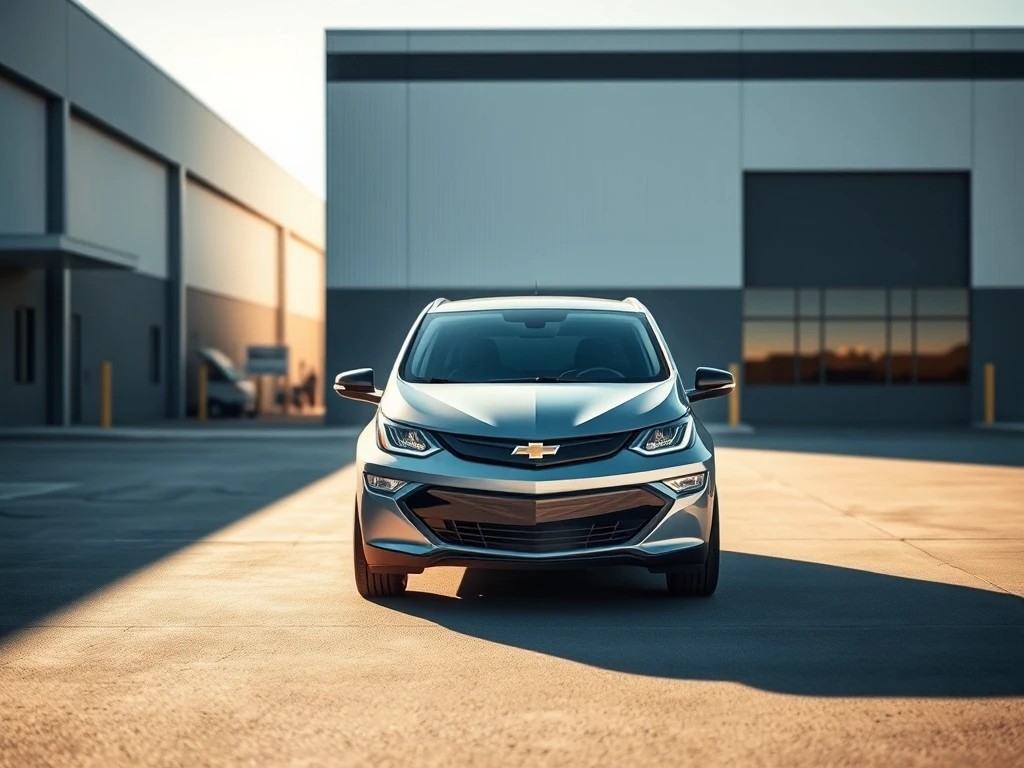
KANSAS CITY, June 9 — General Motors has greenlit the return of the Chevrolet Bolt, a move that reveals a pragmatic new blueprint for electric vehicle profitability in an uncertain market. The automaker confirmed production of a refreshed 2027 Bolt model will commence at its underutilized Fairfax Assembly Plant, leveraging existing parts and factory capacity to turn a historically challenging program into a calculated business success. This decision, finalized in early 2026, provides a critical case study in how legacy automakers can navigate the volatile EV transition without multibillion-dollar gambles on all-new platforms.
The Business Logic Behind the Chevy Bolt’s Surprising Comeback
GM’s announcement to revive the Chevy Bolt electrified its loyal fanbase, but internal approval documents point to cold, hard arithmetic. The program’s resurrection hinged on two converging factors: available factory capacity and a mature supply chain for EV-specific components. The Fairfax plant in Kansas had stood partially idle since the Chevy Malibu’s production ended in 2025. With plans to build the Chevy Equinox SUV and Buick Envision not starting until 2027 and 2028, respectively, the facility presented a multi-year gap. “The math finally penciled out,” a GM source familiar with the capital allocation committee told TechCrunch. “We had a plant, a workforce, and a parts bin that could make a compelling EV without a ground-up investment.”
This stands in stark contrast to the original 2017 Bolt’s development. That vehicle was GM’s first dedicated EV in two decades, requiring costly new partnerships with LG Chem for battery packs and a completely unique chassis. Today, GM sells over a dozen all-electric models across its brands, creating a vast repository of shared components and engineering knowledge. The new Bolt’s development cost is a fraction of its predecessor’s, primarily funding integration and refinement rather than foundational technology.
Engineering the 2027 Bolt for Profit and Performance
The 2027 Chevy Bolt is not a revolutionary redesign but a masterclass in incremental improvement for market competitiveness. TechCrunch’s recent first drive of a prototype confirmed the vehicle’s core proposition: delivering more value and range at a lower cost to produce. The most significant change sits under the hood. Engineers borrowed the front-drive motor from the popular Chevy Equinox EV. While its torque rating appears lower on paper, advancements in power electronics and a shorter gear ratio in the single-speed transmission deliver driving performance comparable to the outgoing model.
The real gain is in efficiency and cost. This shared motor spins faster and uses energy more effectively. Combined with refined battery management software—now powered by the Android Automotive OS—the new Bolt achieves an estimated 15 additional miles of range over the previous Bolt EUV. For consumers, this translates to greater practicality. For GM, it means higher profitability per unit, a hurdle the old model never cleared. The company anticipates the 2027 Bolt will be its first high-volume EV to be solidly profitable from launch.
- Shared Powertrain: Utilizing the Equinox EV’s motor slashes development and parts costs.
- Software-Driven Efficiency: Android Automotive OS optimizes battery charging and route planning.
- Incremental Range Gain: A 15-mile increase addresses a key consumer concern without a new battery.
- Profitability Target: The program is structured to be financially positive, a first for the Bolt line.
Expert Analysis: A Signal to the Broader Industry
Industry analysts view GM’s strategy as a bellwether. “This is the antithesis of the ‘clean sheet’ approach that has burned billions,” said Dr. Liza Johnson, Director of Automotive Strategy at the Center for Automotive Research. “GM is demonstrating that the next phase of the EV transition isn’t about technological moonshots, but about smart manufacturing, parts commonality, and margin management.” Her research indicates that platforms sharing over 60% of parts across models can reduce production costs by up to 30%. GM’s decision follows a challenging quarter where it took a $6 billion charge due to slower-than-expected EV adoption, underscoring the urgent need for capital discipline.
Navigating EV Uncertainty with Pragmatic Platform Strategy
GM’s Bolt revival occurs amidst a sector-wide recalibration. While the company maintains its commitment to an all-electric future and a 2035 phase-out of fossil fuel vehicles, its tactics have shifted. The flashy, exclusive Ultium platform will continue for premium vehicles, but the Bolt’s return on an evolved version of its original architecture signals a dual-path strategy. This approach allows GM to compete in the value-focused segment without diluting its premium EV investments. A comparison of key GM EV programs highlights the strategic divergence.
| Vehicle/Platform | Strategy | Investment Level | Target Margin |
|---|---|---|---|
| Cadillac Lyriq (Ultium) | Clean-sheet, technology flagship | Very High | Premium |
| Chevy Silverado EV (Ultium) | New platform for high-volume trucks | High | Competitive |
| 2027 Chevy Bolt (BEV2 Evolved) | Incremental update, parts sharing | Moderate | Profitable from launch |
| Chevy Equinox EV (Ultium) | Volume platform for core SUV segment | High | Growing |
The Road Ahead for GM and the Bolt
Production of the 2027 Chevy Bolt is scheduled to begin in the second quarter of 2027 at the Fairfax plant. GM has not released pricing but indicates it will be competitive within the compact EV segment, aiming to undercut newer rivals by leveraging its cost-advantaged manufacturing. The company’s immediate goal is to reclaim and grow its share in the entry-level EV space, a segment that remains critical for achieving regulatory compliance and introducing new buyers to electric driving. Success here could validate the parts-sharing, incremental improvement model for other programs across GM’s portfolio.
Stakeholder Reactions: From Enthusiasts to Wall Street
The announcement has been met with cautious optimism. Bolt owner communities, which lobbied intensely for the model’s return, celebrate the victory. “It shows a company can listen,” said Maria Chen, founder of the Bolt EV Owners Association. On Wall Street, analysts praise the capital efficiency. “This is the kind of rational, ROI-focused decision we needed to see,” noted Michael Torres, senior auto analyst at Bernstein. “It mitigates risk while keeping them in the game.” The move also secures the future of the Fairfax workforce, providing a bridge to next-generation SUV production.
Conclusion
The revival of the Chevy Bolt is far more than the return of a popular car. It represents General Motors’ strategic pivot towards a more sustainable and profitable electric vehicle business model. By utilizing existing factory capacity, sharing parts across a now-broad EV portfolio, and focusing on incremental gains, GM has found a formula to navigate current market uncertainty. The 2027 Bolt may not make headlines for groundbreaking technology, but its success could prove transformative, demonstrating that the EV market’s next chapter will be won not just by innovation, but by smart execution and financial discipline. The industry will be watching Kansas closely.
Frequently Asked Questions
Q1: When will the new Chevy Bolt go on sale?
The refreshed 2027 Chevrolet Bolt is scheduled to begin production in Q2 of 2027, with customer deliveries expected in the latter half of that year.
Q2: What is the main reason GM decided to bring the Bolt back?
The decision was driven by a combination of available factory capacity at the Fairfax plant and the ability to use shared, cost-effective EV parts from GM’s existing portfolio, making the program profitable.
Q3: How does the new Bolt’s range compare to the old model?
The 2027 Bolt is expected to travel approximately 15 miles farther on a single charge than the previous Bolt EUV, thanks to a more efficient motor and power electronics.
Q4: Will the new Chevy Bolt be more affordable?
While final pricing is not set, GM’s strategy of using shared parts and existing assembly lines is designed to lower production costs, which should allow for competitive pricing in the compact EV market.
Q5: Does this mean GM is moving away from its Ultium platform?
No. GM is pursuing a dual-path strategy. The Ultium platform remains for new, premium vehicles, while the evolved Bolt architecture allows for a profitable entry-level option. This gives the company flexibility across market segments.
Q6: How does this affect GM’s overall EV commitment?
The Bolt’s revival reinforces GM’s commitment to EVs but signals a more pragmatic, financially disciplined approach. It allows the company to maintain volume and presence in the market while managing investment risk.