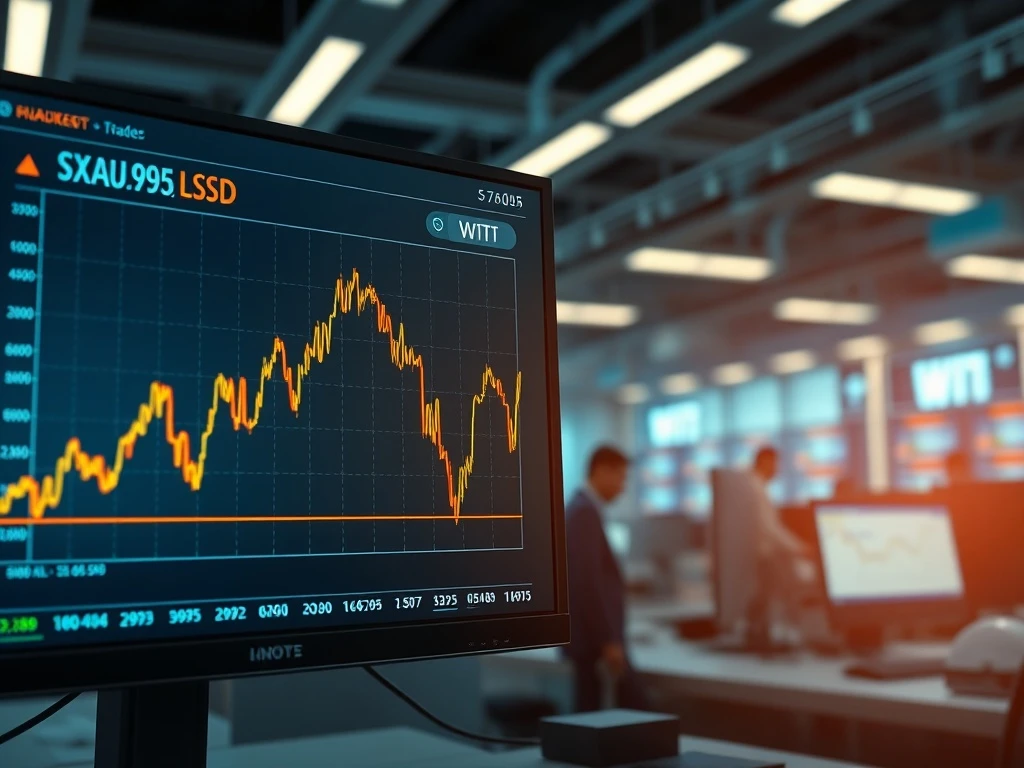
LONDON, March 13, 2026 — Global gold markets experienced a sharp sell-off today, with spot prices breaking decisively below the critical $5,100 per ounce support level. The sudden decline, which saw gold trade as low as $5,095 in early European hours, directly correlates with a parallel surge in Brent crude oil above $112 per barrel. Consequently, this commodity divergence is stoking fresh inflation concerns among institutional investors and central bank watchers, who fear a return of persistent price pressures that could alter monetary policy trajectories. Market analysts point to real-time chart patterns showing a clear breakdown in gold’s recent consolidation, signaling a potential shift in safe-haven asset allocation.
Gold Price Chart Breakdown and Technical Analysis
The London Bullion Market Association (LBMA) fixing price settled at $5,102 this morning, marking the first sub-$5,110 close since late February. Trading volumes on the COMEX exceeded 30-day averages by 45% in the first two hours, according to CME Group data. “The chart tells a clear story of technical failure,” stated Marcus Chen, Head of Commodity Strategy at Financier Global. “Gold had held the $5,120-$5,150 band for seven sessions. Today’s break, on high volume, with the 50-day moving average now turning downward, signals a new bearish phase is likely targeting the $5,050 zone.” The sell-off accelerated after the U.S. Energy Information Administration’s weekly report showed a larger-than-expected drawdown in crude inventories, sending oil prices higher and triggering a broad re-evaluation of inflation hedges.
Historical context adds weight to the move. The last time gold traded below $5,100 was on January 15, 2026, following a surprisingly hawkish Federal Reserve minutes release. However, today’s catalyst is fundamentally different, rooted in energy market supply dynamics rather than direct central bank commentary. This suggests the pressure on gold may be more sustained if oil fundamentals remain tight. The World Gold Council’s most recent monthly report, published March 5, noted that ETF holdings had seen modest inflows, making today’s price rejection particularly notable against ostensibly supportive investor positioning.
Oil Price Surge and Direct Inflationary Impact
Brent crude futures rallied 3.8% to $112.40 per barrel, the highest level since November 2025. This surge stems from a confluence of geopolitical tensions in key producing regions and operational disruptions at several major refineries. “Every $10 sustained increase in the oil price can add 0.4 to 0.5 percentage points to headline inflation in major economies over the following year,” explained Dr. Elara Vance, Chief Economist at the Peterson Institute for International Economics, referencing a 2025 study by the institute. This direct pass-through effect threatens to undermine the progress central banks have made in taming consumer price indices over the past eighteen months.
- Consumer Goods and Transportation: Higher fuel costs immediately increase logistics and production expenses, which companies typically pass to consumers within one to two billing cycles.
- Central Bank Dilemma: Rising energy-driven inflation complicates the policy path for the Fed and ECB, potentially delaying or reducing the scope of anticipated interest rate cuts.
- Market Sentiment Shift: The traditional inverse relationship between gold and real yields is being overwhelmed by the ‘inflation shock’ narrative, forcing a recalculation of gold’s hedging efficacy.
Expert Analysis on the Commodity Divergence
The simultaneous rise in oil and fall in gold presents a puzzle for classic macroeconomic models. Dr. Vance elaborated further in a client note seen by this publication: “Gold is reacting not to inflation per se, but to the expected monetary policy response to that inflation. The market is pricing in a higher likelihood that the Fed will maintain a restrictive stance for longer, boosting the dollar and nominal yields, which are negative for non-yielding bullion.” This view is supported by a spike in the U.S. 10-Year Treasury yield, which climbed 12 basis points today. Conversely, the International Energy Agency (IEA), in its March Oil Market Report, warned of a “significant supply deficit” in Q2 2026, lending fundamental credence to the oil rally.
Historical Comparison and Market Psychology
This is not the first instance of gold and oil decoupling, but the magnitude and speed are notable. A similar pattern emerged in Q3 2021, when oil rallied on post-pandemic demand while gold slumped amid taper talk. However, the absolute price levels and global debt context are vastly different today. The table below compares key metrics from the current event and the 2021 analogue.
| Metric | March 2026 Event | Q3 2021 Event |
|---|---|---|
| Gold Price Level | ~$5,100/oz | ~$1,750/oz |
| Oil Price Level (Brent) | ~$112/barrel | ~$75/barrel |
| U.S. 10-Year Yield | 4.2% | 1.5% |
| Primary Market Narrative | Stagflation Fears | Growth & Tapering |
| Fed Funds Rate | 4.50%-4.75% | 0.00%-0.25% |
The critical difference lies in the starting point for interest rates. In 2021, central banks had room to react. Today, with policy already restrictive, the reaction function is less clear, creating greater market volatility. This uncertainty is arguably a greater headwind for gold than the inflation number itself, as it increases the opportunity cost of holding a zero-yield asset in a potentially higher-for-longer rate environment.
Forward Outlook: Policy Signals and Key Levels to Watch
Immediate attention now turns to the Federal Reserve’s FOMC statement next week and the European Central Bank’s meeting on March 20. Any language acknowledging the inflationary risk from commodities will be scrutinized. “The next support for gold is at $5,050, then the 200-day moving average near $4,980,” noted Marcus Chen. “A weekly close below $5,100 would confirm the breakdown and likely extend the decline. For oil, the market will watch for any strategic reserve releases or diplomatic progress in the Middle East that could cap prices.” Scheduled data releases, including next week’s U.S. PPI and CPI figures, will now carry amplified weight, acting as a verification mechanism for today’s market move.
Trader and Miner Reactions to the Price Swing
On the ground, physical gold dealers in major hubs like Dubai and Zurich reported a mixed response. “We see some bargain-hunting from high-net-worth individuals in Asia,” said a Zurich-based trader who requested anonymity due to company policy. “But the larger ETF and futures-driven selling is overwhelming that physical bid.” Meanwhile, shares of major gold mining companies, including Newmont and Barrick Gold, fell 4-6% in pre-market trading, underperforming the drop in the metal itself—a sign of leveraged downside exposure. In contrast, energy sector equities rallied sharply, highlighting the divergent fortunes within the broader commodity complex.
Conclusion
The breach of $5,100 for gold is a significant technical and psychological event, directly tied to resurgent inflation concerns fueled by soaring oil prices. The move reflects a market reassessment of the inflation trajectory and the corresponding monetary policy path, outweighing gold’s traditional safe-haven status. Key takeaways include the demonstrated sensitivity of gold to real yield movements, the potent inflationary impact of current energy dynamics, and the challenging environment now facing central banks. Investors should monitor the $5,050 support level for gold and any policy rhetoric from central banks next week, as these will determine whether today’s decline marks a brief correction or the start of a deeper trend reversal in the bullion market.
Frequently Asked Questions
Q1: Why did gold fall sharply on March 13, 2026?
Gold fell below $5,100 primarily because surging oil prices raised fears of renewed inflation, leading markets to anticipate that central banks like the Fed may keep interest rates higher for longer. Higher rates increase the opportunity cost of holding non-yielding gold and often strengthen the dollar, pressuring bullion prices.
Q2: How does rising oil price cause inflation?
Oil is a fundamental input for transportation, manufacturing, and energy. Higher prices directly increase costs for businesses, which are often passed on to consumers in the form of more expensive goods, services, and fuel, thereby raising the overall Consumer Price Index (CPI).
Q3: What is the next key support level for the gold price?
According to technical analysts cited in market reports, the next major support level for gold is around $5,050 per ounce, followed by the 200-day moving average, which was near $4,980 as of March 13, 2026.
Q4: Is gold still a good hedge against inflation?
Gold can be an effective long-term hedge against currency debasement and loss of purchasing power. However, in the short term, as seen today, it can struggle when inflation sparks expectations of aggressive central bank tightening, which boosts yields and the currency it’s priced in (USD).
Q5: What are central banks likely to do if oil-driven inflation persists?
If rising oil prices translate into sustained higher core inflation, major central banks like the Federal Reserve and European Central Bank would likely delay planned interest rate cuts or signal a more cautious, “higher-for-longer” monetary policy stance to prevent inflation expectations from becoming unanchored.
Q6: How does this affect the average investor or retirement portfolio?
Investors with exposure to gold ETFs or mining stocks may see short-term losses. Those heavily invested in energy may see gains. The situation underscores the importance of diversification. Rising inflation expectations also erode the real value of future fixed-income payments, impacting bond-heavy portfolios.