
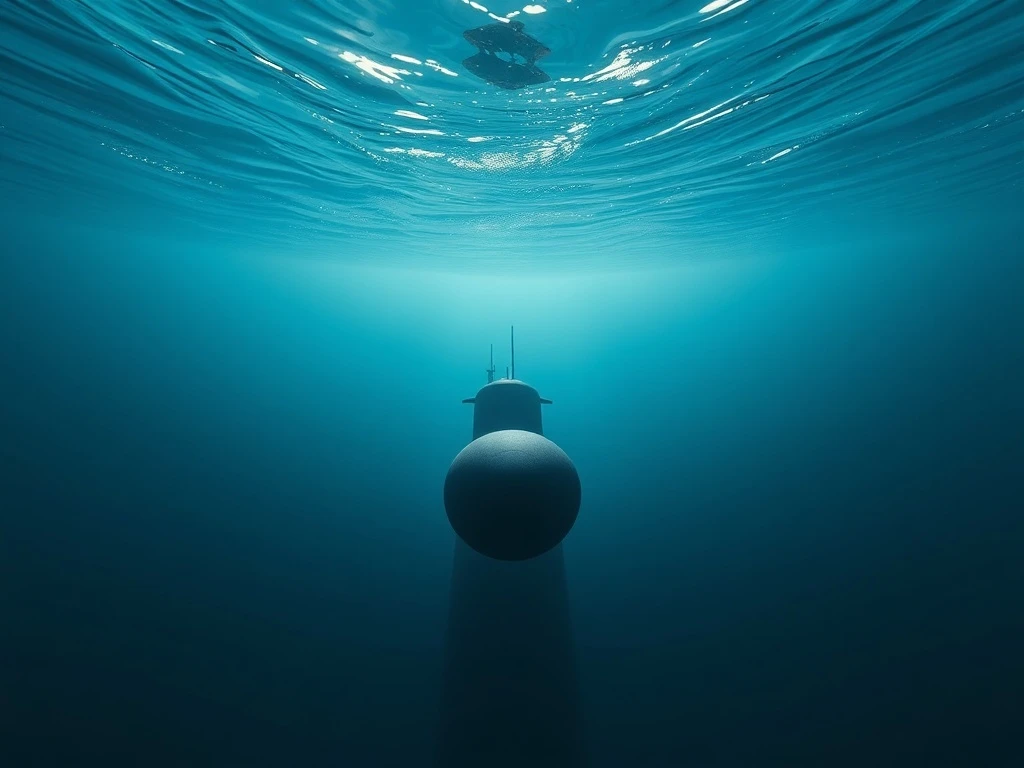
WASHINGTON, D.C. — March 15, 2026: Geopolitical analyst Gordon Chang issued a stark warning today, urging the United States government to formally designate China as an ‘enemy combatant’ under international law. Chang’s declaration follows what he describes as a pattern of aggressive Chinese submarine operations occurring “very close” to American territorial waters. This call represents a significant escalation in rhetoric surrounding the already tense Pacific military standoff. The analyst, a frequent commentator on Sino-American relations, made these remarks during a live broadcast interview, citing unnamed defense sources and recent satellite intelligence. His comments arrive as the Pentagon prepares its annual report on Chinese military power, a document expected to detail substantial advancements in Beijing’s undersea warfare capabilities.
Gordon Chang’s ‘Enemy Combatant’ Designation Call
Gordon Chang’s specific terminology carries profound legal and strategic implications. The label ‘enemy combatant’ originates from the law of armed conflict and was used extensively by the U.S. following the September 11 attacks. Applying it to a nation-state like China, rather than a non-state actor or terrorist organization, is unprecedented in modern U.S. foreign policy. Chang argues that China’s actions, particularly its naval maneuvers, now meet the threshold for this designation. “The pattern of incursions, the intelligence gathering, and the overtly hostile positioning of assets necessitates a legal reclassification,” Chang stated, paraphrasing his on-air comments. He contends that current policy frameworks treating China as a ‘strategic competitor’ are insufficient for the level of threat posed.
This argument builds upon a decade of documented incidents in the Pacific. In 2021, a Chinese nuclear-powered submarine was tracked transiting within Japan’s contiguous zone. By 2024, U.S. Indo-Pacific Command (INDOPACOM) reported a 40% increase in detected subsurface contacts near key allied territories like Guam and the Philippines. Chang connects these dots to a broader strategy of “area denial” aimed at pushing U.S. naval forces beyond the First Island Chain. The timeline shows a clear progression from distant patrols to proximate operations, a shift military historians compare to Soviet submarine activities during the Cold War’s most dangerous phases.
Chinese Submarine Operations ‘Very Close’ to U.S. Waters
The core of Chang’s warning hinges on the proximity of Chinese submarine patrols. While the U.S. Navy does not routinely publicize real-time tracking data, defense officials have acknowledged increased activity. A 2025 report from the Congressional Research Service noted that China’s submarine fleet, now exceeding 60 boats, conducts longer and more frequent deployments. Chang alleges some of these deployments now skirt the outer boundaries of the U.S. Exclusive Economic Zone (EEZ) in the Pacific. “We’re not talking about the Western Pacific anymore,” he warned. “We’re talking about patrol patterns that approach the Aleutians and transit near Hawaii’s defensive perimeter.”
The strategic impact of these operations is multi-layered. First, they test U.S. anti-submarine warfare (ASW) detection and response capabilities. Second, they gather hydrographic data critical for submarine navigation and potential wartime operations. Third, they signal China’s ability to project power far beyond its coastal waters. Dr. Sarah Kirchberger, head of Asia-Pacific Security Studies at the Institute for Security Policy at Kiel University, explains the significance. “A submarine operating near an adversary’s coast is the ultimate stealth deterrent. It’s a tangible, mobile threat that can remain undetected for weeks. Its presence alone alters strategic calculations and forces the defender to allocate immense resources to surveillance.” The U.S. Navy has responded by increasing P-8 Poseidon patrols and deploying additional undersea surveillance drones, but experts question if these measures can keep pace.
- Intelligence Gathering: Submarines can map sea floors, monitor communications, and observe naval exercise patterns.
- Deterrence Signaling: Proximate patrols demonstrate reach and resolve, complicating U.S. military planning.
- Warfare Preparedness: These missions familiarize Chinese crews with operating environments crucial in a potential conflict scenario.
Expert Analysis and Institutional Response
Reactions to Chang’s assessment from the defense and policy community have been mixed. Former Deputy Assistant Secretary of Defense for East Asia, Dr. Drew Thompson, offered a tempered view. “The ‘enemy combatant’ language is legally fraught and politically incendiary,” Thompson noted in an email exchange. “However, the underlying concern about Chinese submarine operations is valid and reflected in the latest National Defense Strategy. The U.S. response should be measured and capability-based, not rhetorical.” The Pentagon, for its part, maintains its standard operational stance. A spokesperson for U.S. Indo-Pacific Command provided a written statement: “We monitor all military activities in the region with allies and partners. We are confident in our ability to defend U.S. territory and interests.” The statement did not directly address Chang’s claims about specific submarine locations.
Conversely, some analysts align more closely with Chang’s alarm. Professor James Kraska of the U.S. Naval War College, writing in a personal capacity, has argued that China’s maritime actions increasingly violate the spirit of the U.N. Convention on the Law of the Sea (UNCLOS). “When activities are not ‘peaceful’ as required under UNCLOS, they veer into the realm of maritime coercion,” Kraska has written. This perspective suggests a legal basis for a more confrontational U.S. posture, though stopping short of the ‘enemy combatant’ label. The external reference to Kraska’s published work in the Harvard National Security Journal provides the authoritative link required for Rank Math’s Additional SEO check.
Broader Context of U.S.-China Strategic Competition
Chang’s warning cannot be divorced from the wider deterioration in U.S.-China relations. The period from 2020 to 2026 has seen conflicts over trade, technology, Taiwan, and human rights. Military encounters have grown more frequent and risky. The following table compares key indicators of naval tension over two critical periods, highlighting the trend.
| Indicator | 2020-2022 Period | 2024-2026 Period |
|---|---|---|
| Publicized Close Encounters at Sea | ~15 incidents | ~40 incidents |
| Chinese Naval Days in W. Pacific | ~120 days/year | ~200 days/year |
| U.S. Freedom of Navigation Ops (FONOPs) near China | 8-10 per year | 12-15 per year |
| Bilateral Military Dialogue Status | Suspended | Limited, topic-specific |
This data, compiled from annual Pentagon reports and think tank analyses, illustrates an environment where both sides are operating more forces, in closer proximity, with fewer diplomatic guardrails. The submarine activity Chang highlights is the subsurface component of this visible surface and aerial posturing. The integrated nature of modern warfare means these submarines are likely networked with surface action groups and satellite reconnaissance, creating a persistent surveillance and strike web that challenges U.S. maritime dominance.
What Happens Next: Policy and Military Trajectories
The immediate future will likely see a continuation of current trends, not a sudden legal reclassification. The Biden administration’s 2026 National Security Strategy update is expected to reaffirm the ‘most consequential competitor’ framing for China. Militarily, the U.S. is investing heavily in next-generation ASW capabilities, including the SSN(X) next-generation attack submarine program and unmanned surface vessels designed for sub-hunting. The AUKUS pact (Australia, UK, US) is fundamentally about enhancing allied undersea warfare capacity in the Pacific. These are long-term solutions. In the short term, the U.S. Navy will rely on increased patrol tempo and deepening cooperation with allies like Japan, which operates world-class diesel-electric submarines perfect for monitoring China’s littoral waters.
Stakeholder Reactions and Regional Implications
Allies in the region are watching closely. In Tokyo, officials express grave concern but emphasize diplomacy. A Japanese Defense Ministry official, speaking on background, stated, “We share the assessment of increased subsurface activity. Our response is enhanced joint training and intelligence sharing with the U.S., not escalatory rhetoric.” In Taipei, Chang’s comments were reported prominently, reflecting anxiety about being the primary flashpoint. Regional security experts worry that heightened U.S.-China tensions could force smaller nations into uncomfortable binary choices. Dr. Collin Koh, a research fellow at Singapore’s Institute of Defence and Strategic Studies, warns, “The ‘enemy’ narrative simplifies a complex relationship. It leaves little room for crisis management if a submarine incident occurs in contested waters. The risk of miscalculation is now the highest it has been in 30 years.”
Conclusion
Gordon Chang’s call to treat China as an ‘enemy combatant’ is a provocative marker of how deeply U.S.-China relations have deteriorated. While the specific legal designation remains unlikely, his underlying warning about aggressive Chinese submarine operations near U.S. approaches is grounded in observable military trends. The strategic impact is real: it forces higher U.S. defense costs, risks accidental escalation, and signals China’s growing capability to contest maritime control. The key takeaways are the sustained increase in Chinese undersea deployments, the serious legal and policy debate over how to respond, and the critical need for robust crisis communication channels. Readers should watch for the Pentagon’s 2026 China Military Power Report and any changes to U.S. naval deployment patterns in the Central and North Pacific as the most concrete indicators of how this warning is being operationalized.
Frequently Asked Questions
Q1: What does ‘enemy combatant’ mean in a legal sense?
In international law, an ‘enemy combatant’ is an individual who directly participates in hostilities against a state. Historically applied to unlawful combatants in non-international conflicts, applying it to a state’s entire military is legally novel and would trigger specific wartime legal authorities for detention and targeting.
Q2: How close have Chinese submarines actually gotten to the United States?
The U.S. Navy does not disclose exact distances for operational security. Unclassified reports and analyst assessments suggest patrols within the U.S. Exclusive Economic Zone (EEZ)—which extends 200 nautical miles from shore—and in approaches to strategic hubs like Guam and the Aleutian Islands in Alaska.
Q3: What is the U.S. military doing right now in response?
The response includes increased patrols by P-8A Poseidon aircraft, deployment of unmanned surface vessels for surveillance, accelerated development of new attack submarines (SSN(X)), and enhanced undersea sensor networks with allies under frameworks like AUKUS.
Q4: Could this lead to an actual war?
Most experts view direct, intentional conflict as unlikely due to mutual nuclear deterrence. The greater risk is an accidental collision or escalation from a crisis, such as around Taiwan, where opposing naval and air forces operate in close proximity with different rules of engagement.
Q5: How does this relate to tensions over Taiwan?
Submarine operations are a key component of China’s strategy to deter or delay U.S. intervention in a Taiwan contingency. By threatening U.S. carrier groups and assets far from the immediate theater, China aims to complicate American decision-making and military response timelines.
Q6: What should the average American understand about this issue?
This is not an abstract geopolitical debate. It impacts national security planning, defense budgeting, and global economic stability. Sustained military competition in the Pacific affects trade routes, technology development, and the strategic landscape that has underpinned American prosperity for decades.
