
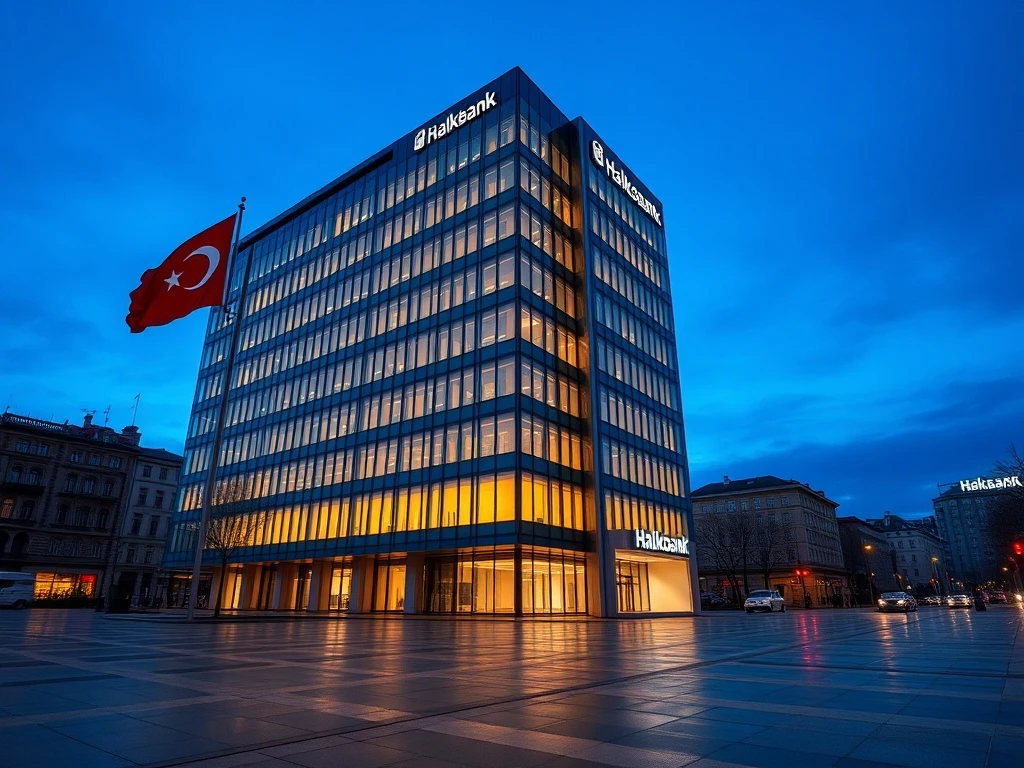
ISTANBUL, March 15, 2026 — Shares of Türkiye Halk Bankası AŞ, commonly known as Halkbank, surged dramatically in Monday trading following confirmation of a landmark settlement with United States authorities that spares the Turkish state-owned lender from potentially crippling financial sanctions. The Halkbank shares rally began in pre-market trading on Borsa Istanbul and accelerated throughout the morning session, ultimately closing 28.3% higher at ₺48.75 — the bank’s largest single-day gain since 2012. This development follows months of tense negotiations between Ankara and Washington, resolving a decade-long legal battle that threatened to destabilize Turkey’s banking sector and further strain diplomatic relations between the NATO allies.
Halkbank Settlement Details and Immediate Market Impact
The U.S. Department of Justice announced the deferred prosecution agreement early Monday, confirming that Halkbank will pay a $2.1 billion penalty while avoiding criminal charges for alleged violations of Iran sanctions between 2012 and 2016. Crucially, the settlement includes no restrictions on the bank’s U.S. dollar clearing capabilities — a primary concern for Turkish financial stability. Banking analyst Mehmet Yılmaz of Istanbul-based AK Investment described the outcome as “the best possible scenario under the circumstances” during a client briefing. “The market had priced in far worse outcomes, including potential loss of correspondent banking relationships,” Yılmaz noted. “Preserving dollar access was non-negotiable for Turkey’s financial system.” Trading volume reached 450 million shares, nearly ten times the 30-day average, indicating massive institutional repositioning.
Background context reveals this settlement concludes litigation dating to 2019, when U.S. prosecutors charged Halkbank with conspiracy to evade Iran sanctions. The case created persistent uncertainty, with the bank setting aside ₺15.2 billion in provisions since 2020. Monday’s agreement includes a three-year monitoring period by an independent compliance consultant, but removes the Sword of Damocles that had hung over Turkey’s fourth-largest bank by assets. Banking Regulation and Supervision Agency (BDDK) data shows Halkbank holds approximately 8.3% of Turkey’s total banking sector assets, with particular strength in small business and agricultural lending across Anatolia.
Broader Financial and Diplomatic Consequences
The resolution carries implications far beyond Halkbank’s balance sheet, potentially easing pressure on Turkey’s sovereign credit ratings and reducing risk premiums across Turkish assets. Immediately following the announcement, the yield on Turkey’s 10-year lira bonds fell 85 basis points, while the BIST 100 index gained 4.2% — its best performance in eleven months. International investors had grown increasingly concerned about potential contagion effects, particularly after Moody’s warned in November 2025 that sanctions against Halkbank could “trigger review of Turkey’s entire banking sector’s external vulnerability assessment.”
- Foreign Exchange Stability: Turkey’s central bank interventions to support the lira may decrease by an estimated $300-400 million monthly, according to Capital Economics estimates
- Corporate Borrowing Costs: Average interest rates for Turkish corporate dollar bonds could decline 150-200 basis points over the next quarter
- Diplomatic Channel Reopening: The settlement creates space for progress on other bilateral issues, including F-16 fighter jet sales and Syria policy coordination
Expert Analysis and Institutional Responses
Dr. Selin Sayek Böke, former deputy governor of Turkey’s central bank and current finance professor at Bilkent University, emphasized the systemic importance during an interview with Bloomberg TV. “This removes a major uncertainty premium that has burdened Turkish assets since 2019,” Böke stated. “While the financial penalty is substantial, the alternative — being cut off from dollar clearing — would have necessitated emergency measures affecting every Turkish company and household with international transactions.” The Association of Turkish Banks issued a brief statement welcoming the “constructive resolution” and emphasizing members’ commitment to international compliance standards. Meanwhile, U.S. Deputy Attorney General Lisa Monaco characterized the settlement as “holding a financial institution accountable while avoiding unnecessary collateral damage to innocent parties and the broader financial system.”
Historical Context and Comparative Banking Settlements
This settlement follows a pattern of major international banks resolving U.S. sanctions cases through deferred prosecution agreements rather than criminal convictions that could trigger automatic regulatory consequences. The $2.1 billion penalty represents approximately 18% of Halkbank’s market capitalization before Monday’s surge, comparable proportionally to BNP Paribas’s 2014 settlement (which totaled $8.9 billion, about 15% of its then-market value). However, the geopolitical dimensions distinguish this case, occurring amid complex Turkey-U.S. relations where security cooperation coexists with periodic sanctions tensions.
| Bank | Settlement Year | Violation | Penalty Amount | Percentage of Market Cap |
|---|---|---|---|---|
| Halkbank | 2026 | Iran Sanctions Evasion | $2.1 billion | ~18% |
| BNP Paribas | 2014 | Sudan/Iran Sanctions | $8.9 billion | ~15% |
| Standard Chartered | 2019 | Iran Sanctions | $1.1 billion | ~4% |
| UniCredit | 2019 | Iran/Cuba Sanctions | $1.3 billion | ~6% |
Forward-Looking Implications and Monitoring Framework
The three-year independent monitor appointment represents a standard feature of such settlements, with former New York Federal Reserve compliance official David Cohen reportedly under consideration for the role. Halkbank must implement enhanced due diligence protocols for correspondent banking relationships and transaction screening systems, with progress reports submitted quarterly to the U.S. District Court for the Southern District of New York. Turkish banking analysts anticipate the bank may need to raise additional capital later this year despite the share price recovery, with estimates ranging from ₺5-8 billion in fresh equity potentially required to maintain capital adequacy ratios while absorbing the penalty.
Market Reactions and Investor Sentiment Shift
International fund managers who had reduced Turkish exposure since 2020 indicated renewed interest, though most await confirmation of smooth implementation. “We’re seeing the first genuine risk-on sentiment toward Turkish banks in nearly four years,” commented Elena Lytova, emerging markets portfolio manager at Amundi in London. “The key test will be whether this settlement genuinely improves Turkey’s standing in cross-border compliance assessments rather than merely avoiding the worst-case scenario.” Domestic retail investors participated heavily in Monday’s rally, with individual trading accounts executing 38% of volume according to Borsa Istanbul data — well above the 22% average for bank stocks.
Conclusion
The dramatic Halkbank shares rally reflects more than relief over avoiding catastrophic sanctions; it signals potential normalization in Turkey’s international financial relationships after years of tension. While the $2.1 billion penalty imposes real costs, preserving dollar clearing access was essential for financial stability. Looking forward, investors should monitor the independent monitor’s initial assessment due in September 2026, along with Turkey’s broader progress in addressing remaining Financial Action Task Force (FATF) concerns. This settlement likely marks an inflection point where Turkey’s banking sector can redirect energy from legal defense toward supporting economic growth, provided compliance improvements prove durable and bilateral diplomacy maintains constructive momentum.
Frequently Asked Questions
Q1: What exactly did Halkbank admit to in the settlement?
The deferred prosecution agreement states Halkbank participated in a scheme to evade U.S. sanctions on Iran between 2012-2016 by facilitating oil revenue transfers through false documents and front companies. The bank accepts the statement of facts while avoiding formal criminal conviction.
Q2: How will Halkbank pay the $2.1 billion penalty?
The bank has approximately $1.4 billion in provisions already set aside and will likely fund the remainder through a combination of operational earnings over 2-3 years and potentially a capital increase. The settlement allows installment payments subject to court approval.
Q3: Does this settlement affect ordinary Turkish citizens’ banking access?
No direct impact on retail banking services is expected. The crucial element was preserving Halkbank’s ability to process U.S. dollar transactions, which maintains normal international banking operations for Turkish businesses and individuals.
Q4: Could this case reopen or lead to new charges?
The deferred prosecution agreement includes a three-year term after which charges will be dismissed if Halkbank complies fully. New charges would require evidence of violations occurring after the settlement date or material breach of agreement terms.
Q5: How does this affect Turkey’s broader economic outlook?
Removing this uncertainty premium could improve Turkey’s sovereign credit profile, potentially lowering borrowing costs for the government and corporations. It also reduces pressure on central bank reserves previously used to stabilize the lira amid sanctions fears.
Q6: What should investors watch next regarding Halkbank?
Key indicators include the independent monitor’s first report, any capital increase plans, quarterly earnings impact from the penalty, and whether correspondent banks maintain relationships without imposing additional restrictions.



