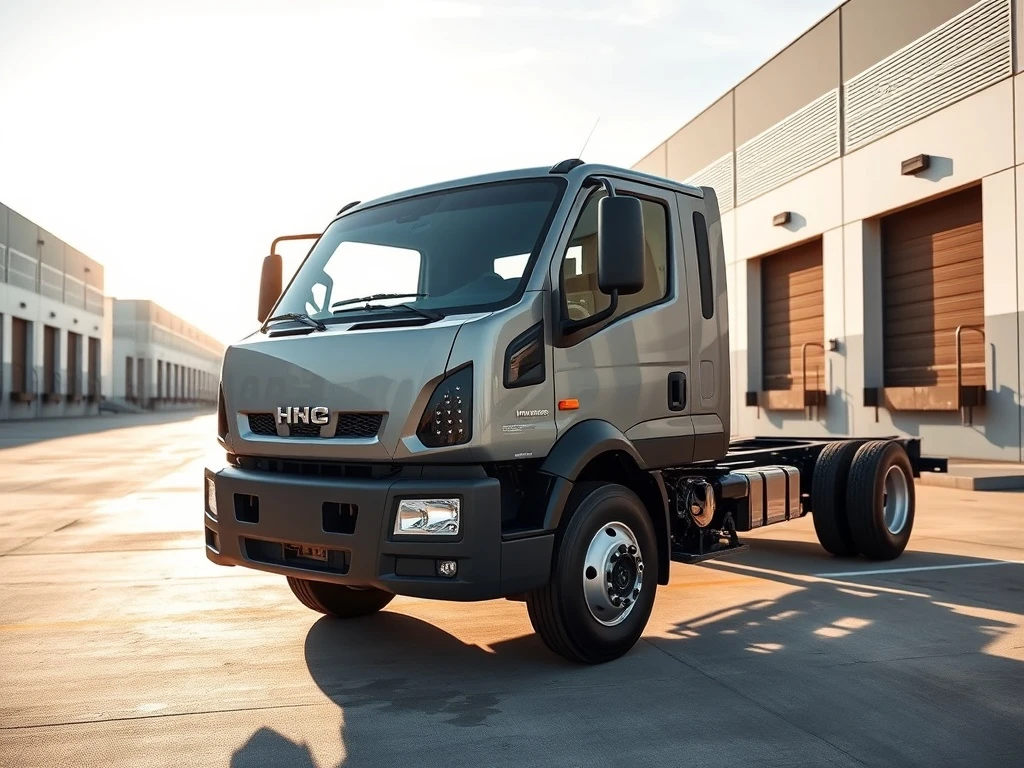
LOS ANGELES, June 9, 2026 — Electric vehicle startup Harbinger has unveiled its second vehicle, targeting the heart of the commercial trucking market with a new, smaller medium-duty work platform. The company revealed the HC Series Cab, a versatile truck chassis available in both all-electric and range-extended hybrid configurations. This strategic move, announced from the company’s Los Angeles headquarters, directly addresses fleet operators’ long-standing demands for payload capacity, maneuverability, and operational range without compromise. The launch signals Harbinger’s aggressive expansion beyond its initial larger chassis products and into a broader segment of the commercial transportation sector.
Harbinger HC Series Cab: Engineered for Real Fleet Work
The newly revealed HC Series Cab is engineered as a medium-duty workhorse. Harbinger designed the platform to offer fleet managers a clear alternative to legacy diesel trucks. Consequently, the vehicle features a tight turning radius for urban maneuverability and easy entry-and-exit cab design for driver comfort during multiple daily stops. Furthermore, the chassis is built for straightforward upfitting, allowing customers to configure it with various bodies like cargo boxes, service bodies, or flatbeds. The company has not released official pricing but emphasizes the vehicle’s total cost of ownership advantages.
John Harris, Harbinger’s co-founder and CEO, stated the truck solves a persistent industry problem. “For too long, fleets have had to compromise between payload, maneuverability, range and onboard capability,” Harris said in the official announcement. “We engineered this platform to outperform legacy diesel options while unlocking new advantages through electrification.” The hybrid variant, a key selling point, boasts an impressive range of up to 500 miles, addressing a primary concern for fleets operating beyond urban centers or without dense charging infrastructure.
Strategic Expansion in a Turbulent EV Market
Harbinger’s reveal comes amid significant headwinds for the consumer electric vehicle market, including slowed demand and pricing pressures. However, the company is betting heavily on the commercial and industrial segment, where the economic case for electrification often proves stronger. Harris has consistently argued that lower total cost of ownership and reduced maintenance make EVs and hybrids compelling for commercial trucking. This launch follows a period of rapid growth and diversification for the two-year-old startup.
- Financial Momentum: The company secured a $100 million Series B round in January 2025, followed by a substantial $160 million Series C in November of the same year.
- Customer Traction: Harbinger has already attracted major clients like FedEx and RV manufacturer THOR Industries for its larger truck chassis platform.
- Revenue Growth: While not disclosing specific 2025 revenue figures, Harris told TechCrunch last month that the company’s sales were a “multiple” of the entire electric truck market’s volume in 2024.
Building a Vertically Integrated Powerhouse
Beyond vehicle manufacturing, Harbinger’s strategy involves creating a vertically integrated company with multiple revenue streams. This approach, Harris explained, is a deliberate buffer against market volatility. “The more we diversify revenue sources, the better kind of long-term, stable company we build,” he told TechCrunch in February. The company has moved swiftly to execute this plan. In January, it began selling energy storage systems, with Airstream named as its first customer. Then, in February, Harbinger made its first acquisition, purchasing autonomous vehicle software firm Phantom AI.
Harris frames these moves as leveraging internal capabilities developed for its vehicles. “We built these verticals of what I think of as our own in-house suppliers,” he said. “We have a battery supplier, which we now sell from. We have a motor supplier, which we’ll now sell from. We have a suspension supplier. We have an axle supplier. All these things are Harbinger suppliers.” This vertical integration provides numerous pathways for launching new business lines beyond complete vehicles.
Navigating the Startup Landscape with Focused Execution
The path for EV startups has been notoriously difficult, littered with high-profile failures over the past several years. Harris attributes Harbinger’s current position to a disciplined, focused approach. He previously emphasized to TechCrunch the importance of having “very high confidence in what we say we’re going to do before we say we’re going to do it.” This philosophy appears central to the company’s measured yet rapid rollout of products and services, contrasting with the over-promising common in the sector.
The company’s focus on the commercial market also differentiates it from many consumer-focused EV startups. Commercial fleets typically make purchasing decisions based on rigorous cost-benefit analyses over multi-year horizons, a dynamic that can favor technologies with lower operating costs, even at a higher upfront price. This market reality underpins Harbinger’s product development and sales strategy.
| Feature | HC Series Cab (Electric) | HC Series Cab (Hybrid) | Typical Legacy Diesel Competitor |
|---|---|---|---|
| Powertrain | All-electric battery | Range-extended electric hybrid | Diesel internal combustion |
| Estimated Range | Not yet disclosed | Up to 500 miles | Varies, often 400-600 miles |
| Key Advantage | Zero tailpipe emissions, low operating cost | Long range, emission-free urban operation | Ubiquitous fueling, proven technology |
| Target Use Case | Urban delivery, fixed-route operations | Regional haul, mixed-duty cycles | Broad applicability |
What’s Next for Harbinger and the Commercial EV Segment
The immediate next step for Harbinger is likely securing pre-orders and finalizing production timelines for the HC Series Cab. The company will need to demonstrate it can scale manufacturing reliably to meet potential fleet demand. Additionally, integrating Phantom AI’s autonomous software could lead to future announcements regarding driver-assistance or self-driving capabilities for its platforms, a major area of interest for logistics companies. The expansion into energy storage also opens potential synergies, such as vehicle-to-grid services or managed charging for fleet depots.
Industry Reactions and Competitive Landscape
The commercial medium-duty truck segment is becoming increasingly competitive. Established players like Ford, with its E-Transit, and Daimler Truck North America (Freightliner), alongside startups like Harbinger and others, are all vying for early market share. Fleet managers, while interested in the potential savings of electrification, remain cautious, prioritizing vehicle reliability, uptime, and total cost. Harbinger’s hybrid option may be a critical differentiator, offering a stepping stone for fleets not yet ready to commit to fully electric operations. The company’s ability to attract blue-chip customers like FedEx early on provides a significant credibility boost as it enters this new vehicle category.
Conclusion
Harbinger’s reveal of the HC Series Cab marks a pivotal expansion for the Los Angeles-based startup, strategically positioning it in the high-volume medium-duty work truck market. By offering both electric and long-range hybrid variants, the company provides flexible solutions for fleets at different stages of the energy transition. Backed by substantial funding, a growing list of anchor customers, and a deliberate vertical integration strategy, Harbinger is executing a plan to build a durable business beyond just vehicle assembly. While challenges around scaling production and navigating a complex competitive field remain, the company’s focused, stepwise approach and commercial-market specificity offer a distinct pathway in the evolving landscape of electric transportation. The success of the HC Series will be a key indicator of whether specialized EV startups can carve out a lasting and profitable niche alongside industry giants.
Frequently Asked Questions
Q1: What is the Harbinger HC Series Cab?
The HC Series Cab is a new medium-duty work truck chassis from EV startup Harbinger. It is available in both all-electric and range-extended hybrid configurations, designed for commercial fleets with a focus on maneuverability, upfit flexibility, and low operating costs.
Q2: What is the range of the Harbinger hybrid truck?
The range-extended hybrid variant of the HC Series Cab offers up to 500 miles of total range. This combines a battery-electric driving mode with an onboard generator, making it suitable for longer regional routes where charging infrastructure may be limited.
Q3: When will the Harbinger HC Series be available for purchase?
Harbinger has revealed the vehicle but has not announced specific pricing or delivery timelines. The company typically follows a pattern of announcing key customers and pre-orders before detailing full production and delivery schedules.
Q4: How does Harbinger’s strategy differ from other EV startups?
Harbinger focuses exclusively on the commercial vehicle market, emphasizes vertical integration to control costs and create new revenue streams, and is pursuing a hybrid-electric strategy alongside pure battery-electric vehicles to address range concerns.
Q5: Who are Harbinger’s main customers?
The company’s announced customers include major logistics provider FedEx and RV manufacturer THOR Industries for its larger chassis. The new HC Series Cab is aimed at a broader base of medium-duty fleet operators, including last-mile delivery, utilities, and trades.
Q6: What other businesses does Harbinger operate?
Beyond trucks, Harbinger sells energy storage systems and, following its acquisition of Phantom AI, is developing autonomous vehicle software. The company views these as complementary business lines leveraging its in-house technology.