
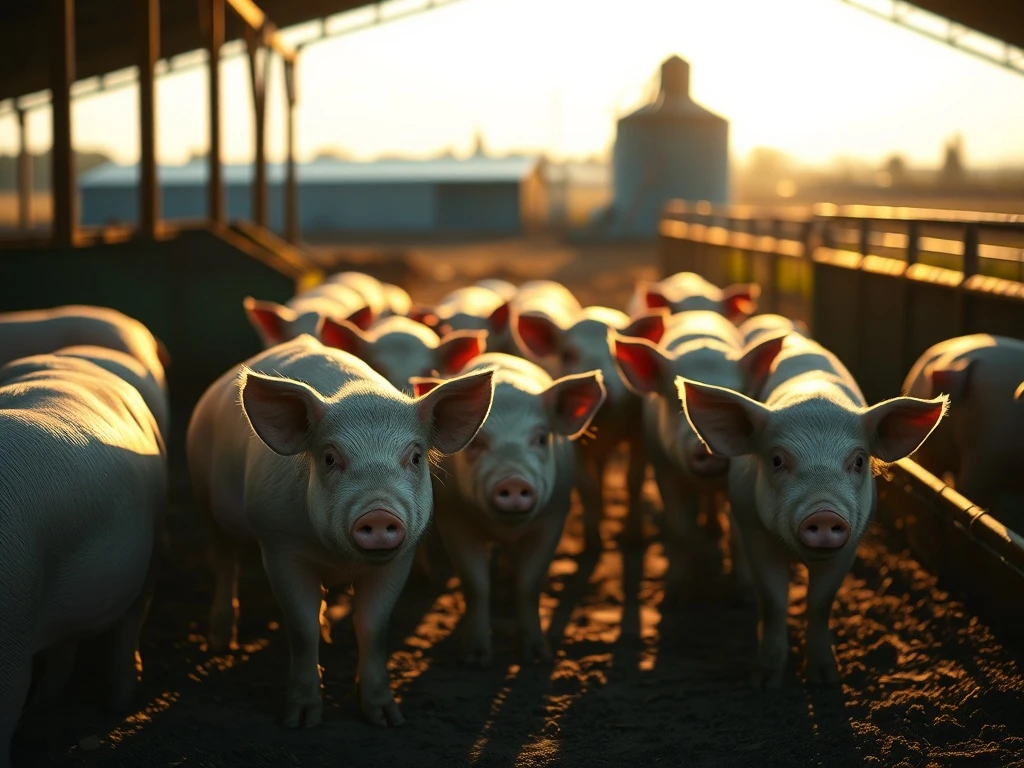
CHICAGO, March 8, 2026 — Lean hog futures demonstrated notable resilience in Friday’s trading session, closing with mixed but predominantly positive movement. The session, which concluded at 07:25 pm EDT, saw deferred contracts post gains of 20 to 67 cents, providing a counterbalance to a slight decline in the front-month April contract. This activity unfolded against a backdrop of firming cash prices and increased speculative interest, as detailed in the latest Commitment of Traders report. The national base hog price, reported by the USDA, climbed $1.95 to $91.69, signaling underlying strength in the physical market as traders digested weekly slaughter estimates and cutout values.
Analyzing the Friday Hog Futures Session
The Chicago Mercantile Exchange (CME) witnessed a classic example of deferred contract strength on March 8. While the April 2026 contract settled at $95.625, down a modest nickel, the May contract gained 32.5 cents to close at $100.850. The June contract led the rally, adding 67.5 cents to finish at $110.575. This price structure, where later-dated contracts trade at a premium, often indicates trader expectations for tighter supplies or stronger demand in future months. According to data from Barchart, the CME Lean Hog Index itself rose 37 cents to $90.55 for March 4, providing a firmer foundation for futures. The most compelling data point came from the Commodity Futures Trading Commission (CFTC). Managed money traders, a category including hedge funds and commodity trading advisors, increased their net-long position in lean hog futures and options by 7,053 contracts in the week ending Tuesday. This bullish bet now stands at 124,036 contracts, reflecting significant professional confidence in the market’s direction.
This positioning shift did not occur in a vacuum. It follows a period of price pressure earlier in the week, with the April contract ultimately down a dime from the previous Friday’s close. The Friday rebound, therefore, suggests traders are reassessing the balance between supply signals and demand potential as they look toward the spring and summer months. The market’s ability to absorb the weekly slaughter data and still push prices higher in key contracts points to a complex interplay of factors beyond immediate supply.
USDA Data Reveals a Complex Supply and Demand Picture
The U.S. Department of Agriculture’s afternoon reports provided the fundamental backbone for Friday’s trading. The weekly federally inspected hog slaughter was estimated at 2.497 million head. This figure represents a decrease of 19,000 head from the prior week but remains substantially higher—by 95,953 head—than the same week in 2025. This year-over-year increase confirms the ongoing expansion in hog production, a trend that typically exerts downward pressure on prices. However, the market’s positive response indicates traders may be looking past absolute supply numbers toward other metrics. The pork carcass cutout value, a measure of wholesale pork prices, dipped 95 cents to $98.27 per hundredweight in the Friday PM report. This decline was not uniform across all cuts. The report showed strength in primal cuts like the belly, rib, and picnic, while the loin, butt, and ham primals were reported lower. This mixed cutout performance highlights the nuanced nature of meat demand, where specific products like bacon (from bellies) can show strength even as the broader composite value softens slightly.
- Slaughter Pace: Weekly slaughter down slightly from last week but significantly above last year’s level, indicating ample supply.
- Cash Market Strength: The national base price increase of $1.95 suggests packers are competing for available hogs, supporting cash values.
- Cutout Divergence: Strong belly and rib prices support packer margins for certain products, offsetting weakness in other primals.
Expert Insight on Hog Market Dynamics
Dr. Lee Schulz, an Extension Livestock Economist at Iowa State University, often notes that hog market dynamics require analyzing multiple data streams simultaneously. “The market is constantly triangulating between slaughter numbers, cutout values, and cold storage levels,” Schulz has explained in previous publications for the university’s Center for Agricultural and Rural Development. “A rising cash price in the face of large slaughter numbers can signal stronger-than-expected immediate demand or tighter market-ready supplies than the headline number suggests.” This expert perspective underscores why traders may have focused on the climbing base price and bullish speculator positioning rather than the high year-over-year slaughter figure. Furthermore, the USDA’s World Agricultural Supply and Demand Estimates (WASDE) report, a globally recognized authority on agricultural commodity forecasts, continues to monitor export demand as a critical variable for U.S. pork prices, adding another layer to the analysis.
Broader Context: Hog Futures in the 2026 Commodity Landscape
The activity in lean hog futures occurs within a wider commodity market that has seen volatility across the board in early 2026. While equity markets, reflected in tickers like AAPL and TSLA repeated in the source data, often dominate financial news, agricultural commodities like hogs, cattle, and grains represent a critical sector of the real economy. The performance of hog futures can serve as a barometer for consumer protein demand, input cost pressures for feed (primarily corn and soybeans), and global trade flows. Compared to the live cattle market, which has faced recent challenges as noted in related Barchart headlines, the hog complex has shown relative technical strength. This divergence can be attributed to different supply cycles, export market fortunes, and domestic consumption patterns for beef versus pork.
| Contract | Friday Close (3/8/26) | Daily Change |
|---|---|---|
| Apr 26 Hogs | $95.625 | -$0.050 |
| May 26 Hogs | $100.850 | +$0.325 |
| Jun 26 Hogs | $110.575 | +$0.675 |
What to Watch Next in the Hog Markets
Market participants will immediately turn their attention to next week’s USDA slaughter reports and daily cash price updates to see if Friday’s strength is sustained. The upcoming quarterly Hogs and Pigs Report, scheduled for release later this month, will be the next major fundamental catalyst. This report provides the official estimate of the U.S. hog inventory, including breakdowns for breeding and market hogs, which will shape expectations for supplies through the remainder of 2026. Traders will also monitor export sales data closely. Sustained demand from key trading partners is essential to absorb the elevated production levels suggested by the year-over-year slaughter increases. Any significant shift in export volumes or the emergence of new trade barriers could quickly alter the price trajectory.
Industry and Analyst Reactions
Initial reactions from the trading floor, as relayed by market reporters, suggested a sense of cautious optimism following the Friday close. The ability of the market to rally deferred contracts in the face of large slaughter numbers was seen as a technically positive sign. Independent market analysts, whose commentary often circulates in commodity newsletters, pointed to the expanding managed money net-long as a key supportive factor. However, producers remain mindful of feed cost volatility and the potential for demand elasticity if retail pork prices rise too sharply. The consensus view is one of a balanced but finely tuned market, where weekly data points will drive short-term volatility within a longer-term trend still being established.
Conclusion
Friday’s session in the lean hog futures market revealed underlying strength despite superficially bearish supply data. The gains in the May and June contracts, coupled with a firming cash market and increased bullish speculation, indicate traders are focusing on demand resilience and forward fundamentals. The key takeaways are the $1.95 jump in the national base price, the sizable expansion of the managed money net-long position, and the mixed but not weak cutout value. While weekly slaughter remains high, the market’s price action suggests it may have already accounted for this supply. Moving forward, participants should watch for confirmation in next week’s cash trade and prepare for the pivotal Hogs and Pigs Report, which will provide the next major piece of the supply puzzle for the remainder of 2026.
Frequently Asked Questions
Q1: What caused lean hog futures to rise on Friday, March 8, 2026?
The rise was driven by strength in deferred contracts (May and June), a $1.95 increase in the USDA’s national base hog price, and data showing managed money traders significantly increased their net-long bullish bets by over 7,000 contracts.
Q2: How does the current hog slaughter level affect prices?
Estimated weekly slaughter of 2.497 million head is 95,953 head higher than the same week last year, which typically pressures prices. However, the concurrent rise in cash prices suggests strong immediate demand or tighter immediately available supplies are offsetting that larger supply figure.
Q3: What is the next major report that will impact hog futures?
The next major catalyst is the USDA’s quarterly Hogs and Pigs Report, scheduled for later this month. This report provides official inventory estimates that shape supply expectations for the coming months.
Q4: What does a “net-long” position by managed money mean?
It means large speculators like hedge funds hold more long (betting on higher prices) futures and options contracts than short (betting on lower prices) contracts. An increase in this net-long position is generally interpreted as a bullish sentiment indicator.
Q5: How does the pork cutout value relate to hog futures prices?
The cutout value is the estimated wholesale value of a hog carcass. It influences packer profitability and their willingness to pay for live hogs. A stable or rising cutout supports cash hog prices, which in turn supports futures prices.
Q6: How might this market activity affect consumers at the grocery store?
Strength in wholesale pork markets and futures can eventually translate to firmer retail prices for pork products like chops, ham, and bacon, though the timing and magnitude depend on competition, promotions, and retailer margins.



