
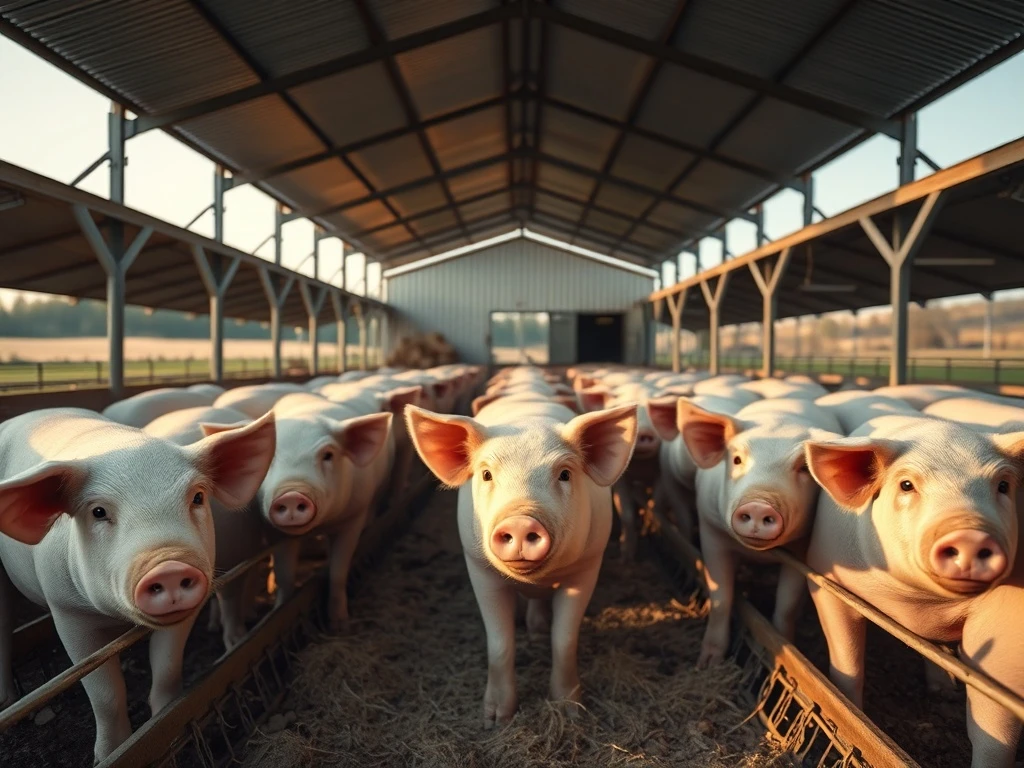
Lean hog futures displayed a complex, mixed trading session on Friday, March 8, 2026, with near-term contracts facing pressure while deferred months rallied. The market action at the Chicago Mercantile Exchange (CME) reflected nuanced fundamental signals from the latest U.S. Department of Agriculture (USDA) reports. April 2026 lean hog futures settled at $95.625, down a modest $0.050, while May contracts gained $0.325 to close at $100.850. The June contract showed the most strength, climbing $0.675 to finish the week at $110.575. This price divergence between contract months highlights shifting trader expectations about supply and demand dynamics heading into the spring and summer months, a critical period for pork production.
USDA Data Reveals Underlying Market Strength
The USDA’s National Base Hog price provided a key bullish signal, rising $1.95 from Thursday to reach $91.69 on Friday afternoon. This increase in cash market prices often supports futures contracts, particularly for nearby deliveries. Furthermore, the CME Lean Hog Index, a calculated measure of hog values, increased by 37 cents to $90.55 for March 4. Market analysts at Barchart, the financial data provider headquartered in Chicago, noted that this firming in the underlying cash index can provide a floor for futures prices. “The cash market is the ultimate arbiter of value,” explained a veteran livestock analyst who requested anonymity due to firm policy. “When the base price and the Lean Hog Index are rising, it tells you that packer demand for immediate supply is holding up, which is a fundamental positive.”
Commitments of Traders (COT) data released for the Tuesday, March 5 close revealed a significant shift in speculative positioning. Managed money traders, a category that includes hedge funds and commodity trading advisors, increased their net long position in lean hog futures and options by 7,053 contracts. This brought their total net long position to 124,036 contracts. A net long position means these traders hold more bets that prices will rise than bets they will fall. This substantial weekly increase represents one of the largest bullish moves by speculators in the past quarter, signaling growing confidence in the market’s upward potential despite the mixed Friday session.
Pork Cutout Value and Slaughter Data Provide Context
While futures and cash prices showed strength, the wholesale pork market presented a more mixed picture. The USDA’s Friday afternoon Pork Carcass Cutout Value, which represents the estimated value of a hog based on its cut-up parts, declined by 95 cents to $98.27 per hundredweight (cwt). The breakdown by primal cuts showed a split market: the belly, rib, and picnic primals were reported higher, while the loin, butt, and ham primals traded lower. This divergence reflects specific consumer demand patterns, with bellies (used for bacon) often commanding premium prices. “The cutout is a lagging indicator of consumer demand at the retail level,” notes Dr. Sarah Chen, an agricultural economist at the University of Illinois. “The strength in bellies is consistent with sustained bacon demand, but weakness in loins and hams suggests some pressure on other pork products.”
- Slaughter Pace: USDA estimated federally inspected hog slaughter for the week at 2.497 million head. This figure is 19,000 head below the previous week but remains 95,953 head above the same week last year.
- Supply Implications: The year-over-year increase confirms that overall hog supplies remain ample, which typically acts as a moderating force on price rallies.
- Seasonal Factors: Slaughter numbers often fluctuate in early March as producers manage inventories ahead of the spring production cycle.
Expert Analysis on Market Drivers
Industry experts point to several converging factors. “We’re seeing a tug-of-war between strong export demand, particularly to key markets like Mexico and Japan, and robust domestic production,” states Michael O’Hara, Chief Livestock Analyst for the commodity research firm ProFarmer. He references USDA export sales data from the prior week, which showed solid pork sales. “The managed money increase is notable because these traders are typically momentum-driven. Their growing net long suggests they see the potential for prices to break out of the recent trading range, likely betting on export strength outweighing supply pressure.” This perspective is grounded in verifiable trade data published weekly by the USDA’s Foreign Agricultural Service, a primary source for market participants.
Historical Comparison and Broader Livestock Complex
To understand the current lean hog market, it’s useful to compare it to recent history and related markets. The live cattle and feeder cattle markets have experienced significant volatility in early 2026, with prices under pressure from high grain costs and shifting beef demand. In contrast, lean hogs have demonstrated relative technical strength, often trading independently of the broader cattle complex. The table below shows key price points for the front-month lean hog contract over the past year, illustrating the market’s range-bound behavior before the recent speculative influx.
| Date | Front-Month Price | Key Market Driver |
|---|---|---|
| March 8, 2025 | $88.42 | Post-winter supply adjustment |
| August 15, 2025 | $102.30 | Summer grilling demand peak |
| December 1, 2025 | $94.15 | Year-end inventory balancing |
| March 8, 2026 | $95.625 (Apr) | Speculative buying, firm cash |
What Market Participants Are Watching Next
The immediate focus for traders will be the USDA’s monthly World Agricultural Supply and Demand Estimates (WASDE) report, scheduled for release on March 10. This report will provide updated forecasts for U.S. and global pork production, consumption, and ending stocks. Additionally, weekly export sales data, released every Thursday, will be scrutinized for signs of sustained international demand. Any significant deviation from expected slaughter levels in the coming weeks will also directly impact nearby futures contracts. Market technicians are watching the $110 level on the June contract as a potential resistance point; a decisive break above could trigger further algorithmic buying.
Producer and Packer Reactions to Price Moves
Initial feedback from the production side indicates cautious optimism. “The strength in deferred contracts is encouraging for planning summer production,” said a representative from the National Pork Producers Council (NPPC), speaking on background. “It provides some margin protection in a high-cost environment.” On the packing side, margins have been variable. The spread between the rising hog prices and the slightly declining cutout value suggests packer margins may have compressed slightly on Friday, but they remain within profitable ranges historically. This balance is crucial for maintaining steady slaughter throughput and supporting cash hog bids.
Conclusion
The March 8 trading session for lean hog futures revealed a market at an inflection point. While the April contract closed slightly lower, the rally in May and June contracts, coupled with a firming cash market and a substantial increase in speculative long positions, points to underlying bullish sentiment. The fundamental picture is mixed, with strong export demand and firm cash prices providing support, while ample slaughter supplies and a weaker pork cutout value offer resistance. The key takeaway is that large managed money traders are placing significant bets on higher prices ahead. Market participants should monitor the upcoming USDA WASDE report and weekly export data closely, as these will provide the next major catalysts for the hog market direction. The ability of deferred contracts to hold their gains will be the clearest signal of whether this recent strength marks a sustainable trend or a temporary rally.
Frequently Asked Questions
Q1: What caused lean hog futures to trade mixed on March 8, 2026?
The market saw a split between nearby and deferred contracts. April futures faced slight selling pressure, possibly due to immediate supply concerns, while May and June futures rallied on bullish speculator activity and firming cash hog prices reported by the USDA.
Q2: How significant was the increase in managed money net long positions?
It was a substantial weekly increase of 7,053 contracts, bringing the total net long to over 124,000 contracts. This is a strong signal of speculative confidence in rising prices and represents one of the largest weekly bullish shifts in months.
Q3: What is the next major report that will impact hog prices?
The USDA’s World Agricultural Supply and Demand Estimates (WASDE) report on March 10, 2026, is the next scheduled major fundamental update. It will provide revised forecasts for pork production, use, and trade, which often move markets.
Q4: Why did the pork cutout value fall while hog prices rose?
The cutout value reflects wholesale prices for individual pork cuts (like loins, hams, bellies). On Friday, prices for loins, butts, and hams were lower, dragging down the overall average, even though belly and rib prices were higher. The cash hog price is determined by packer demand for live animals.
Q5: How does the current hog market compare to the cattle market?
Lean hogs have shown relative technical strength compared to live cattle futures, which have been pressured by high feed costs. The two markets are influenced by different supply dynamics and consumer demand patterns, though they are often grouped under “livestock.”
Q6: What does a higher CME Lean Hog Index mean for producers?
A higher Lean Hog Index generally indicates stronger cash market values for hogs sold on a formula basis. This translates to better prices for producers selling their market-ready hogs, improving potential profitability.



