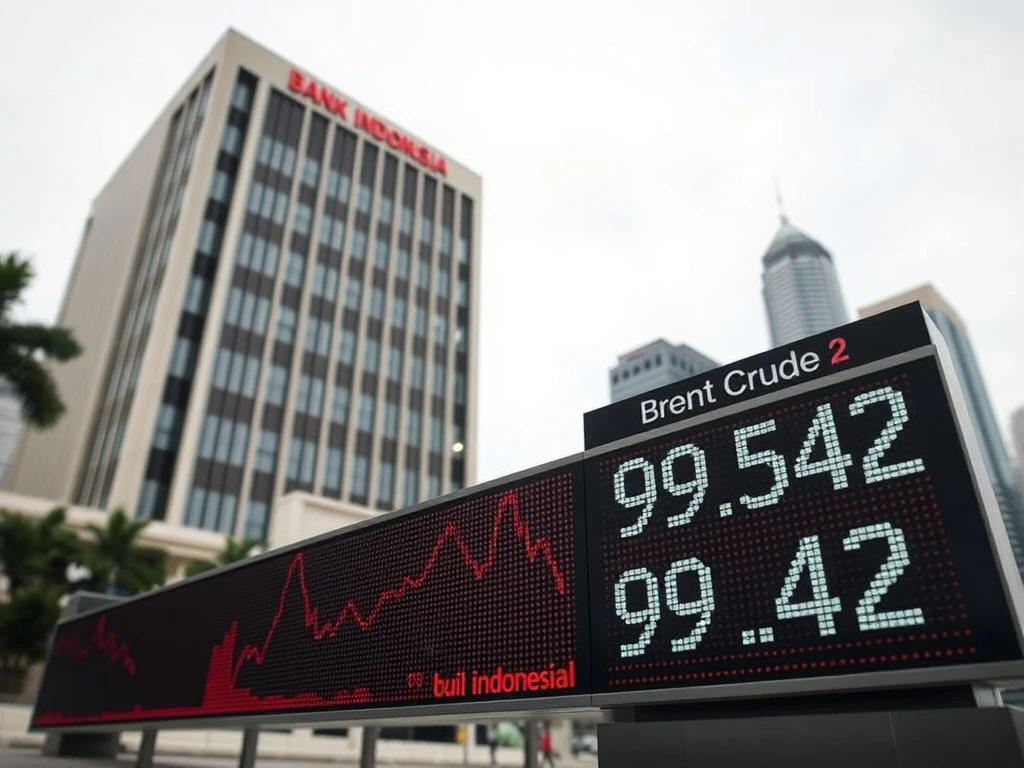
JAKARTA, March 15, 2026 — Global investment bank Standard Chartered issued a stark warning today, stating that persistently higher global oil prices pose a significant and immediate risk to Bank Indonesia’s (BI) anticipated monetary easing cycle. Analysts now see a high probability that the central bank will delay planned interest rate cuts, a move with profound implications for Southeast Asia’s largest economy. This analysis, based on the bank’s latest commodity and macroeconomic charts, injects fresh uncertainty into Indonesia’s 2026 economic outlook just as policymakers were signaling a shift towards supporting growth.
Standard Chartered’s Analysis: Oil Prices and the BI Policy Dilemma
Standard Chartered’s research team, led by Asia economist Edward Lee, pinpointed the $90-$100 per barrel range for Brent crude as a critical threshold. Consequently, current prices hovering near $96 create a direct inflationary pass-through risk for Indonesia, a major net oil importer. The bank’s models show every $10 sustained increase in oil prices adds approximately 0.3-0.4 percentage points to Indonesia’s headline inflation within two quarters. “The window for easing is narrowing,” Lee stated in a client note accessed by our desk. “BI’s primary mandate is price stability. They cannot ignore the second-round effects of elevated energy costs on core inflation.”
This warning arrives against a specific timeline. Bank Indonesia Governor Perry Warjiyo had previously indicated a potential shift in the second half of 2026, contingent on inflation remaining anchored within the 2.5%±1% target band. However, February’s inflation print of 3.1% already sits at the upper limit. Standard Chartered’s charts project that without a material oil price correction, headline inflation could breach 3.5% by Q3 2026, effectively tying the central bank’s hands.
Broader Economic Impacts of a Delayed Easing Cycle
A delayed BI easing cycle would ripple across multiple sectors of the Indonesian economy. Higher-for-longer interest rates strengthen the Rupiah, which helps contain import costs but simultaneously pressures export competitiveness. More critically, they increase borrowing costs for the government’s ambitious infrastructure agenda and for corporations seeking capital investment.
- Government Fiscal Space: The 2026 state budget assumes a gradual decline in financing costs. A delay in BI’s benchmark rate cuts would increase debt servicing costs, potentially forcing a reallocation of funds from development projects.
- Corporate Investment: Capital-intensive industries like manufacturing and mining, which are pivotal to Indonesia’s downstreaming strategy, would face higher project financing hurdles, risking a slowdown in job creation.
- Consumer Demand: Mortgage and auto loan rates would remain elevated, cooling domestic consumption—a key growth driver that accounts for over half of Indonesia’s GDP.
Expert Perspectives on the Policy Trade-Off
Economists are divided on the appropriate response. David Sumual, Chief Economist at Bank Central Asia, agrees with the caution. “BI has built tremendous credibility on inflation fighting. Sacrificing that to chase growth prematurely would be a mistake,” he told us. Conversely, Faisal Rachman, an economist with Bank Mandiri, emphasizes growth risks. “Global demand is softening. We need domestic stimulus to counter that. The focus should be on targeted fiscal measures to shield consumers from energy inflation, not on keeping monetary policy overly restrictive.” This debate references the delicate balance outlined in research from the Institute for Development of Economics and Finance (INDEF), which warns of stagflation risks if policy missteps occur.
Historical Context and Regional Comparisons
Indonesia’s current predicament echoes past episodes but within a new global framework. The 2022-2023 inflation surge prompted BI to hike rates aggressively by 225 basis points. The bank has held steady since, aiming to guide inflation down sustainably. The current risk is not a return to 2022’s highs, but a stubborn plateau that prevents pro-growth policies. Compared to regional peers, Indonesia’s situation is unique.
| Central Bank | Current Policy Stance | Key Vulnerability |
|---|---|---|
| Bank Indonesia (BI) | Hold, easing bias delayed | Net oil importer, currency stability |
| Bangko Sentral ng Pilipinas (BSP) | Hold, cautious | Food price inflation, strong domestic demand |
| Bank of Thailand (BOT) | Modest easing cycle begun | Weak growth, low inflation pressure |
| Bank Negara Malaysia (BNM) | Hold, data-dependent | Subsidies cushion oil impact, ringgit volatility |
The Path Forward: Scenarios for BI’s Next Moves
Market watchers now see three plausible scenarios for Bank Indonesia’s next six months. The baseline scenario (40% probability) involves a prolonged hold until Q4 2026, awaiting clear signs of oil price moderation. A more hawkish scenario (35% probability) could see BI reiterating its readiness to hike if inflation expectations become unanchored. The dovish scenario (25% probability) rests on a swift resolution to geopolitical tensions and a sharp drop in oil prices, allowing for a Q3 2026 cut. Governor Warjiyo’s next public speech, scheduled for March 28, will be scrutinized for any shift in rhetoric.
Market and Stakeholder Reactions
Financial markets reacted swiftly to Standard Chartered’s analysis. The 5-year government bond yield rose 8 basis points, reflecting reduced expectations for near-term easing. The Rupiah strengthened slightly against the dollar. Meanwhile, the Indonesian Chamber of Commerce and Industry (KADIN) expressed concern. “While we understand the need for stability, the real economy needs a signal that borrowing costs will not remain at a multi-decade high indefinitely,” a KADIN spokesperson noted. This tension between financial stability and economic growth will define the policy debate in Jakarta in the coming weeks.
Conclusion
Standard Chartered’s warning underscores a fundamental truth for emerging markets like Indonesia: domestic monetary policy remains critically tethered to volatile global commodity markets. The anticipated BI easing cycle, a key pillar of 2026 growth projections, now faces a formidable obstacle in the form of elevated oil prices. Bank Indonesia’s decision will hinge on incoming data, particularly inflation prints and oil market dynamics. The central bank’s challenge is to navigate these crosscurrents without derailing Indonesia’s hard-won macroeconomic stability or its growth ambitions. Investors and policymakers alike should prepare for a period of extended caution, with the timing of the first rate cut becoming the most watched indicator in Indonesia’s financial landscape.
Frequently Asked Questions
Q1: What exactly did Standard Chartered say about Bank Indonesia’s policy?
Standard Chartered’s analysis, based on economic charts and models, warns that sustained high global oil prices create significant inflationary pressure for Indonesia. This pressure makes it highly likely that Bank Indonesia will delay any plans to cut its benchmark interest rate in 2026 to ensure inflation remains under control.
Q2: How do higher oil prices directly affect Indonesia’s inflation?
Indonesia is a net importer of oil. Higher global prices increase the cost of imported fuel and energy. This directly raises transportation and production costs, which are then passed on to consumers through higher prices for goods and services, a process known as inflationary pass-through.
Q3: If BI delays easing, what is the expected timeline for a rate cut now?
Most analysts, following this report, have pushed back their expectations. The consensus is shifting from a potential mid-2026 cut to late Q4 2026 or even early 2027, contingent on a meaningful decline in oil prices and a confirmation that core inflation is trending firmly toward the midpoint of BI’s 1.5%-3.5% target range.
Q4: How will this delay impact ordinary Indonesians?
Ordinary Indonesians will likely see continued high interest rates on loans for homes, vehicles, and small businesses. This can slow down big purchases and business expansions. However, the policy aims to prevent a broader surge in the cost of living, which would hurt consumers even more.
Q5: Are other central banks in Southeast Asia facing the same issue?
Yes, but to varying degrees. The Philippines is also cautious due to inflation concerns. In contrast, Thailand has begun cutting rates to fight weak growth, as it faces lower inflation pressure. Malaysia’s extensive fuel subsidies provide a larger buffer against global oil price swings.
Q6: What can the government do to help if BI cannot cut rates?
The government can use fiscal policy tools. This includes maintaining or optimizing energy subsidies to shield consumers, accelerating targeted social assistance programs, and using state spending to stimulate specific high-priority sectors of the economy, thereby supporting growth without compromising monetary stability.