
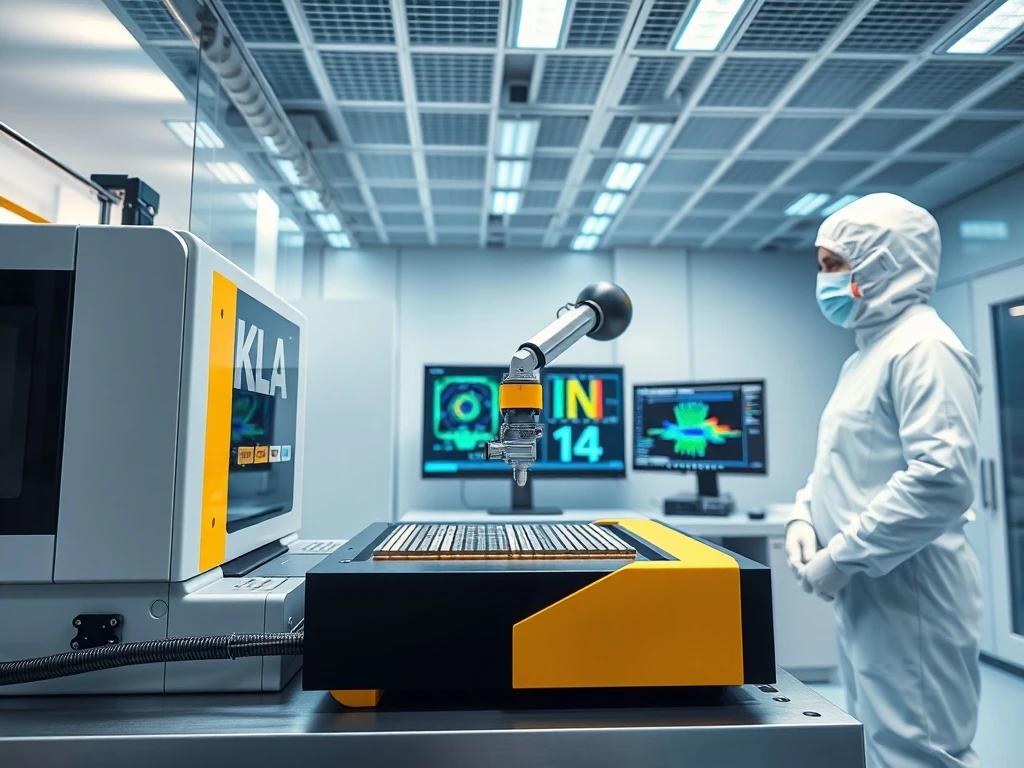
March 11, 2026 — SAN JOSE, Calif. — KLA Corporation (NASDAQ: KLAC) shares have delivered a striking 21.7% return over the trailing three-month period, dramatically outperforming broader technology indices. This surge comes despite the company facing significant operational headwinds, including supply chain constraints and rising component costs. As of midday trading on March 11, 2026, investors are grappling with a central question: does KLA’s dominant position in semiconductor process control and its exposure to explosive advanced packaging and artificial intelligence infrastructure markets justify further growth, or has the stock run too far, too fast? The answer lies in a complex interplay of market dynamics, technological shifts, and financial metrics that will define the semiconductor equipment sector through 2026.
KLA’s Market Outperformance Amid Sector Volatility
KLA’s recent performance presents a study in contrasts. According to data from Zacks Investment Research, while the Zacks Computer and Technology sector declined 2% over the same three-month window, and the Electronics-Miscellaneous Products industry group appreciated 9.3%, KLAC shares surged ahead. However, this headline growth masks relative weakness against direct competitors. MKS Instruments (MKSI), Lam Research (LRCX), and Entegris (ENTG) all posted stronger gains during this period. The primary drag on KLA’s relative performance stems from its third-quarter fiscal 2026 guidance, issued in late February, which disappointed some analysts. The company now expects revenues of approximately $3.35 billion (± $150 million), indicating a modestly weaker product mix sequentially. Rick Wallace, KLA’s President and CEO, attributed this to “rapidly escalating costs for DRAM chips used in our image processing computers,” a headwind that directly pressures gross margins. Furthermore, increasing product lead times due to persistent supply constraints and a negative tariff impact of roughly 100 basis points present near-term challenges.
The semiconductor capital equipment (WFE) market has entered a phase of selective growth following the historic expansion of the early 2020s. While overall WFE spending is forecast to grow in the high-single to low-double digits in 2026, reaching the low $120 billion range, the growth is uneven. Investment is concentrating on specific technologies, notably advanced packaging and process control—areas where KLA holds commanding market share. This bifurcation creates both opportunity and risk for equipment makers, as noted in a recent industry report from SEMI, the global industry association representing the electronics manufacturing and design supply chain.
The Advanced Packaging Engine: Fueling KLA’s Long-Term Trajectory
Beneath the quarterly guidance concerns lies a powerful, structural growth driver. KLA is a primary beneficiary of the industry’s pivot toward advanced packaging—technologies like 2.5D and 3D integration that allow multiple chips (chiplets) to be combined into a single package. This shift is fundamental to enabling next-generation computing, particularly for AI workloads. “Advanced packaging is no longer a niche; it’s a necessity for performance scaling,” stated Dr. G. Dan Hutcheson, Vice Chair of TechInsights, a leading semiconductor research firm. “Each new, complex package requires exponentially more inspection, metrology, and yield management. That plays directly to KLA’s core strengths.” The company expects its advanced packaging revenues to grow in the mid-to-high teens year-over-year in 2026. This segment, currently an $11 billion market, is growing faster than the core WFE market and represents a substantial new frontier for KLA’s process control solutions.
- Heterogeneous Integration Demand: The growth of custom silicon, especially among hyperscalers like Google, Amazon, and Microsoft designing their own AI chips, has led to a proliferation of unique device architectures. Each design requires rigorous process control to ensure yield and performance, directly boosting demand for KLA’s tools.
- Total Addressable Market Expansion: KLA forecasts the total market for core WFE and advanced packaging to reach the mid-$130 billion range in 2026, up from approximately $110 billion in 2025. The advanced packaging component alone is expected to grow to roughly $12 billion.
- Process Control Leadership: KLA’s systems help customers manage increasing design complexity and accelerate time-to-market by resolving integration challenges during fabrication ramp-up. This capability is becoming a critical bottleneck in bringing new chips to volume production.
Earnings Estimates and Valuation: A Premium Price for Premium Technology?
The Zacks Consensus Estimate provides a quantitative lens on KLA’s prospects. The estimate for Q3 fiscal 2026 earnings stands at $9.15 per share, having inched up 0.3% over the past 30 days and indicating 8.8% year-over-year growth. Revenue estimates for the quarter are $3.38 billion, suggesting 10.3% growth. For the full fiscal year 2026, the consensus calls for earnings of $36.63 per share on revenues of $13.41 billion, representing approximately 10% growth. However, these growth expectations come at a cost. KLA shares trade at a significant premium, evidenced by a Value Score of F from Zacks. The stock’s forward 12-month price-to-earnings (P/E) ratio of 33.47X exceeds the broader sector’s 24.59X and peers like MKS Instruments (22.45X) and Entegris (32.82X), though it trails Lam Research’s 34.59X. This premium valuation reflects the market’s belief in KLA’s sustainable competitive moat in process control.
Technical analysis reinforces the bullish sentiment. The stock is currently trading above both its 50-day and 200-day simple moving averages, a pattern technicians interpret as confirmation of a sustained upward trend. This technical strength, combined with fundamental drivers, has led Zacks to maintain a Rank #2 (Buy) rating on KLAC, suggesting accumulation is warranted. “In an environment where technological differentiation is paramount, KLA’s tools are essentially the quality control department for the entire semiconductor industry,” commented Kevin Cook, Senior Stock Strategist at Zacks. “That’s a recurring revenue model embedded in the fabric of innovation.”
Competitive Landscape and Strategic Positioning for 2026
KLA’s journey through 2026 will not occur in a vacuum. The competitive dynamics within the semiconductor equipment sector are intensifying. The table below compares key metrics for KLA and its closest peers, highlighting the context for its valuation and growth profile.
| Company (Ticker) | Forward P/E (12-Month) | YTD Stock Performance | Primary Growth Driver |
|---|---|---|---|
| KLA Corporation (KLAC) | 33.47X | +21.7% | Advanced Packaging & Process Control |
| Lam Research (LRCX) | 34.59X | +25.1% | Etherech & Deposition for Logic/DRAM |
| MKS Instruments (MKSI) | 22.45X | +26.8% | Power Solutions & Advanced Materials |
| Entegris (ENTG) | 32.82X | +24.3% | Advanced Materials Handling & Purification |
The data shows that while KLA’s absolute return is strong, it has slightly lagged its direct peers recently, partly due to its guidance. However, its growth driver—advanced packaging—is viewed by many analysts as having a longer runway than cyclical memory or legacy logic spending. The strategic bet is that the secular trend toward chiplet-based designs and 3D stacking will make process control increasingly valuable per wafer produced, potentially justifying its premium multiple over time.
Navigating Headwinds: Supply Chain and Geopolitical Risks
The path forward is not without obstacles. KLA management has explicitly flagged two near-term headwinds. First, supply chain constraints for certain components are extending lead times for its own systems, potentially delaying revenue recognition. Second, the evolving global trade and tariff landscape is creating cost pressures, estimated at a 100-basis-point drag on margins. These are industry-wide issues, but they hit high-margin, complex assembly businesses like KLA’s particularly hard. The company’s ability to manage these operational challenges through strategic inventory management, supplier diversification, and potential pricing actions will be a key focus for investors throughout 2026. Furthermore, the concentration of advanced semiconductor manufacturing in specific geographic regions adds a layer of geopolitical risk to the entire equipment sector’s outlook.
Investment Community Reaction and Analyst Sentiment
The investment community’s reaction to KLA’s guidance and prospects has been measured. Several analyst firms maintained their outperform or buy ratings following the guidance announcement but slightly trimmed price targets, reflecting the near-term margin pressure. The prevailing sentiment, as echoed in reports from firms like Morgan Stanley and Credit Suisse, is that the long-term story remains intact. The thesis centers on KLA’s “mission-critical” role in semiconductor manufacturing—its tools are essential for achieving yield on leading-edge nodes and advanced packages, making its products relatively resilient to cyclical downturns in specific chip segments. This defensive characteristic within a growth industry is a core part of the investment argument.
Conclusion
KLA Corporation’s 22% surge in three months is a testament to powerful secular trends overpowering near-term operational friction. The stock’s growth potential for the remainder of 2026 hinges on three critical factors: the continued explosive growth of the advanced packaging market, the sustained investment in AI infrastructure requiring leading-edge process control, and the company’s ability to navigate supply chain and cost headwinds. While its premium valuation demands flawless execution, KLA’s technological leadership in an increasingly complex manufacturing landscape provides a formidable competitive advantage. For investors, KLAC represents a high-conviction way to bet on the underlying complexity of semiconductor innovation itself. The coming quarters will be crucial in determining whether the company can translate its market leadership into financial performance that finally outpaces its formidable peers, justifying the faith embedded in its current stock price. Monitoring quarterly margins, advanced packaging revenue growth rates, and updates on lead times will provide the clearest signals for the stock’s trajectory.
Frequently Asked Questions
Q1: Why did KLA stock jump 22% in three months despite weak guidance?
The surge is driven by long-term optimism around KLA’s exposure to high-growth segments like advanced packaging and AI-related process control, which investors believe outweigh near-term margin pressures from supply chain costs and tariffs.
Q2: What is advanced packaging, and why is it so important for KLA’s growth?
Advanced packaging refers to technologies (like 2.5D/3D integration) that combine multiple chiplets into a single package. It’s crucial for AI and high-performance computing. Each complex package requires extensive inspection and metrology from KLA’s tools, creating a fast-growing, multi-billion dollar market for the company.
Q3: Is KLA stock overvalued trading at a 33x P/E ratio?
KLA trades at a premium to the sector (24.59X) and some peers. This premium reflects its dominant, hard-to-replicate market share in semiconductor process control—a “mission-critical” segment with high recurring revenue potential, which some investors believe justifies the higher multiple.
Q4: What are the biggest risks to KLA’s growth story in 2026?
Key risks include a sharper-than-expected slowdown in semiconductor capital spending, an inability to pass on rising component costs to customers, prolonged supply chain disruptions, and increased geopolitical tensions affecting global chip manufacturing.
Q5: How does KLA’s performance compare to its main competitors like Lam Research?
Over the last three months, KLA (+21.7%) slightly underperformed Lam Research (+25.1%) and others. This is largely attributed to KLA’s cautious Q3 guidance. However, their growth drivers differ, with KLA more leveraged to process control and packaging, while Lam is more exposed to memory and logic fabrication spending cycles.
Q6: Should a long-term investor consider buying KLA stock now?
Analysts with a long-term view (2-3 years) often cite KLA’s essential role in semiconductor manufacturing as a compelling reason to own the stock. However, given its premium valuation, a disciplined investment approach might involve dollar-cost averaging or waiting for a market pullback to build a position, as near-term volatility is likely.



