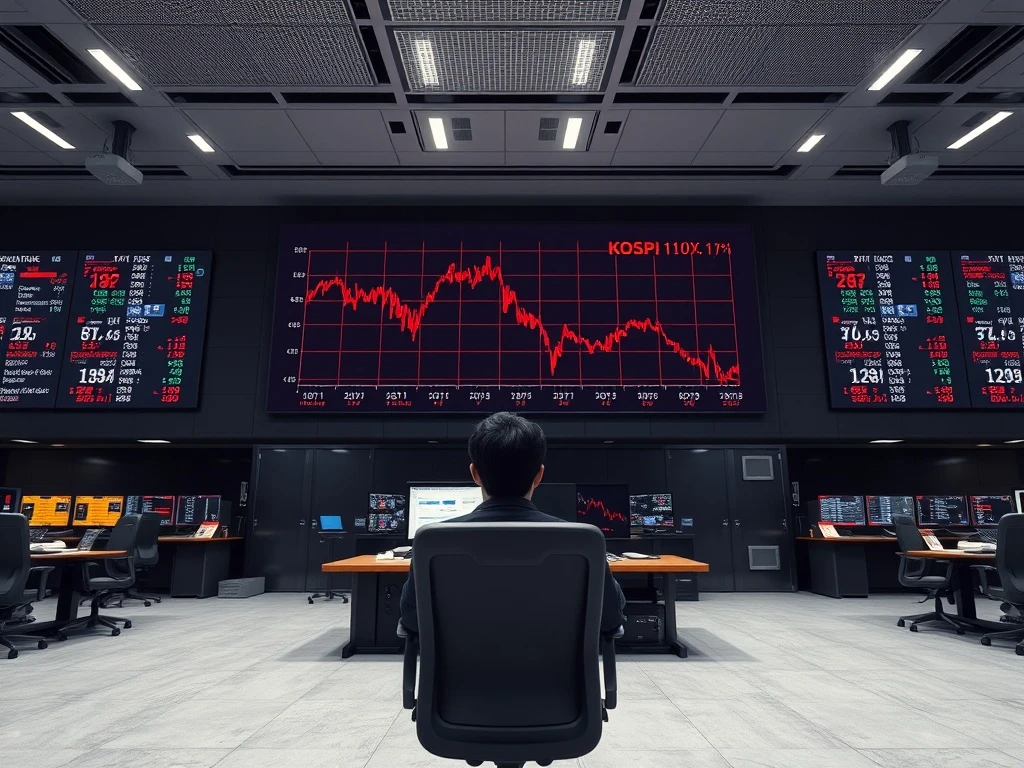
Asian equity markets presented a fragmented picture on Thursday, March 26, 2026, with South Korea’s benchmark KOSPI index leading regional declines by falling 1.20% to close at 2,745.32. The sell-off in Seoul contrasted with modest gains in Japan and a flat performance in Hong Kong, creating a distinctly mixed trading session across the Asia-Pacific region. Investors grappled with conflicting signals from overnight Wall Street movements, persistent currency pressures, and sector-specific headwinds in technology and automotive exports. This divergence highlights the complex, localized factors now driving regional bourses beyond broader global trends.
KOSPI Leads Regional Declines with 1.20% Drop
The KOSPI opened lower and extended losses throughout the Thursday session, ultimately shedding 33.41 points. Trading volume was notably high at approximately 750 million shares, suggesting active institutional repositioning. The decline was broad-based but particularly acute in the technology and battery sectors. Samsung Electronics, the index heavyweight, fell 1.8%, while LG Energy Solution dropped 3.2% following a broker downgrade citing margin concerns. Conversely, the Korean Won weakened past 1,350 against the US dollar, providing a partial cushion for export-oriented companies like Hyundai Motor, which limited its loss to 0.5%. The Korea Exchange reported significant net selling by foreign investors, who offloaded a net 412.3 billion won ($305 million) in equities, marking their third consecutive session of net sales.
Market analysts immediately pointed to technical factors and local liquidity conditions. “The 1.20% drop isn’t a panic, but it’s a clear signal of profit-taking and sector rotation,” said Ji-young Park, Head of Research at Meritz Securities in Seoul, in a morning note to clients. “We saw strong inflows into the KOSPI in early March, and some of that money is now exiting as quarterly window-dressing concludes. The key support level to watch is 2,720.” The Bank of Korea’s decision last week to hold interest rates steady, while expected, has also removed a potential catalyst for financial stocks, which traded mostly flat.
Mixed Signals Across Major Asian Bourses
While Seoul slumped, other major Asian markets told a different story. Japan’s Nikkei 225 managed a gain of 0.3%, buoyed by a weaker yen and strength in semiconductor equipment makers. Hong Kong’s Hang Seng Index fluctuated within a narrow band, finishing virtually unchanged. Australia’s S&P/ASX 200 edged up 0.2%, supported by mining stocks following stable iron ore prices. This patchwork performance underscores how domestic narratives are overpowering a once-unified regional trend. For instance, anticipation of potential stimulus in China provided a floor for Hong Kong shares, while Japan benefited from specific currency dynamics absent in South Korea.
- Currency Divergence: The Japanese Yen’s continued weakness directly boosted exporter earnings projections in Tokyo. The Korean Won’s movement, however, was less pronounced and paired with specific corporate news, limiting its positive impact.
- Sector-Specific Winds: The global chip sector showed signs of bifurcation. While memory chip concerns weighed on Korean giants, Japanese firms producing chip-making machinery rose on strong order forecasts.
- Policy Expectations: Markets are parsing central bank commentary differently. Remarks from the Bank of Japan are currently seen as dovish for equities, while the Bank of Korea’s stance is viewed as neutral to slightly cautious.
Expert Analysis on the Regional Split
Financial institutions are emphasizing the shift toward stock-picking over regional indexing. “The era of ‘Asia up, Asia down’ is fading,” noted Michael Lee, Asia-Pacific Equity Strategist at Citigroup, during a client briefing. “Our models now show a correlation breakdown between major Asian indices. Country-level factors—like corporate governance reforms in Japan, property sector policies in China, and export composition in Korea—account for over 60% of individual market performance, up from 40% just two years ago.” This analysis, referenced in Citi’s latest Asia Pacific Market Outlook, suggests fund managers must adopt a more nuanced approach. Furthermore, data from the Institute of International Finance shows that cross-border portfolio flows into Asia are becoming increasingly selective, with Korea experiencing outflows this month while Japan records inflows.
Comparative Performance of Asia-Pacific Markets
The day’s trading highlights the growing performance gap within the region. The table below compares key metrics from the March 26, 2026, session, illustrating how similar global inputs yielded different local outcomes.
| Market (Index) | % Change | Key Driver | Foreign Flow (Net) |
|---|---|---|---|
| South Korea (KOSPI) | -1.20% | Tech Sector Profit-Taking | -$305 Million |
| Japan (Nikkei 225) | +0.30% | Weak Yen Boosting Exporters | +$420 Million |
| Hong Kong (Hang Seng) | +0.05% | Property Stimulus Hopes | +$50 Million |
| Australia (S&P/ASX 200) | +0.20% | Commodity Price Stability | +$180 Million |
Forward Outlook and Key Levels to Watch
The immediate focus shifts to the final trading days of the quarter and upcoming economic data. For the KOSPI, analysts at Korea Investment & Securities identify the 2,720 level as critical short-term support; a sustained break below could signal a deeper correction toward 2,680. Conversely, a rebound above 2,770 would negate the bearish intraday pattern. The market will closely monitor South Korea’s February industrial production and trade data, scheduled for release on Friday, March 27. Meanwhile, the broader region awaits policy cues from the upcoming U.S. Personal Consumption Expenditures (PCE) price index, a key inflation gauge for the Federal Reserve. “Asian markets are in a data-watching mode,” concluded Park from Meritz Securities. “The direction for the rest of the week will hinge less on Wall Street and more on local prints and currency movements.”
Investor Sentiment and Sector Rotation
Early reports from major Korean brokerages indicate a rotation out of high-flying technology and battery names and into defensive sectors like utilities and telecommunications. Retail investor sentiment, as measured by the Korea Financial Investment Association’s weekly survey, turned slightly bearish for the first time in four weeks. However, long-term institutional holders appear to be using the dip to accumulate shares in fundamentally strong companies, suggesting the sell-off may be contained. This creates a tug-of-war that could lead to increased volatility but may establish a new trading range rather than instigating a sustained downtrend.
Conclusion
Thursday’s 1.20% decline in South Korea’s KOSPI served as the standout move in a otherwise mixed Asian trading session. The drop reflected localized profit-taking, foreign outflows, and sector-specific concerns, particularly in technology. Crucially, it occurred in isolation, with Japan and Australia posting gains, underscoring a major shift toward market-specific drivers in the Asia-Pacific region. Investors should now prioritize country-level analysis and corporate fundamentals over broad regional themes. The key takeaway is that the story of Asian markets is no longer a single narrative but a collection of distinct chapters, with the KOSPI’s current chapter focused on technical support levels and upcoming local economic data.
Frequently Asked Questions
Q1: Why did the KOSPI fall 1.20% on March 26, 2026?
The decline was driven by a combination of profit-taking after recent gains, net selling by foreign investors totaling $305 million, and weakness in major technology and battery stocks like Samsung Electronics and LG Energy Solution.
Q2: How did other Asian markets perform on the same day?
Markets were mixed. Japan’s Nikkei 225 rose 0.3%, Australia’s ASX 200 gained 0.2%, and Hong Kong’s Hang Seng was nearly flat. This shows divergent performance across the region.
Q3: What is the next important data point for the KOSPI?
South Korea’s February industrial production and trade data, released on Friday, March 27, will be closely watched for signs of economic strength or weakness that could influence market direction.
Q4: What does a ‘mixed’ trading session mean for investors?
It indicates that broader regional trends are weakening. Investors need to analyze individual countries and companies more carefully, as uniform moves across Asia are becoming less common.
Q5: Are foreign investors leaving the South Korean stock market?
They were net sellers for this session and the past three sessions. However, this often represents short-term portfolio rebalancing rather than a long-term exodus, especially at the quarter’s end.
Q6: What key level are analysts watching for the KOSPI now?
Technical analysts cite 2,720 as a crucial short-term support level. Holding above it could stabilize the market, while a break below might lead to a further test of 2,680.