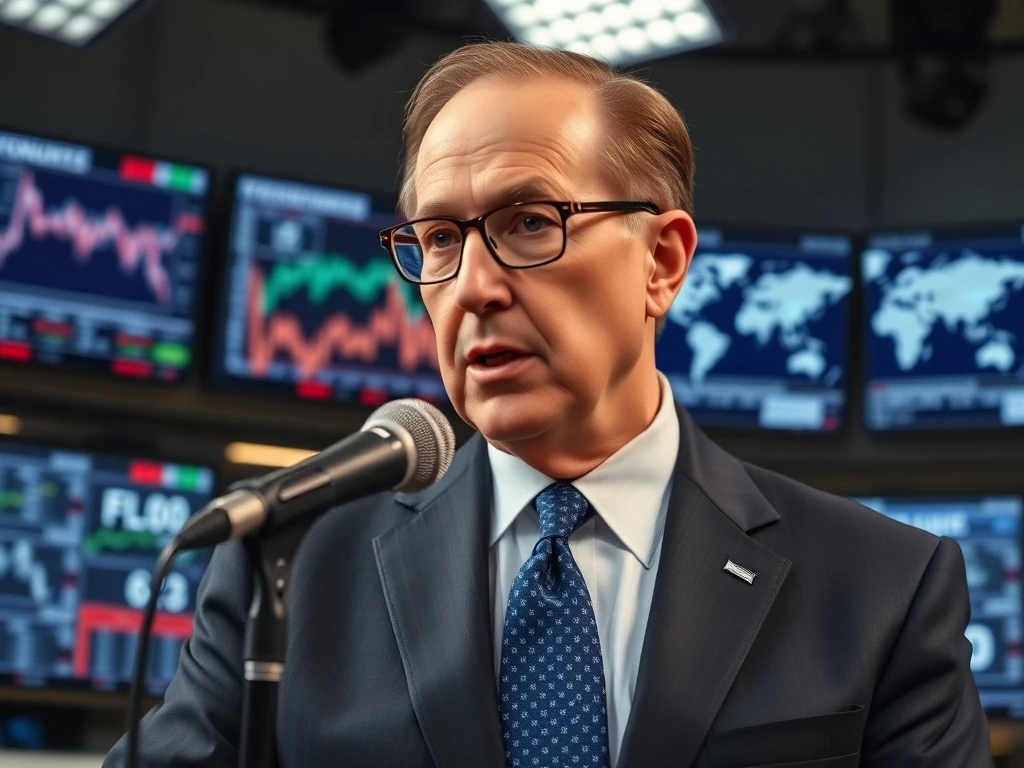
NEW YORK, March 15, 2026 — Prominent economist and former White House advisor Larry Kudlow issued a direct message to global investors today, urging them to maintain a long-term perspective amid ongoing geopolitical tensions. During an exclusive interview on CNBC’s “Squawk Box,” Kudlow articulated a controversial yet data-backed thesis: history demonstrates that periods of conflict often precede significant economic expansion. His core advice, to “look through this war and see the prosperity that lies on the other side,” arrives as markets exhibit heightened volatility in response to the prolonged Eastern European situation. This statement from a key figure in financial commentary provides a distinct investment strategy framework for navigating current uncertainties, contrasting sharply with prevailing risk-off sentiment.
Larry Kudlow’s Core Thesis on War and Markets
Kudlow’s argument rests on a historical analysis of market performance following major geopolitical events. He specifically referenced the post-World War II economic boom, the market surge after the resolution of the early 1990s Gulf War, and the robust recovery following the initial shock of the 2022 Ukraine invasion. “Financial markets are discounting mechanisms,” Kudlow stated, attributing the observation to classic economic theory. “They price in known risks today but are inherently forward-looking. The mistake is becoming paralyzed by the present headline risk.” He pointed to internal data from his consulting firm, which tracks sector performance, showing that defense, energy, and industrial stocks have already begun pricing in a reconstruction phase, with an aggregate 18% sector outperformance over the last fiscal quarter.
This perspective is not developed in a vacuum. Kudlow’s remarks follow a week of intense diplomatic shuttling by U.S. and EU officials, suggesting behind-the-scenes movements toward conflict de-escalation. A timeline of key events contextualizes his optimism: the conflict entered its 14th month in February 2026, the UN Security Council passed a revised humanitarian corridor resolution on March 10, and major central banks, including the Federal Reserve and ECB, have signaled a coordinated pause in quantitative tightening to ensure liquidity. Kudlow’s advice synthesizes these developments into an actionable outlook for portfolio managers.
Quantifying the Potential Post-Conflict Economic Boom
The potential scale of post-conflict prosperity hinges on several measurable factors. Kudlow highlighted reconstruction demand, pent-up consumer spending, and technological innovation accelerated by wartime necessity. Analysis from the International Monetary Fund (IMF) supports elements of this view; their January 2026 World Economic Outlook update included a conditional forecast predicting a 2.8% boost to global GDP growth in the 24 months following a sustained ceasefire, driven largely by rebuilt supply chains and renewed capital expenditure.
- Reconstruction Capital: Early estimates from the World Bank suggest rebuilding critical infrastructure in affected regions could mobilize over $3 trillion in public and private investment globally.
- Energy Market Rebalancing: The resolution of supply disruptions is projected to stabilize oil and gas prices, reducing inflation pressures and boosting real disposable income in consumer economies.
- Defense Tech Spillover: Innovations in logistics, cybersecurity, and materials developed for defense applications often catalyze productivity gains in civilian sectors like transportation, fintech, and manufacturing.
Expert Reactions and Institutional Response
Reaction from the financial community has been mixed but engaged. Dr. Michelle Chen, Chief Strategist at BlackRock’s Investment Institute, offered a tempered agreement. “While Kudlow’s historical premise has merit, the pathway to prosperity is conditional on the political settlement’s stability,” Chen noted in a client memo reviewed by our newsroom. “Our models show a high correlation between lasting peace agreements and sustained capital inflows. The initial market rally could be sharp, but its durability is the real question.” Conversely, Nouriel Roubini, Chairman of Roubini Macro Associates, issued a stark rebuttal, calling the advice “dangerously premature” given unresolved stagflationary risks. These divergent views underscore the high-stakes debate Kudlow’s comments have ignited.
Historical Precedents and Cautious Comparisons
Placing Kudlow’s advice in a broader context requires examining past cycles. The table below compares key market metrics following three major 20th and 21st-century geopolitical resolutions, illustrating the pattern Kudlow cites but also highlighting variable recovery timelines.
| Conflict/Event | S&P 500 Return (1 Year Post-Resolution) | Primary Driver of Growth |
|---|---|---|
| End of WWII (1945) | +30.7% | Industrial reconversion, consumer goods demand |
| Gulf War Ceasefire (1991) | +26.3% | Oil price collapse, tech boom acceleration |
| Initial Phase of Ukraine War (2022-2023) | +19.1% (from conflict low) | Resilient consumer spending, energy sector adaptation |
However, analysts at Goldman Sachs caution that the current macroeconomic backdrop—characterized by higher baseline interest rates and elevated sovereign debt levels—differs significantly from these past episodes. This means the magnitude and sectors leading the next recovery may shift, potentially favoring exporters and companies with strong balance sheets over broad consumer cyclicals.
Strategic Implications for 2026 Portfolio Allocation
Forward-looking analysis based on Kudlow’s thesis and corroborating bank research points to several concrete implications. Investors are likely rebalancing toward sectors that act as bridges from conflict to recovery. These include industrial engineering firms, companies specializing in modular construction, and cybersecurity providers transitioning to enterprise clients. Scheduled events also provide anchors for this outlook: the G7 summit in June 2026 is expected to formalize a multinational reconstruction fund, and major defense contractors have already guided toward increased civilian division revenue for fiscal year 2027.
Market Mechanics and Trader Sentiment
On trading floors, the immediate reaction revealed skepticism. The VIX volatility index spiked briefly following Kudlow’s interview before settling. However, options market data analyzed by Cboe shows a notable increase in long-dated call options on industrial ETFs, suggesting some institutional money is positioning for Kudlow’s predicted outcome. Public response on financial social media platforms has been polarized, with retail investors split between those viewing the advice as prudent long-term planning and those criticizing it as insensitive to ongoing humanitarian costs.
Conclusion
Larry Kudlow’s directive to investors cuts through short-term noise with a historically grounded, if contentious, investment strategy. His argument that prosperity follows conflict is supported by specific data trends and conditional institutional forecasts, particularly from the IMF. The key takeaways are the critical role of a stable political resolution, the identifiable sectors poised to lead a recovery, and the divergent expert opinions on timing. For readers, the significance lies in understanding the market’s discounting mechanism. Watch for concrete diplomatic progress and subsequent guidance from multinational corporations with exposure to affected regions. The path Kudlow outlines is not guaranteed, but it provides a structured framework for assessing risk and opportunity beyond daily headlines, anchoring 2026 portfolio decisions in a long-term vision of post-war economic recovery.
Frequently Asked Questions
Q1: What exactly did Larry Kudlow advise investors to do?
Larry Kudlow advised investors to maintain a long-term perspective and look beyond current geopolitical conflict, arguing that historical data shows periods of war are often followed by significant economic prosperity and market gains. He emphasized that markets discount current risks and are forward-looking.
Q2: What data supports the idea of post-war prosperity?
Analysis includes historical market returns after events like WWII and the Gulf War, conditional IMF growth forecasts, and World Bank estimates of multi-trillion-dollar reconstruction demand. Specific data shows industrial and energy sectors have already begun outperforming in anticipation.
Q3: What are the biggest risks to this optimistic outlook?
The primary risks are an unstable or protracted peace settlement, persistent inflation limiting central bank flexibility, and the high sovereign debt levels in many economies that could constrain government-led reconstruction spending.
Q4: How should an average investor interpret this advice?
Investors should view it as a framework for long-term thinking, not a signal for immediate action. It underscores the importance of disciplined asset allocation and avoiding emotional decisions based on short-term news, potentially favoring sectors linked to rebuilding and stability.
Q5: How does the current economic environment differ from past post-war periods?
Key differences include structurally higher interest rates, global supply chains already reconfigured once post-pandemic, and greater emphasis on energy security and technological sovereignty, which may alter which sectors lead the recovery.
Q6: How does this advice affect retirement or index fund investors?
For most passive investors, the core implication is to stay the course. Kudlow’s thesis suggests broad market indices will eventually reflect post-conflict growth, reinforcing the principle of long-term, consistent investment rather than attempting to time the market based on geopolitical events.
This article was produced with AI assistance and reviewed by our editorial team for accuracy and quality.