
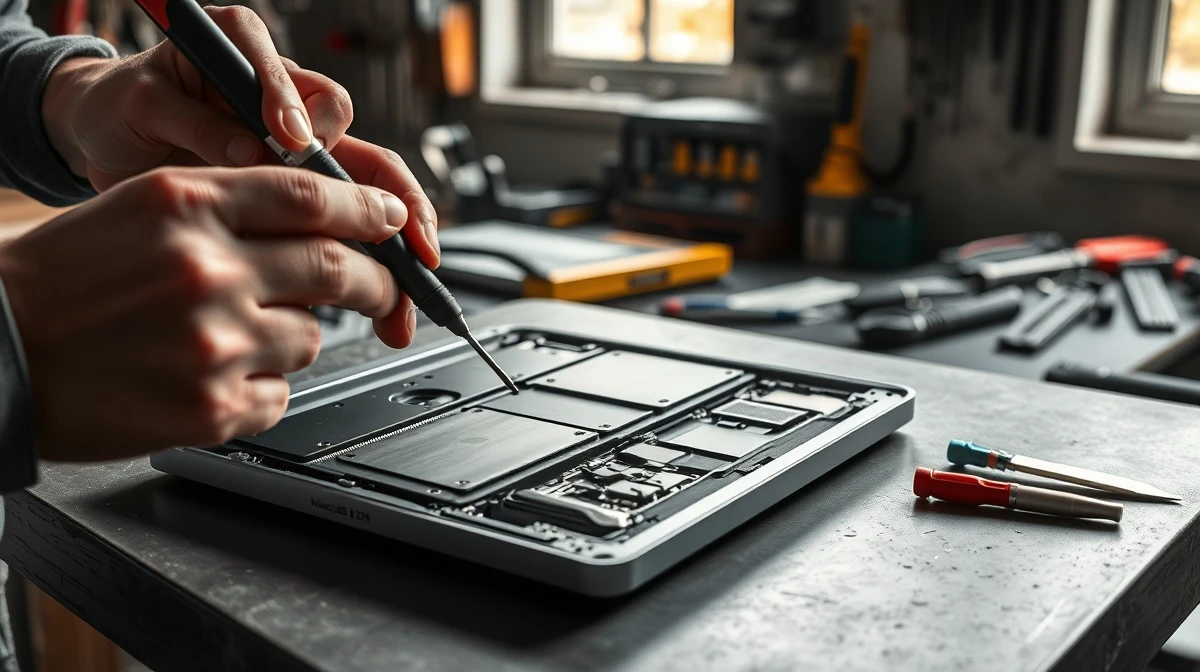
Apple’s newly released MacBook Neo has been identified as the most repairable MacBook in approximately fourteen years, according to a detailed teardown analysis published by the repair guide website iFixit on March 14, 2026.
A Break from Adhesive: The Battery Tray
The analysis highlights a fundamental design shift in the MacBook Neo’s battery assembly. iFixit reports that, unlike many recent Apple laptops where batteries are adhered with strong glue, the Neo’s battery is secured within a tray fastened by 18 screws. While this requires more steps for removal, iFixit’s team strongly favored this method, stating that “screws still beat adhesive every time.” The website noted the new arrangement “sent cheers across the iFixit office” for its potential to simplify a common and costly repair.
This change could significantly lower the barrier for users and third-party repair shops to replace aging batteries, a frequent point of failure in portable electronics. The design move aligns with growing regulatory and consumer pressure for more sustainable and repairable hardware.
Additional Repair-Friendly Features
Beyond the battery, iFixit’s teardown revealed other improvements aimed at serviceability. The laptop reportedly features a flat disassembly tree, meaning technicians can access internal components without navigating complex, layered assemblies. The display and keyboard are also described as easier to replace compared to recent MacBook generations.
Furthermore, iFixit found that the MacBook Neo’s built-in Repair Assistant software accepted replacement parts without generating system warnings or hindering functionality. This software acknowledgment is a critical step for independent repair, as system locks on non-genuine parts have been a major obstacle.
The Score and Persistent Limitations
Despite these advances, iFixit assigned the MacBook Neo a repairability score of 6 out of 10. The score reflects remaining design choices that complicate user repair. Primary among these are the soldered-on RAM and storage, which permanently attach these core components to the logic board, preventing post-purchase upgrades or straightforward replacements.
“For a MacBook, that’s a strong score,” iFixit stated, contextualizing the rating within Apple’s historical design philosophy, which has often prioritized thinness and performance over modularity. The score places the Neo as a notable departure from recent trends, though not a complete reversal.
Context and Industry Shift
The improved repairability of the MacBook Neo arrives amid a broader industry and legislative push for right-to-repair reforms. Regulations, such as those recently enacted in New York and California, require manufacturers to make parts, tools, and documentation available to consumers and independent repair shops.
Apple has also expanded its own Self Service Repair program, offering genuine parts and manuals for select models. The MacBook Neo’s design appears to be a tangible product of this evolving landscape, balancing Apple’s integration goals with new serviceability requirements.
What remains to be seen is whether this design philosophy will extend to Apple’s higher-end professional laptops, which have traditionally featured even more integrated components. The MacBook Neo, positioned as an affordable model, may serve as a test case for the company’s future approach to hardware design across its entire lineup.
This article was produced with AI assistance and reviewed by our editorial team for accuracy and quality.



