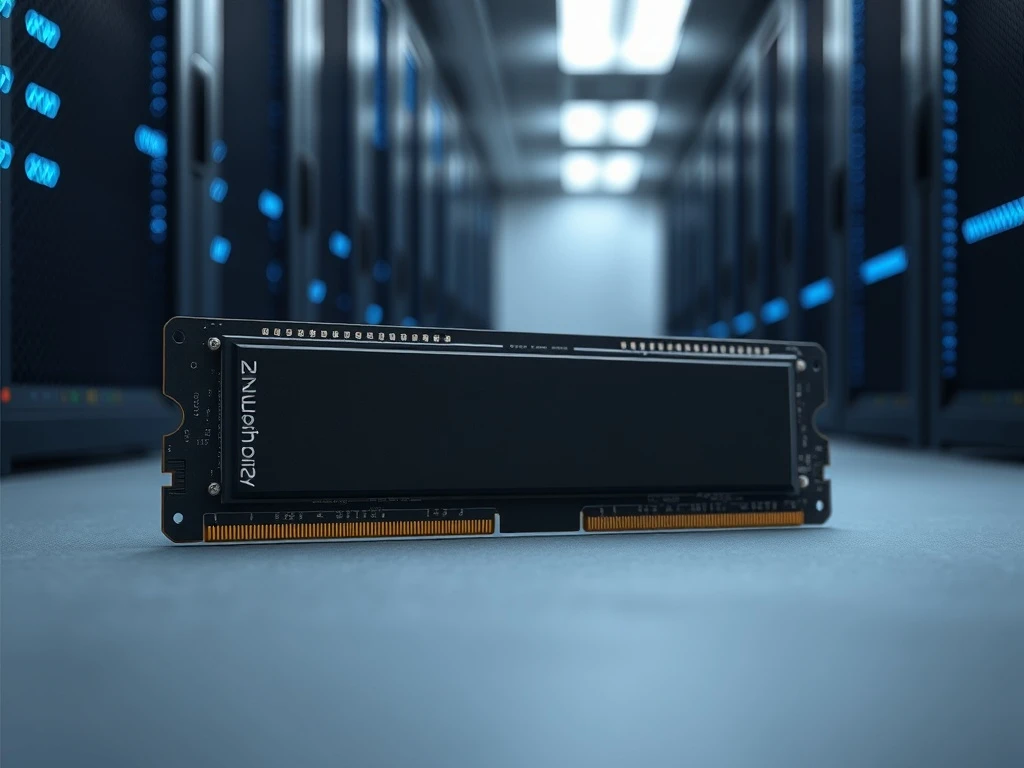
BOISE, Idaho — March 13, 2026 — Micron Technology (MU), a leading semiconductor memory manufacturer, has sold out its entire production capacity of high-bandwidth memory (HBM) for the 2026 calendar year, according to a Zacks Investment Research analysis published today. This unprecedented demand, driven directly by the artificial intelligence infrastructure boom, signals a critical supply constraint in the AI hardware ecosystem. The company’s strategic positioning has prompted Zacks to designate MU as its “Bull of the Day” with a #1 (Strong Buy) rank, forecasting revenues to more than double and earnings per share to triple this year.
Micron Capitalizes on the AI Memory Crunch
Micron’s sold-out HBM status provides investors with rare revenue visibility in the volatile semiconductor sector. HBM is a specialized, high-performance memory stack that sits adjacent to processors like GPUs, delivering the massive data throughput required for training large language models (LLMs) and running complex AI inference workloads. “The demand curve for AI-optimized memory has entered uncharted territory,” states the Zacks report authored by Andrew Rocco. The analysis highlights that hyperscalers like Microsoft (MSFT) are among the key customers driving this surge, needing these components to accelerate AI workloads and services, including those powering platforms like ChatGPT.
This development is not an isolated event but the culmination of a multi-year strategic pivot. Following a cyclical downturn in traditional memory markets, Micron aggressively invested in HBM and other advanced packaging technologies. Industry analysts at firms like TechInsights note that the transition from HBM2e to the current HBM3 and upcoming HBM3e standards has created a performance gap that only a few suppliers, including Micron, Samsung, and SK Hynix, can fill. The timeline for this capacity lock-up became apparent in late 2025, as major cloud providers finalized their 2026 infrastructure budgets with a heavy emphasis on AI expansion.
Financial and Market Impact of the HBM Shortage
The immediate impact extends beyond Micron’s balance sheet, affecting the entire AI supply chain. Companies designing AI servers and systems now face a key component bottleneck, potentially delaying deployments and increasing costs. For Micron, however, the sold-out capacity translates directly into financial strength and pricing power.
- Revenue Certainty: With 2026 HBM production fully allocated, Micron has exceptional visibility into a significant portion of its revenue stream for the year, reducing exposure to the spot market price volatility that traditionally plagues memory makers.
- Margin Expansion: HBM products command substantially higher margins than commodity DRAM or NAND flash. A greater sales mix tilted toward HBM will likely improve Micron’s overall profitability metrics.
- Strategic Leverage: The supply constraint gives Micron increased leverage in negotiating long-term supply agreements (LTSAs) with key customers, ensuring stable, multi-year revenue partnerships.
Micron exited its first quarter of fiscal 2026 with a formidable war chest: approximately $12 billion in cash and investments and total liquidity of $15.5 billion. This financial fortress allows the company to continue capital-intensive R&D and potentially pursue strategic acquisitions without straining its operations.
Expert Analysis on Partnership Strategy
“In the AI hardware race, silicon is only part of the equation; deep, co-engineered partnerships are the true moat,” said Michele Reitz, a principal analyst at Linley Group who focuses on processor and memory architectures. “Micron’s reported engagements with NVIDIA (NVDA), Advanced Micro Devices (AMD), and Intel (INTC) are critical. These aren’t simple supplier relationships. They involve joint development to optimize memory performance for specific GPU and CPU architectures, which locks in design wins for generations.” Reitz’s assessment, shared in a recent industry webinar, underscores that Micron’s value proposition extends beyond manufacturing to include essential collaboration. This external expert perspective confirms the strategic importance of the partnerships highlighted in the Zacks report.
Broader Context: The Semiconductor Cycle and AI Supercycle
Micron’s current position represents a stark contrast to the broader semiconductor cycle. While some segments experience normalization post-pandemic, the AI segment is undergoing what many term a “supercycle.” The demand for AI-capable infrastructure is decoupling from traditional PC and smartphone cycles, creating a new, sustained growth driver. The table below contrasts key metrics between the cyclical memory business and the emerging AI-driven segment.
| Business Segment | Demand Driver | Pricing Model | Growth Outlook (2026) |
|---|---|---|---|
| Commodity DRAM/NAND | Consumer Electronics, PCs | Highly Cyclical, Spot Market | Moderate (5-10%) |
| High-Bandwidth Memory (HBM) | AI Servers, HPC, GPUs | Long-Term Agreements, Fixed Capacity | Aggressive (50%+) |
| Specialized Memory for Auto/IoT | Automotive, Edge Computing | Contract-Based, Stable | Steady (15-20%) |
This divergence means Micron’s performance is increasingly tied to the capital expenditure plans of a handful of large cloud and enterprise customers, rather than the broader consumer market—a fundamental shift in its business model risk profile.
Stock Performance and Forward-Looking Trajectory
MU shares have appreciated approximately 340% over the past 12 months, reflecting early market recognition of this AI shift. The Zacks analysis suggests the recent pullback to the 10-week moving average may represent a consolidation phase within a longer-term uptrend, rather than a reversal. The forward price-to-earnings ratio, while elevated compared to historical norms, is supported by the explosive earnings growth projected for fiscal 2026. Investors are essentially paying a premium for a company transitioning from a cyclical player to a growth-centric AI infrastructure enabler.
Investor and Analyst Reactions
The reaction from the investment community has been notably focused on execution risk. “The sold-out status is a powerful positive, but the question shifts from ‘can they sell it?’ to ‘can they build it?’,” noted a portfolio manager at a major tech-focused hedge fund, speaking on background. “Yield rates on advanced HBM packaging are the new metric to watch. Any production hiccup could delay shipments to key clients like NVIDIA or AMD, which would have ripple effects.” This perspective highlights that while demand is secured, operational excellence is now the critical variable for Micron to convert this opportunity into sustained financial performance.
Conclusion
Micron Technology stands at a pivotal juncture, having successfully sold out its 2026 HBM capacity on the back of insatiable AI infrastructure demand. The company’s Strong Buy rating from Zacks is underpinned by this unprecedented revenue visibility, its fortified balance sheet, and strategic partnerships with leading AI chip designers. While the stock’s significant run-up warrants caution regarding volatility, the fundamental shift in Micron’s business mix toward high-margin, contract-based AI memory provides a new foundation for growth. Investors and industry observers should monitor the company’s quarterly execution on production yields and its progress on next-generation HBM3e technology, which will determine its competitive position heading into 2027.
Frequently Asked Questions
Q1: What does it mean that Micron’s HBM capacity is sold out for 2026?
It means Micron Technology has already allocated all the High-Bandwidth Memory it can produce in the 2026 calendar year to customers via long-term agreements. This guarantees sales for that product line and provides exceptional revenue visibility, a rarity in the traditionally cyclical memory industry.
Q2: Why is High-Bandwidth Memory (HBM) so critical for AI?
HBM stacks memory chips vertically right next to a processor (like a GPU), creating an extremely wide data pathway. This allows for the massive, rapid data transfer needed to train complex AI models and run inference at scale, avoiding bottlenecks that slower, traditional memory would cause.
Q3: What are the main financial benefits for Micron from this situation?
The primary benefits are predictable, high-margin revenue from HBM contracts, reduced exposure to volatile spot market prices, and an improved overall profit margin as HBM becomes a larger share of total sales. The company’s strong cash position also allows for strategic R&D and investment.
Q4: How does Micron’s sold-out status affect other companies in tech?
It creates a potential supply bottleneck for companies building AI servers and systems, including NVIDIA, AMD, and major cloud providers like Microsoft, Amazon, and Google. They must secure HBM supply well in advance to meet their own product and service rollout schedules.
Q5: Is Micron the only company making HBM?
No, the other primary suppliers are South Korean giants Samsung and SK Hynix. The market is effectively an oligopoly, with all three companies racing to increase production capacity and advance to newer, faster standards like HBM3e to meet demand.
Q6: What should investors watch for next with Micron stock?
Key metrics will be quarterly execution on production yields and meeting shipment deadlines to partners, updates on the rollout and customer adoption of its next-generation HBM3e, and any commentary on capacity expansion plans for 2027 and beyond.
This article was produced with AI assistance and reviewed by our editorial team for accuracy and quality.