
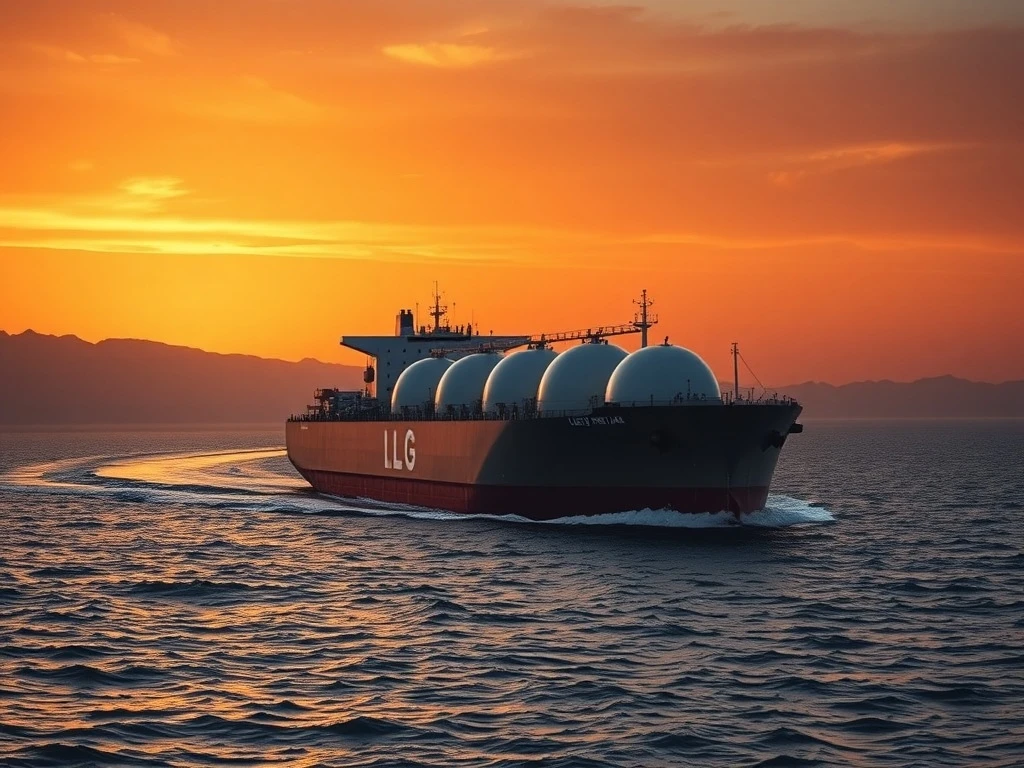
NEW YORK, March 11, 2026 — Natural gas prices surged dramatically Wednesday, closing up 6.26% as escalating military conflict in Iran disrupted critical global energy shipping lanes. The April Nymex natural gas contract (NGJ26) settled at $3.214 per million British thermal units, marking one of the sharpest single-day gains in 2026. This price rally directly correlates with new missile attacks on commercial vessels in the Strait of Hormuz and Persian Gulf, alongside continued volleys targeting Israel. Consequently, energy markets face unprecedented supply uncertainty as the United States Navy assesses mine threats before attempting to reopen the world’s most vital oil and gas chokepoint.
Geopolitical Triggers Behind the Natural Gas Price Surge
Wednesday’s natural gas prices rally stems from concrete security developments in the Middle East. According to maritime security reports verified by Barchart, three commercial vessels sustained missile hits in the Strait of Hormuz and Persian Gulf on March 11. Simultaneously, new missile attacks targeted Israeli infrastructure. These events compound the ongoing closure of Qatar’s Ras Laffan plant, the world’s largest LNG export facility, following an Iranian drone attack on March 3. BloombergNEF (BNEF) data confirms the Ras Laffan facility typically accounts for approximately 20% of global liquefied natural gas supply. Its indefinite shutdown has redirected global demand toward alternative suppliers, including United States export terminals.
Market analysts immediately noted the absence of diplomatic signals suggesting imminent conflict resolution. Former President Donald Trump, referenced in initial reports, made no statements indicating a near-term ceasefire. This geopolitical stalemate, combined with physical supply disruptions, created perfect conditions for a volatility spike. The U.S. Energy Information Administration (EIA) had previously warned that Strait of Hormuz closures could remove 18-21 million barrels of oil and equivalent gas volumes from daily circulation.
Immediate Market Impacts and Supply Chain Disruptions
The conflict’s ripple effects extend across global energy markets. European natural gas prices, a key benchmark, climbed to a three-year high last Tuesday. Meanwhile, U.S. LNG export terminals reported increased activity. BNEF tracking shows estimated LNG net flows to U.S. export terminals reached 19.7 billion cubic feet per day on Wednesday, a 2.9% weekly increase. This surge reflects Europe’s urgent need to replace lost Qatari volumes. However, the situation remains fluid. The U.S. Navy has not yet cleared the Strait of Hormuz for safe passage, citing potential Iranian-laid mines as a “major complication,” according to a Pentagon briefing summary.
- Global LNG Supply Shock: The Ras Laffan closure removes roughly 20% of global LNG capacity, forcing buyers to compete for remaining volumes and driving prices higher.
- Shipping Insurance Crisis: War risk premiums for vessels transiting the Persian Gulf have skyrocketed, adding significant cost to delivered energy.
- Inventory Draw Uncertainty: The market expects Thursday’s EIA storage report to show a -41 bcf draw, weaker than the five-year average, but weather and export demand could alter actual figures.
Expert Analysis from Energy Market Strategists
Michelle Liu, Senior Commodity Strategist at BNEF, contextualized the price move. “Wednesday’s rally isn’t just about today’s headlines,” Liu stated. “It’s about the market pricing in prolonged structural risk. The Strait of Hormuz handles about 21 million barrels of oil and equivalent gas daily. Every day of closure necessitates massive logistical reshuffling. U.S. producers are benefiting in the short term, but prolonged conflict could trigger broader economic slowdowns, reducing demand.” Liu’s analysis aligns with data from the Edison Electric Institute, which reported U.S. electricity output rose 1.00% year-over-year for the week ending March 7, indicating resilient industrial demand that supports gas prices.
U.S. Production Response and Storage Context
Domestic market fundamentals present a complex picture. On one hand, U.S. dry gas production remains robust. Wednesday’s output measured 111.8 bcf/day, a 3.9% annual increase according to BNEF. The EIA’s February forecast raised its 2026 U.S. dry nat-gas production estimate to 109.97 bcf/day. Active gas rigs, despite a slight two-rig dip last week to 132, hover near a 2.5-year high. This growing supply potential acts as a bearish counterweight to geopolitical premiums.
| Metric | Current Data (March 11, 2026) | Year-over-Year Change |
|---|---|---|
| U.S. Dry Gas Production | 111.8 bcf/day | +3.9% |
| Lower-48 Gas Demand | 76.4 bcf/day | +0.5% |
| LNG Export Flows | 19.7 bcf/day | +2.9% (weekly) |
| Gas Storage (as of Feb 27) | -2.2% vs. 5-Year Average | Inventories +7.2% y/y |
Conversely, storage data reveals tightening conditions. The last weekly EIA report showed a larger-than-expected draw of -132 bcf for the week ended February 27. Inventories now sit slightly below the five-year seasonal average. The contrast is starker in Europe, where gas storage was only 30% full as of March 4, compared to a 44% five-year average for the date. This global inventory picture amplifies the market’s sensitivity to supply shocks.
Forward Outlook: Weather, Diplomacy, and Price Trajectory
Near-term price direction hinges on three factors: military developments, weather patterns, and diplomatic efforts. The National Oceanic and Atmospheric Administration (NOAA) forecasts warmer-than-normal temperatures across major U.S. heating regions through mid-March, which should suppress domestic heating demand. However, this bearish weather signal is currently overwhelmed by bullish geopolitical news. Traders will closely monitor any U.S. or allied naval movement to secure the Strait of Hormuz, which would likely trigger a sharp price correction. Meanwhile, the market awaits concrete diplomatic initiatives, though none appear imminent.
Industry and Financial Market Reactions
Energy sector equities exhibited mixed reactions. While pure-play natural gas producers saw share price lifts, integrated majors faced pressure from broader conflict risk. The volatility spike has also increased trading volume in natural gas futures and options on the CME Group’s NYMEX, with open interest rising significantly. Risk management departments at utilities and trading houses are reportedly stress-testing scenarios for prolonged Strait closures, examining coal-to-gas switching potential and alternative pipeline routes where available.
Conclusion
The March 11 natural gas prices rally underscores the commodity’s acute vulnerability to Middle Eastern geopolitics. A 6.26% single-day surge, driven by missile attacks and critical LNG facility outages, demonstrates how physical supply chains and financial markets intertwine. While robust U.S. production provides a fundamental ceiling, the immediate market is dominated by fear of prolonged Strait of Hormuz disruption. Investors and analysts should monitor U.S. naval actions, European storage refill rates, and any diplomatic breakthroughs. The next 72 hours will be critical for determining whether this price spike represents a short-term geopolitical premium or the beginning of a sustained energy market crisis with global inflationary consequences.
Frequently Asked Questions
Q1: Why did natural gas prices surge on March 11, 2026?
Prices rallied 6.26% due to escalating conflict in Iran, including missile strikes on ships in the Strait of Hormuz and the ongoing closure of Qatar’s massive Ras Laffan LNG plant after a drone attack. These events threatened global supply routes and liquefied natural gas exports.
Q2: How does the Iran war affect U.S. natural gas prices?
The conflict disrupts global shipping, increases demand for U.S. LNG exports as buyers seek alternatives, and creates a “risk premium” as traders price in potential wider supply disruptions. U.S. export flows to LNG terminals rose 2.9% week-over-week as a direct result.
Q3: What is the Strait of Hormuz, and why is it important for energy?
The Strait of Hormuz is a narrow sea passage between Oman and Iran. It is the world’s most important oil and gas transit chokepoint, with about 21 million barrels of oil and equivalent gas volumes passing through daily. Closure or attack risk immediately impacts global prices.
Q4: Are U.S. natural gas inventories low right now?
As of February 27, U.S. working gas inventories were about 2.2% below the five-year seasonal average, indicating relatively tight supplies. A recent weekly draw of -132 bcf was larger than expected, supporting prices alongside the geopolitical news.
Q5: Could this price rally continue, or is it a short-term spike?
Continuation depends on conflict duration and Strait of Hormuz security. If the U.S. Navy successfully reopens safe passage, prices could retreat quickly. However, prolonged closure or further attacks on energy infrastructure would likely sustain higher prices.
Q6: How does this affect household energy bills?
There is typically a lag of several weeks to months between wholesale price spikes and residential utility bills. Sustained high prices would eventually increase heating and electricity costs, particularly in regions reliant on natural gas for power generation.



