
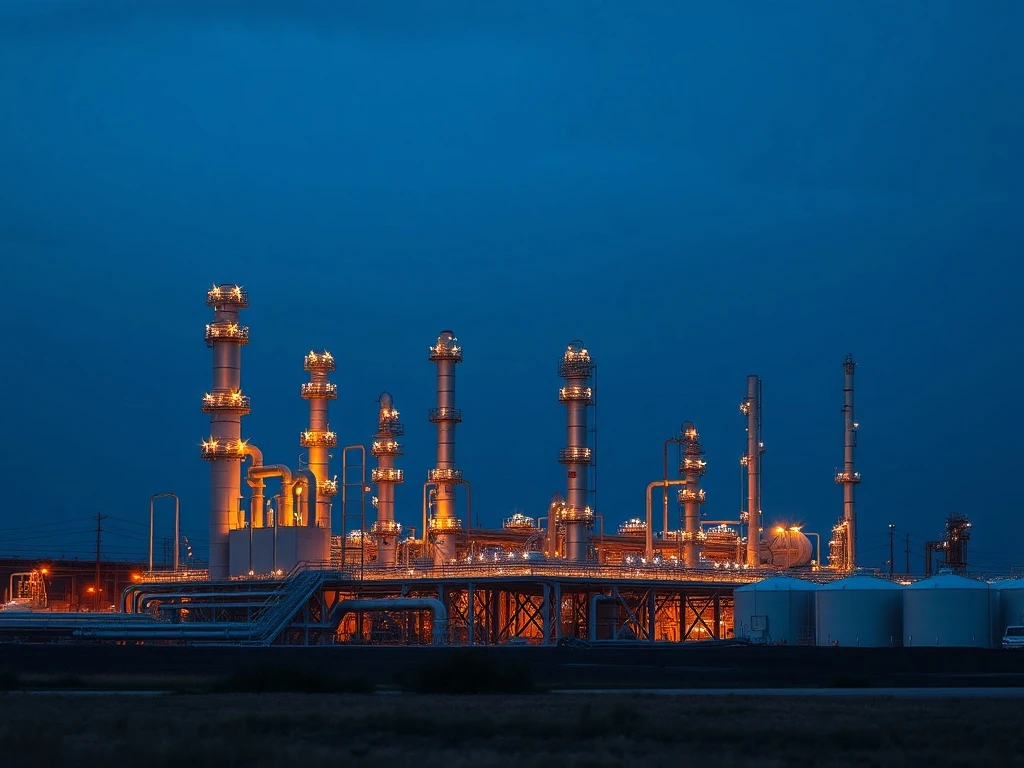
CHICAGO, March 13, 2026 — Natural gas prices rallied sharply in early trading Thursday, closing up 0.75% as geopolitical tensions in the Middle East created carry-over support from surging crude oil markets. The April Nymex natural gas contract (NGJ26) settled at $3.214 per million British thermal units, gaining +0.024 as threats to close the Strait of Hormuz amplified supply concerns across global energy markets. This price movement represents the second consecutive weekly gain for natural gas, reflecting how regional conflicts now transmit rapidly between different energy commodities through both physical supply chains and trader psychology.
Geopolitical Flashpoint: Iran’s Threat to Close Vital Waterway
The immediate catalyst for Thursday’s energy market volatility came from Tehran. Iran’s Supreme Leader Ayatollah Mojtaba Khamenei declared on March 13 that Iran should exercise its “leverage” by closing the Strait of Hormuz, the world’s most important oil transit chokepoint. Simultaneously, he confirmed attacks on Gulf Arab neighbors would continue. UK Defense Secretary John Healey provided independent confirmation hours later, stating intelligence showed Iran was “increasingly evident” in laying mines within the strategic waterway. These developments followed last Monday’s Iranian drone attack on Qatar’s Ras Laffan plant, the planet’s largest natural gas export facility, which remains shuttered.
Market analysts immediately recognized the compounding risks. The Strait of Hormuz handles approximately 21 million barrels of oil daily—about 21% of global petroleum consumption. Furthermore, about one-fifth of global liquefied natural gas supply transits nearby waters. “When Iran talks about closing Hormuz, every energy trader from London to Singapore pays attention,” noted Samantha Chen, lead commodities strategist at Global Energy Insights. “The 2019 and 2021 incidents showed how quickly supply fears can spike prices across the entire complex, not just crude.”
Supply-Demand Dynamics: Conflicting Signals Emerge
Thursday’s price gains occurred despite mixed fundamental data from the United States. The Energy Information Administration reported natural gas inventories fell by 38 billion cubic feet for the week ended March 6. However, this draw was smaller than the market consensus expectation of 41 bcf and substantially below the five-year average draw of 64 bcf for this period. Consequently, total working gas in storage stood at 2,123 bcf—8.8% higher than last year but still 0.9% below the five-year average, indicating essentially balanced supplies.
- Production Growth: U.S. dry gas production reached 112.3 bcf/day on March 13, a 5.3% year-over-year increase according to BloombergNEF data. The EIA recently raised its 2026 production forecast to 109.97 bcf/day.
- Demand Strength: Lower-48 state gas demand registered 84.7 bcf/day (+7.8% y/y), while LNG export flows to U.S. terminals hit 20.2 bcf/day, rising 5.4% week-over-week.
- Electricity Link: The Edison Electric Institute reported U.S. electricity output rose 1.00% year-over-year for the week ended March 7, providing underlying demand support.
Expert Analysis: Weather Patterns and Market Psychology
Meteorological forecasts introduced additional complexity. The Commodity Weather Group projected well-above-average temperatures across the western United States from March 17-21, which typically reduces heating demand. Conversely, cooler readings forecast for the Eastern U.S. could sustain some residential and commercial gas consumption. “We’re in the shoulder season where weather forecasts become exceptionally noisy for gas traders,” explained Dr. Michael Torres, director of the Climate and Energy Program at the Northeast Research Institute. “The geopolitical premium we’re seeing today essentially overrides what would normally be a mildly bearish weather outlook.”
Global Context: European Storage and Production Responses
The Iran conflict has already reshaped European energy markets. European natural gas prices climbed to a three-year high last Tuesday, with Dutch TTF futures briefly exceeding €45 per megawatt-hour. As of March 10, gas storage facilities across Europe were just 29% full, compared to the five-year seasonal average of 43% for this time of year. This storage deficit increases Europe’s sensitivity to supply disruptions, particularly as the continent continues to adjust to reduced Russian pipeline gas imports since the 2022 invasion of Ukraine.
| Market Indicator | Current Level | Year-Ago Comparison |
|---|---|---|
| U.S. Dry Gas Production | 112.3 bcf/day | +5.3% |
| U.S. LNG Export Flows | 20.2 bcf/day | +5.4% (weekly) |
| European Storage Level | 29% full | 43% (5-year average) |
| Active U.S. Gas Rigs | 132 | Up from 94 in Sept 2024 |
Forward Outlook: Monitoring Production and Conflict Escalation
Market participants will closely watch several developments through late March. First, the operational status of Qatar’s Ras Laffan facility remains uncertain. Before the attack, the plant accounted for roughly 20% of global LNG supply. Its prolonged closure could significantly increase demand for U.S. LNG exports, potentially tightening domestic supplies. Second, Baker Hughes will report updated rig counts on March 20. The previous week saw active U.S. natural gas drilling rigs fall by 2 to 132, retreating from a 2.5-year high of 134 rigs, but remaining well above the September 2024 low of 94.
Industry and Government Responses
The U.S. Department of Energy has not issued formal statements regarding the Iran developments, but industry sources indicate monitoring has intensified. Major LNG exporters like Cheniere Energy have reportedly increased security protocols at Gulf Coast facilities. Meanwhile, European Commission energy officials convened an emergency meeting Thursday morning Brussels time to assess contingency plans should Strait of Hormuz transit be disrupted. “The 2022 energy crisis taught Europe hard lessons about diversification,” noted Klaus Berger, a senior analyst with the European Energy Agency. “But some vulnerabilities remain, particularly in LNG logistics and storage timing.”
Conclusion
Natural gas markets on March 13 demonstrated how geopolitical events can rapidly transmit price signals across commodity classes. While U.S. storage levels remain adequate and production grows steadily, the threat to global chokepoints has injected a risk premium into pricing. Traders will now monitor whether Iran implements its Strait of Hormuz threats, how quickly Qatar restores its LNG exports, and whether unseasonable U.S. weather alters demand patterns. The convergence of these factors suggests continued volatility ahead for natural gas prices, with the conflict premium likely persisting until either diplomatic solutions emerge or military tensions de-escalate.
Frequently Asked Questions
Q1: Why did natural gas prices rise on March 13, 2026?
Prices gained 0.75% primarily due to geopolitical tensions, as Iran threatened to close the Strait of Hormuz and continued attacks on Gulf neighbors, creating carry-over support from surging crude oil markets.
Q2: How does the Strait of Hormuz affect natural gas markets?
While more crucial for oil (21 million barrels daily), the strait also affects LNG shipments and market psychology. Threats to close it raise fears of broader energy supply disruptions, impacting all related commodities.
Q3: What is the status of U.S. natural gas inventories?
As of March 6, working gas in storage was 2,123 bcf—8.8% above last year but 0.9% below the five-year average, indicating roughly balanced supplies despite the recent smaller-than-expected draw.
Q4: How might U.S. consumers be affected by these price movements?
Residential consumers may see slightly higher heating costs if the geopolitical premium persists, but abundant domestic production and storage should cushion significant price spikes barring major supply disruptions.
Q5: What happens if Qatar’s Ras Laffan plant remains closed?
The facility provides about 20% of global LNG supply. Extended closure would increase demand for U.S. LNG exports, potentially tightening domestic supplies and supporting higher prices.
Q6: What should energy investors watch in coming weeks?
Key indicators include: Strait of Hormuz shipping activity, Ras Laffan restart timeline, weekly EIA storage reports, U.S. weather patterns, and Baker Hughes rig count data on March 20.
This article was produced with AI assistance and reviewed by our editorial team for accuracy and quality.



