
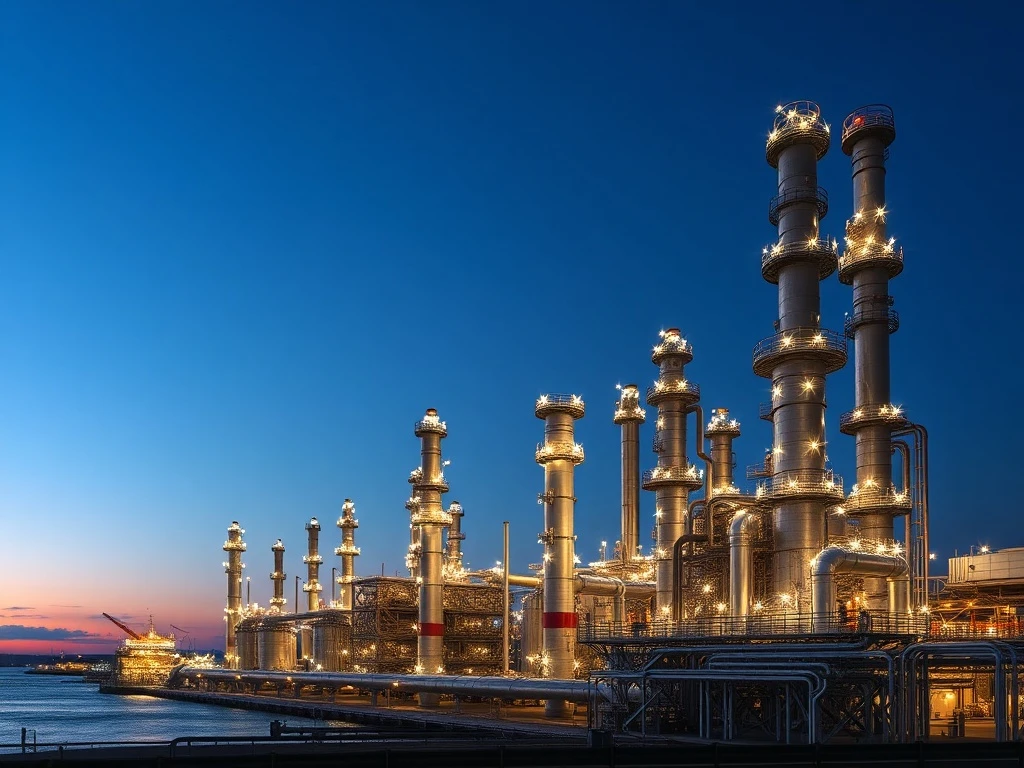
NEW YORK, March 13, 2026 — Natural gas prices climbed sharply in Thursday trading, closing up 0.75% as geopolitical tensions in the Middle East created carry-over support from crude oil’s dramatic surge. The April Nymex natural gas contract (NGJ26) settled at $3.214 per million British thermal units, gaining +0.024 on the session. This rally marks the continuation of a volatile week for energy commodities, directly tied to escalating conflict in Iran and its immediate impact on global shipping channels. Trading floors from Chicago to London monitored developments minute-by-minute as Iran’s Supreme Leader Ayatollah Mojtaba Khamenei explicitly threatened to close the Strait of Hormuz, through which approximately 20% of global LNG shipments transit.
Geopolitical Flashpoint: The Strait of Hormuz Crisis
The immediate catalyst for Thursday’s natural gas price movement came from Tehran. At 9:47 AM local time, Ayatollah Khamenei stated Iran would exercise its “leverage of closing the Strait of Hormuz” and continue attacks on Gulf Arab neighbors. Concurrently, UK Defense Secretary John Healey told Parliament that intelligence showed Iran was “increasingly evident” in laying mines within the strategic waterway. This one-two punch of verbal threat and tangible military action sent shockwaves through commodity markets. The Strait of Hormuz serves as the only sea passage from the Persian Gulf to the open ocean, making it indispensable for Qatar’s massive LNG exports and crude oil shipments from Saudi Arabia, the UAE, and Kuwait. A closure would strand millions of cubic feet of natural gas destined for Europe and Asia, forcing immediate demand shifts to alternative suppliers, primarily the United States.
This crisis follows last Monday’s Iranian drone attack on Qatar’s Ras Laffan plant, the world’s largest natural gas export facility. While the plant has since partially resumed operations, the attack demonstrated Iran’s capability and willingness to target critical energy infrastructure. The Ras Laffan facility alone accounts for roughly 20% of global liquefied natural gas supply. Its temporary closure last week caused European natural gas prices to spike to a three-year high, creating a price umbrella that lifted US benchmarks. The events create a dangerous new normal for energy traders, who must now price in persistent supply disruption risks from the Persian Gulf for the first time since 2022.
Market Mechanics: Inventory Data Versus Geopolitical Premium
Thursday’s price gains occurred despite bearish fundamental data from the US Energy Information Administration. The EIA reported natural gas inventories fell by only 38 billion cubic feet for the week ended March 6. This draw was smaller than the market consensus expectation of a 41 bcf withdrawal and substantially below the five-year average draw of 64 bcf for this period. Typically, such a report would pressure prices lower. However, the geopolitical premium overwhelmed domestic storage concerns. As of March 6, total US natural gas inventories stood at 2.12 trillion cubic feet, just 0.9% below the five-year seasonal average, indicating comfortable supply levels in a vacuum.
- Production Strength: US dry gas production hit 112.3 bcf/day on Thursday, a 5.3% year-over-year increase according to BloombergNEF data.
- Demand Metrics: Lower-48 state gas demand reached 84.7 bcf/day, up 7.8% year-over-year, while LNG export flows to US terminals hit 20.2 bcf/day, a 5.4% weekly increase.
- European Storage: Contrasting sharply with US levels, gas storage in Europe was only 29% full as of March 10, compared to a five-year seasonal average of 43% for this date.
Expert Analysis: The Decoupling of Fundamentals
“We’re witnessing a classic case of headline risk decoupling prices from underlying fundamentals,” explained Dr. Sarah Chen, Senior Commodity Strategist at the Global Energy Institute. “The EIA report was objectively bearish—smaller draw, robust production, mild weather forecasts. But the market is trading the probability of a Strait of Hormuz closure, not storage levels in Pennsylvania.” Chen, who has tracked global gas markets for fifteen years, noted that the options market shows traders are paying record premiums for call options on natural gas futures, betting on further spikes. Meanwhile, the Edison Electric Institute reported US electricity output rose 1.00% year-over-year for the week ended March 7, providing underlying demand support. The mixed signals create a treacherous trading environment where algorithmic systems reacting to headlines clash with fundamental models analyzing storage data.
Structural Shifts: US LNG’s Rising Role in Global Security
The crisis accelerates a structural shift already years in the making: the United States’ emergence as the world’s swing LNG supplier. US export capacity has grown exponentially since 2020, and terminals along the Gulf Coast can now redirect cargoes to Europe or Asia within days. This flexibility gives Washington and Brussels diplomatic leverage previously held by Moscow and Doha. The February 17 EIA forecast revision upward for 2026 US dry natural gas production to 109.97 bcf/day now appears prescient. Active US natural gas rigs reached a 2.5-year high of 134 last Friday before dipping slightly to 132 this week, according to Baker Hughes data. This production growth positions the US to backfill any supply gaps created by Middle Eastern disruption.
| Region | Storage Level (% Full) | Year-Over-Year Change |
|---|---|---|
| United States | ~60% | +8.8% |
| Europe | 29% | -14% |
| Japan (LNG Inventory) | ~55% | +2% |
The table highlights the stark transatlantic storage disparity. Europe entered the winter with depleted reserves following the prolonged 2025 Russia-Ukraine pipeline disputes and never fully recovered. A cold snap in February drew inventories down further. Consequently, European benchmarks like the Dutch TTF remain highly sensitive to supply shocks, creating upward pressure that lifts US Henry Hub prices through arbitrage. Every cargo diverted from the US Gulf to Rotterdam tightens the domestic market, regardless of local weather or storage.
Weather and Demand: The Shoulder Season Wildcard
Complicating the short-term outlook are mixed weather forecasts across North America. The Commodity Weather Group predicts well-above-average temperatures across the western half of the United States from March 17-21, which would reduce heating demand. Simultaneously, cooler readings are expected in the East, potentially extending the heating season there. This regional divergence makes aggregate demand forecasting difficult. The period between winter heating and summer cooling demand—known as the shoulder season—typically sees price weakness as storage injections begin. However, this year, geopolitical factors may override seasonal patterns. Traders are closely monitoring the National Oceanic and Atmospheric Administration’s updated spring outlook, due March 20, for clues about air conditioning demand projections.
Industry Response: Producers and Consumers Adjust
Major US producers have been cautiously optimistic. “Our operations are running at full capacity, and we’re prepared to meet additional export demand if called upon,” said Michael Torres, CEO of a leading Appalachian basin producer, speaking on condition his company not be named due to compliance restrictions. On the consumer side, industrial gas users, particularly in the fertilizer and chemical sectors, have begun hedging their summer needs earlier than usual, locking in prices amid the volatility. The Electricity Consumers Resource Council issued a statement urging regulators to “ensure domestic affordability is not sacrificed for export opportunities,” highlighting the policy tension between energy security and consumer protection.
Conclusion
Natural gas prices remain on a knife’s edge, pulled between robust domestic production and frightening geopolitical risks thousands of miles away. The March 13 rally demonstrates that in today’s interconnected global market, a mine in the Strait of Hormuz can lift prices in Louisiana. While US inventories are adequate and production strong, the market is pricing in a non-zero probability of a prolonged Middle Eastern supply disruption that would require massive US LNG exports to fill. Traders should monitor three key developments: official statements from the US Fifth Fleet regarding Strait security, weekly Baker Hughes rig counts for production signals, and European Union emergency energy council meetings scheduled for next week. The coming days will test whether the geopolitical premium sustains or whether fundamentals reassert control as the shoulder season progresses.
Frequently Asked Questions
Q1: Why did natural gas prices rise on March 13, 2026?
Prices gained 0.75% primarily due to carry-over support from surging crude oil markets and escalating geopolitical tensions. Iran’s threat to close the Strait of Hormuz, a critical shipping channel for LNG, created fears of global supply disruptions, outweighing a bearish US inventory report.
Q2: How does the Strait of Hormuz affect natural gas markets?
Approximately 20% of global liquefied natural gas shipments, primarily from Qatar, transit the Strait of Hormuz. A closure would immediately remove significant supply from the market, forcing Europe and Asia to compete for alternative cargoes, primarily from the United States, driving up prices worldwide.
Q3: What was in the EIA report released on March 13?
The US Energy Information Administration reported a withdrawal of 38 billion cubic feet from natural gas storage for the week ended March 6. This was smaller than the expected 41 bcf draw and well below the five-year average draw of 64 bcf, indicating weaker-than-expected demand or stronger supply.
Q4: How does US natural gas production affect global prices?
The United States has become the world’s largest LNG exporter. When global supply shocks occur, increased US exports to fill the gap tighten the domestic US market, raising the benchmark Henry Hub price that influences contracts worldwide.
Q5: What is the “shoulder season” and why does it matter?
The shoulder season refers to spring and fall periods between peak winter heating and summer cooling demand. Natural gas prices often weaken during these times as demand drops. However, geopolitical events can override this seasonal pattern, as seen currently.
Q6: How are European gas storage levels affecting US prices?
Europe entered March with storage only 29% full, far below the seasonal average. This makes European buyers desperate for LNG cargoes, creating competitive bidding against Asian buyers. US exporters can fetch higher prices abroad, which supports domestic price benchmarks through arbitrage.
This article was produced with AI assistance and reviewed by our editorial team for accuracy and quality.



