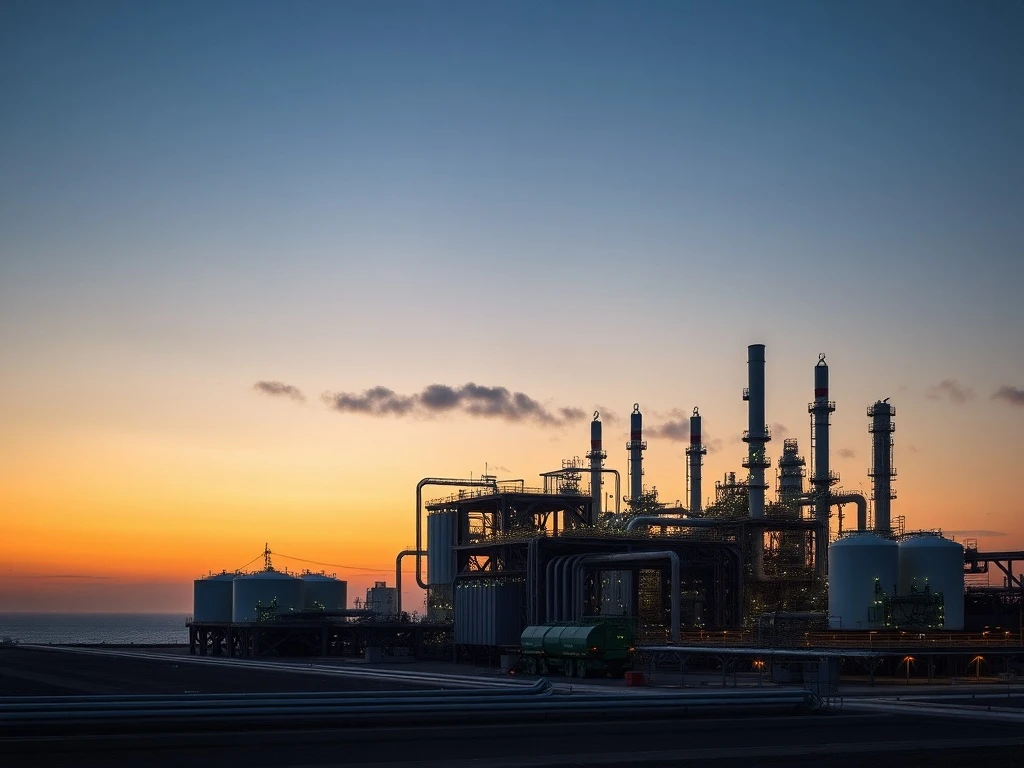
Natural gas prices climbed sharply on Thursday, March 13, 2026, as geopolitical tensions in the Middle East and a surging crude oil market provided significant carry-over support. April Nymex natural gas (NGJ26) settled at $3.214 per MMBtu, marking a 0.75% gain on the session. The rally originated from escalating conflict in Iran and its direct threat to global shipping lanes, particularly the Strait of Hormuz. This development immediately shifted market sentiment, drawing attention away from bearish domestic inventory data and toward potential global supply disruptions. Analysts at Barchart reported the move as traders priced in heightened risk premiums across the entire energy complex.
Geopolitical Flashpoint Drives Energy Market Volatility
The primary catalyst for Thursday’s rally was a series of alarming statements from Iranian leadership and Western defense officials. Iran’s Supreme Leader, Ayatollah Mojtaba Khamenei, explicitly stated that Iran’s leverage to close the Strait of Hormuz “should be used,” confirming market fears of a deliberate strategy to disrupt energy flows. Concurrently, UK Defense Secretary John Healey provided intelligence confirming that Iran was actively laying mines in the strategic waterway. “It is increasingly evident that Iran is laying mines in the Strait of Hormuz,” Healey stated, adding that this action would likely keep the passage closed for the foreseeable future. The Strait of Hormuz is a critical chokepoint, facilitating the transit of roughly 21 million barrels of oil per day, or about one-fifth of global petroleum consumption.
This geopolitical context follows a direct attack last Monday on Qatar’s Ras Laffan plant, the world’s largest natural gas export facility, by an Iranian drone. The facility’s temporary shutdown removed approximately 20% of global liquefied natural gas (LNG) supply from the market. Consequently, European natural gas prices soared to a three-year high last Tuesday, creating a bullish ripple effect across the Atlantic. The incident underscored the vulnerability of concentrated energy infrastructure and prompted a reassessment of supply security, particularly for European nations still reliant on seaborne LNG imports.
Market Impacts and Contradictory Data Signals
The bullish geopolitical narrative clashed directly with bearish fundamental data from the United States, creating a complex trading environment. The U.S. Energy Information Administration (EIA) reported that natural gas inventories for the week ended March 6 fell by 38 billion cubic feet (bcf). This withdrawal was smaller than the market consensus expectation of a 41 bcf draw and significantly below the five-year average weekly draw of 64 bcf for this period. As of March 6, total working gas in storage stood at 2,087 bcf, which was 8.8% higher than the same time last year and only 0.9% below the five-year average, indicating ample domestic supply.
- Production Versus Demand: U.S. dry gas production in the lower-48 states reached 112.3 bcf per day on Thursday, a 5.3% year-over-year increase according to BloombergNEF (BNEF). Meanwhile, lower-48 gas demand was 84.7 bcf/day, up 7.8% year-over-year. This production surplus creates a fundamental headwind for prices.
- LNG Export Strength: A key supportive factor was robust export activity. Estimated LNG net flows to U.S. export terminals hit 20.2 bcf/day on Thursday, a 5.4% week-over-week increase. The Ras Laffan disruption boosted expectations for sustained strong U.S. LNG exports to fill the global gap.
- Weather’s Mixed Role: The Commodity Weather Group forecast well-above-average temperatures across the western U.S. from March 17-21, which would reduce heating demand. However, cooler readings in the East provided some offsetting support, leading to a neutral-to-bearish net weather effect.
Expert Analysis and Institutional Forecasts
Market analysts emphasized the tension between short-term geopolitical risk and long-term supply fundamentals. “The market is currently being pulled in two directions,” explained Rich Asplund, commodity analyst at Barchart. “The immediate fear of a prolonged Hormuz closure is overriding what is otherwise a comfortable storage situation and record production.” The EIA’s own February Short-Term Energy Outlook reinforced the bearish supply picture, raising its forecast for 2026 U.S. dry natural gas production to 109.97 bcf/day from a previous estimate of 108.82 bcf/day. Furthermore, the active U.S. natural gas rig count, as reported by Baker Hughes, remains elevated. Despite a slight dip of 2 rigs to 132 in the week ending March 6, the count is still near a 2.5-year high, having risen steadily from a 4.75-year low of 94 rigs in September 2024.
Broader Energy Context and Historical Precedents
Thursday’s price action fits a historical pattern where natural gas, often viewed as a regional commodity, demonstrates increased correlation with global oil prices during periods of systemic supply risk. The closure of the Strait of Hormuz would represent a supply shock of a magnitude not seen since the 2019 attacks on Saudi Aramco facilities or the early 2020s disruptions following Russia’s invasion of Ukraine. The table below compares key supply chokepoint events and their impact on U.S. natural gas prices.
| Event | Date | Price Impact (Next Day) | Duration of Effect |
|---|---|---|---|
| Drone Attacks on Saudi Aramco | Sep 2019 | +14.2% | ~3 Weeks |
| Russia-Ukraine War Escalation | Feb 2022 | +9.8% | ~6 Months |
| Qatar Ras Laffan Attack | Mar 9, 2026 | +6.1% | Ongoing |
| Iran Strait of Hormuz Threats | Mar 13, 2026 | +0.75% (Session) | To Be Determined |
In Europe, the situation appears more acute. Gas storage on the continent was only 29% full as of March 10, compared to a five-year seasonal average of 43% for this time of year. This lower buffer makes European markets exceptionally sensitive to any LNG supply interruption, creating a price spike that U.S. exporters are poised to capitalize on. The Edison Electric Institute provided a modest bullish signal for domestic demand, reporting that U.S. electricity output in the week ended March 7 rose 1.00% year-over-year to 78,133 gigawatt-hours.
Forward-Looking Market Trajectory and Key Risks
The immediate market focus will remain on military and diplomatic developments in the Persian Gulf. Any confirmation of mine-laying or ship interdiction by Iranian forces would likely trigger another sharp price increase. Conversely, signs of de-escalation or the opening of alternative diplomatic channels could see the geopolitical risk premium rapidly unwind. Traders are also monitoring the restart timeline for the Ras Laffan facility. A prolonged outage would continue to tighten the global LNG balance sheet, supporting U.S. export economics and, by extension, domestic prices. The approaching “shoulder season”—the period between winter heating demand and summer cooling demand—typically exerts downward pressure on prices, but this year it may be overshadowed by international events.
Industry and Stakeholder Reactions
Major energy companies with exposure to LNG exports, including those with operations along the U.S. Gulf Coast, are reportedly assessing the security of their own supply chains and export schedules. Industrial consumers of natural gas, particularly in the manufacturing and chemical sectors, have expressed concern about sustained price volatility impacting operating costs. Meanwhile, regulatory bodies and grid operators are stress-testing scenarios involving prolonged high prices or supply constraints, though most emphasize that U.S. storage levels provide a significant cushion against physical shortage.
Conclusion
The March 13 rally in natural gas prices underscores the commodity’s heightened sensitivity to global geopolitical risk, even in an era of abundant domestic supply. While U.S. fundamentals—including strong production, near-average storage, and a mixed weather forecast—suggest price moderation, the threat to the Strait of Hormuz has injected a powerful and unpredictable bullish element. The key takeaways for market participants are the renewed correlation between oil and gas, the fragility of global LNG supply chains, and the critical importance of the Persian Gulf to energy market stability. Investors and analysts should monitor official statements from the U.S. Fifth Fleet and the UK’s Royal Navy regarding Strait security, as these will provide the next clear directional signal for natural gas prices.
Frequently Asked Questions
Q1: Why did natural gas prices rise on March 13, 2026?
Prices gained primarily due to carry-over support from a surging crude oil market and escalating geopolitical tensions. Iran’s Supreme Leader threatened to close the Strait of Hormuz, a vital oil transit chokepoint, and the UK Defense Secretary confirmed Iran was laying mines there, raising fears of a major global energy supply disruption.
Q2: How does the conflict in Iran affect U.S. natural gas markets?
It affects them indirectly but significantly. A closure of the Strait of Hormuz would spike global oil and LNG prices. Since the U.S. is a major LNG exporter, higher global prices improve export economics, pulling more U.S. gas overseas and tightening domestic supply, which supports higher prices at home.
Q3: Did the EIA storage report support higher prices?
No, the weekly EIA report was actually bearish. Inventories fell by 38 billion cubic feet, which was a smaller draw than the market expected (41 bcf) and much smaller than the five-year average draw (64 bcf). The bullish geopolitical news simply overpowered this bearish data.
Q4: What is the “shoulder season” and how does it impact gas prices?
The shoulder season is the period between peak winter heating demand and peak summer cooling demand, typically in spring and fall. Demand is usually lower, which often leads to price declines. However, this year, international supply risks may delay or mute that typical seasonal pattern.
Q5: How full is natural gas storage in the U.S. and Europe?
As of March 6, U.S. storage was 0.9% below the five-year average, indicating ample supply. In stark contrast, European gas storage was only 29% full as of March 10, compared to a five-year average of 43% for that date, making Europe far more vulnerable to supply shocks.
Q6: What should consumers watch for next?
Consumers and investors should monitor official statements from naval forces in the Persian Gulf regarding the status of the Strait of Hormuz, any updates on the restart of Qatar’s Ras Laffan LNG plant, and the weekly U.S. EIA storage reports to gauge the balance between geopolitical risk and fundamental supply.
This article was produced with AI assistance and reviewed by our editorial team for accuracy and quality.