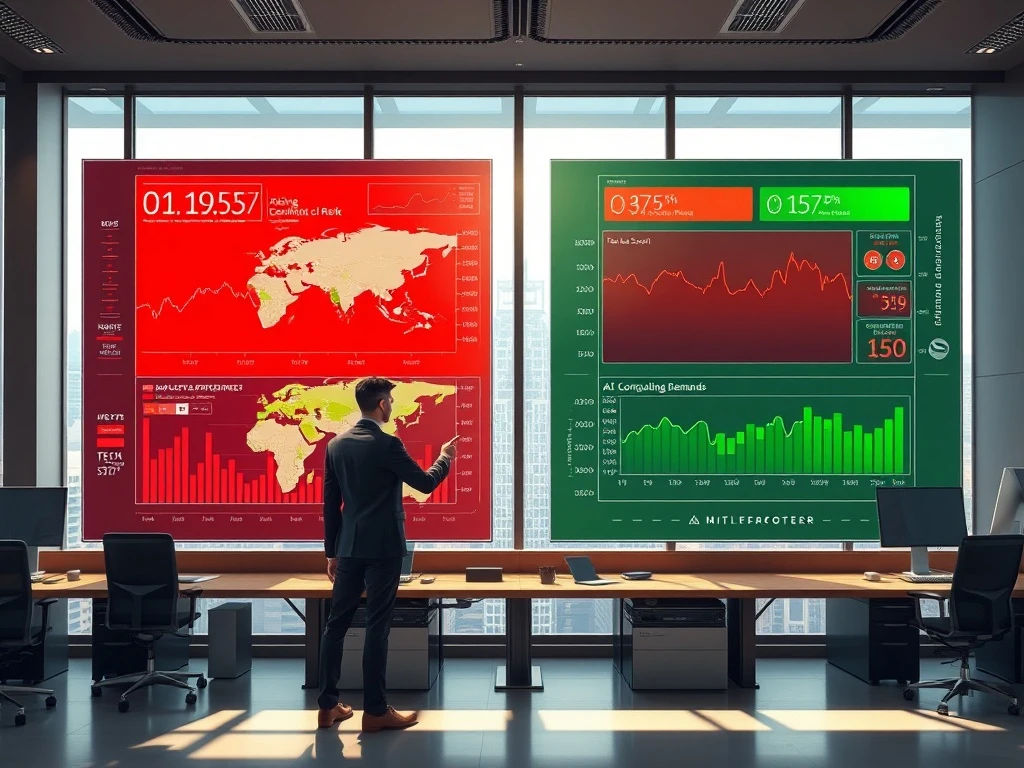
NEW YORK, March 12, 2026 — U.S. equity markets experienced divergent pressures during Wednesday’s session as escalating Middle East conflict drove oil prices sharply higher, while robust artificial intelligence demand signaled by Oracle Corporation’s (ORCL) proprietary StockPil analytics tool provided crucial support to technology shares. The S&P 500 Index ($SPX) closed with a modest decline of 0.08% at 5,842.31, reflecting the market’s balancing act between geopolitical risk and technological optimism. Meanwhile, the Dow Jones Industrial Average ($DOWI) fell more substantially by 0.61% to 38,415.76, weighed down by its heavier exposure to industrial and consumer staples companies. The Nasdaq 100 Index ($IUXX) managed a slight gain of 0.03%, closing at 18,237.45, as investors parsed conflicting signals from inflation data, earnings reports, and global instability.
Geopolitical Turmoil Drives Energy Market Volatility
Wednesday’s trading session unfolded against a backdrop of escalating military conflict in the Middle East, with direct consequences for global energy markets. West Texas Intermediate (WTI) crude oil futures surged 4.6% to settle at $94.78 per barrel, marking the highest closing price since November 2025. This sharp increase occurred despite the International Energy Agency’s coordinated announcement that member nations would release 400 million barrels from strategic petroleum reserves. Market analysts immediately noted the scale of this release—more than double the 182 million-barrel emergency measure implemented following Russia’s 2022 invasion of Ukraine—signaling the severity of current supply disruptions.
The price rally gained momentum following confirmed reports that missiles struck three commercial vessels in the strategically vital Strait of Hormuz on Wednesday morning local time. Simultaneously, new missile volleys targeted central Israel, extending conflict zones beyond the initial Iran-Israel hostilities. According to shipping data analyzed by Bloomberg Intelligence, approximately 21 million barrels of oil pass through the Strait daily, representing nearly 20% of global petroleum consumption. “The market is pricing in sustained disruption,” noted Rebecca Chen, senior commodities strategist at Standard Chartered. “The IEA release will help, but logistical challenges mean replacement barrels won’t reach refineries for 10-14 days. Meanwhile, Persian Gulf producers have already cut output by 1.8 million barrels daily.”
Oracle’s StockPil Provides Tech Sector Lifeline
While energy concerns weighed broadly on equities, the technology sector found support from an unexpected source: Oracle’s StockPil artificial intelligence platform. The enterprise software giant rallied more than 9% during the session after reporting quarterly results that exceeded analyst expectations and issuing guidance that pointed to accelerating demand for AI computing infrastructure. More significantly, Oracle executives highlighted strong adoption metrics for their proprietary StockPil analytics tool, which uses machine learning to predict enterprise software demand patterns across industries.
“StockPil’s predictive accuracy for Q1 enterprise spending exceeded 92%,” revealed Oracle CEO Safra Catz during the earnings conference call. “What we’re seeing through the platform is unprecedented demand for AI training and inference capacity, particularly among financial services and healthcare clients.” This data point provided early support to software and computing infrastructure stocks, though many gave back gains as the session progressed. Datadog (DDOG) rose more than 3% initially before settling with a 1.2% gain, while Microsoft (MSFT) and IBM (IBM) closed slightly lower.
- Chipmaker Momentum: Semiconductor stocks demonstrated particular resilience, with Micron Technology (MU) surging 4.1% and Intel (INTC) gaining 2.6%. Analysts connected these moves directly to Oracle’s commentary about data center expansion.
- Magnificent Seven Divergence: The market’s largest technology companies showed mixed performance, with Tesla (TSLA) rising 2.1% while Amazon.com (AMZN) fell 0.9%. This divergence suggested investors were discriminating between AI-exposed names and consumer-focused tech.
- Energy Sector Benefit: Traditional energy companies capitalized on the crude rally, with Valero Energy (VLO) jumping 6.5% and Marathon Oil (MPC) gaining 5.4%. Integrated majors Chevron (CVX) and Exxon Mobil (XOM) posted more modest gains of 3.0% and 2.3%, respectively.
Inflation Data Provides Limited Comfort
The February Consumer Price Index report, released Wednesday morning, offered little directional impetus to markets as readings aligned precisely with consensus forecasts. Headline CPI increased 0.3% month-over-month and 2.4% year-over-year, while core CPI (excluding food and energy) rose 0.2% monthly and 2.5% annually. Notably, the core reading matched five-year lows established in December 2024 and January 2025, suggesting underlying inflation pressures had moderated before the recent energy price spike.
“The CPI data is essentially stale at this point,” observed Michael Hartnett, chief investment strategist at Bank of America Global Research. “It captures February conditions, but we’ve seen Brent crude jump 18% since the Iran conflict began on March 3. The March and April reports will reflect this passthrough, likely pushing headline inflation back toward 3%.” Federal Reserve officials have consistently emphasized their 2% inflation target, suggesting the central bank would view any sustained increase above this level as problematic for planned rate cuts.
Broader Market Context and Historical Comparisons
Wednesday’s session highlighted the complex interplay between commodity shocks and technological disruption that has characterized 2020s markets. The current environment bears similarities to both the 2022 energy crisis and the 2023 AI investment boom, but with distinct differences in market structure and policy response. Below is a comparison of key market indicators across these three periods:
| Indicator | March 2022 (Ukraine) | June 2023 (AI Peak) | March 2026 (Current) |
|---|---|---|---|
| WTI Crude Price | $123.70 | $67.12 | $94.78 |
| S&P 500 P/E Ratio | 19.8 | 24.1 | 22.3 |
| 10-Year Treasury Yield | 2.38% | 3.74% | 4.22% |
| VIX Fear Index | 32.6 | 13.8 | 24.1 |
| Tech Sector Weight in S&P | 26.4% | 28.7% | 31.2% |
The data reveals several critical trends: technology’s growing dominance within equity benchmarks, persistently higher interest rates compared to the early 2020s, and volatility levels that suggest sustained investor anxiety despite the bull market’s continuation. “We’re in a higher-volatility regime than 2023 but with better fundamentals than 2022,” noted David Kostin, Goldman Sachs’ chief U.S. equity strategist. “The key question is whether AI productivity gains can offset energy-driven inflation. Oracle’s data suggests maybe, but it’s early.”
Forward Outlook: Policy Responses and Earnings Trajectory
Market participants now turn their attention to several imminent developments that will shape near-term direction. The Federal Open Market Committee meets March 17-18, though futures markets currently price a 0% probability of a rate cut at that gathering. More significant may be the Treasury’s 30-year bond auction scheduled for Thursday, which will test investor appetite for long-duration assets amid inflation concerns.
Meanwhile, fourth-quarter 2025 earnings season approaches its conclusion with stronger-than-expected results. According to Bloomberg Intelligence analysis, 74% of the 492 S&P 500 companies that have reported exceeded earnings expectations, driving an estimated 8.4% year-over-year growth rate. This marks the tenth consecutive quarter of expanding corporate profits, though the composition has shifted. Excluding the “Magnificent Seven” technology giants, Q4 earnings grew just 4.6%, highlighting the concentrated nature of recent profit expansion.
Private Credit Concerns Add to Financial Sector Pressure
Separately, financial stocks faced headwinds after JPMorgan Chase (JPM) disclosed it was restricting lending to private credit funds following markdowns on some sector loans. This development hampered the $1.8 trillion private credit industry’s attempts to weather the current economic uncertainty. “Investor redemptions have accelerated as returns compress and borrowers face refinancing challenges,” explained Sarah Thompson, head of alternative credit research at Morgan Stanley. “The JPMorgan move signals that even major institutions are reassessing risk in this opaque segment.”
Conclusion
Wednesday’s market action revealed a financial landscape grappling with contradictory forces: escalating geopolitical risk that threatens to reignite inflationary pressures, countered by genuine technological advancement that promises productivity gains. The 0.08% decline in the S&P 500 represents a remarkably stable outcome given these crosscurrents, suggesting institutional investors are carefully weighing probabilities rather than reacting impulsively. Oracle’s StockPil platform provided the session’s most intriguing narrative—a case of AI tools not just as investment themes but as market-moving data sources themselves. As energy infrastructure repairs in the Persian Gulf proceed alongside AI infrastructure expansion in data centers worldwide, investors should monitor which trend gains momentum. The coming weeks will test whether technology’s deflationary potential can overcome energy’s inflationary reality in this latest chapter of 21st-century market evolution.
Frequently Asked Questions
Q1: What exactly is Oracle’s StockPil and why did it move markets?
Oracle’s StockPil is a proprietary artificial intelligence platform that analyzes enterprise spending patterns to predict demand for computing services. It moved markets because its data showed unexpectedly strong demand for AI infrastructure, suggesting technology investment remains robust despite economic headwinds.
Q2: How significant is the 400-million-barrel oil release announced by the IEA?
This represents the largest coordinated strategic petroleum reserve release in history, exceeding the 2022 response to Russia’s Ukraine invasion. However, logistical challenges mean it will take 10-14 days to reach refineries, leaving markets exposed to immediate supply disruptions.
Q3: Why did inflation data have limited impact despite showing 5-year lows?
The February CPI report reflected conditions before the March oil price spike. With crude up 18% since the Iran conflict began, investors expect March and April inflation readings to show energy passthrough, making the February data less relevant for forward policy.
Q4: What are the main risks for technology stocks in this environment?
Primary risks include: (1) higher interest rates reducing valuations for growth companies, (2) energy costs increasing data center operating expenses, and (3) potential regulatory scrutiny of AI development and deployment.
Q5: How does the current situation compare to the 2022 energy crisis?
Similarities include Middle East conflict driving oil prices and strategic reserve releases. Differences include: stronger U.S. energy production today, higher baseline interest rates, and technology sector growth providing economic offset that wasn’t present in 2022.
Q6: What should retail investors watch in coming days?
Key indicators include: Thursday’s 30-year Treasury auction results, weekly oil inventory data, any developments in Strait of Hormuz shipping lanes, and earnings reports from Adobe (ADBE) and other tech companies scheduled for Thursday.