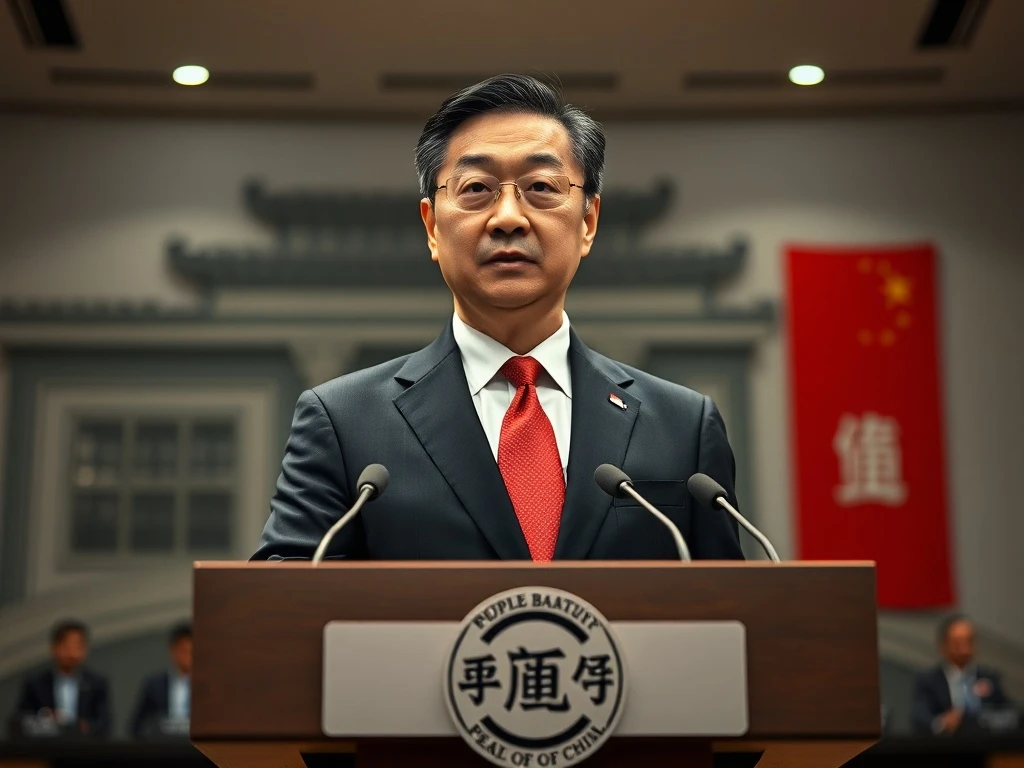
BEIJING, March 15, 2026 — People’s Bank of China Governor Pan Gongsheng announced today that China’s central bank will guide adjustments in interest rate levels based on evolving economic operations. The statement, delivered during the quarterly monetary policy briefing at the PBoC headquarters, signals potential shifts in China’s monetary stance as global economic uncertainty persists. Governor Pan’s remarks come amid mixed economic indicators showing 4.8% GDP growth in the first quarter of 2026, slightly below government targets. Market analysts immediately scrutinized the language for clues about the timing and direction of potential interest rate adjustments, with particular attention to the loan prime rate and reserve requirement ratios.
PBoC’s Monetary Policy Guidance Framework
Governor Pan outlined a data-dependent approach to monetary policy during his 45-minute presentation. “We will maintain flexibility in our policy toolkit,” Pan stated, reading from prepared remarks. “Future adjustments to interest rate levels will be guided comprehensively by domestic economic operations, price stability considerations, and external financial conditions.” The PBoC governor emphasized the central bank’s commitment to supporting reasonable credit growth while preventing financial risks. This balanced approach reflects China’s current economic position between stimulus needs and inflation concerns, with consumer prices rising 2.1% year-over-year in February 2026.
Historical context reveals this guidance follows three consecutive quarters of policy rate stability. The last adjustment occurred in September 2025 when the PBoC cut the one-year loan prime rate by 10 basis points to 3.35%. Since then, economic indicators have shown uneven recovery across sectors. Manufacturing PMI reached 51.2 in February, while services PMI dipped to 49.8, indicating contraction. This sectoral divergence complicates the PBoC’s policy calibration, requiring nuanced responses rather than broad stimulus measures.
Immediate Market Reactions and Economic Impacts
Financial markets responded swiftly to Governor Pan’s guidance. The Shanghai Composite Index closed 0.8% higher, while the offshore yuan strengthened 0.3% against the U.S. dollar. Government bond yields edged lower across most maturities, reflecting expectations of continued accommodative policy. “The market interprets this as dovish signaling,” noted Zhang Wei, chief economist at China International Capital Corporation. “However, the data-dependent framework means actual moves could go either direction depending on next month’s economic releases.”
- Corporate borrowing costs: Medium-term lending facility rates may see adjustment within 30-60 days if economic data weakens further
- Property market implications: Mortgage rates could stabilize or decline slightly, supporting the government’s targeted property sector recovery efforts
- Currency stability: The yuan may face depreciation pressure if rate differentials with major economies widen significantly
Expert Analysis of PBoC’s Strategic Position
Monetary policy specialists offered varied interpretations of today’s guidance. Dr. Li Xun, former PBoC advisor and current professor at Tsinghua University, emphasized the conditional nature of the statement. “This isn’t a commitment to cut rates,” Li explained during a telephone interview. “Rather, it’s a framework announcement that prepares markets for potential adjustments in either direction. The PBoC maintains maximum flexibility while managing expectations.” External analysis from the International Monetary Fund’s latest China assessment, published February 2026, recommended “targeted monetary support” to bolster consumption and private investment without fueling financial imbalances.
Comparative Global Central Bank Approaches
China’s data-dependent guidance places the PBoC alongside other major central banks navigating post-pandemic economic normalization. However, China’s policy space differs significantly due to its managed exchange rate regime and capital controls. The Federal Reserve currently maintains its benchmark rate at 4.25-4.50%, while the European Central Bank holds its main refinancing rate at 3.75%. This creates approximately 100-125 basis points of differential with China’s policy rates, influencing cross-border capital flows.
| Central Bank | Current Policy Rate | Forward Guidance Stance |
|---|---|---|
| People’s Bank of China | 3.35% (1-year LPR) | Data-dependent, flexible adjustments |
| Federal Reserve | 4.25-4.50% | Higher for longer, watching inflation |
| European Central Bank | 3.75% | Cautious, dependent on wage growth |
| Bank of Japan | -0.10% | Ultra-accommodative, gradual normalization |
Forward-Looking Policy Trajectory and Implementation Timeline
The PBoC’s next policy decision window opens in mid-April 2026, coinciding with first-quarter GDP data release. Most analysts expect the central bank to maintain current rates unless March economic indicators show significant deterioration. “The threshold for action appears higher for cuts than for hikes,” observed Chen Long, partner at Plenum China Research. “Governor Pan emphasized ‘comprehensive assessment,’ suggesting multiple indicators must align before policy shifts.” Key monitoring points include industrial production growth, fixed asset investment trends, and export performance, all scheduled for release between March 25-31.
Industry and Regional Response Patterns
Business leaders expressed cautious optimism about the PBoC’s guidance framework. “Predictability matters more than specific rate levels,” stated Wang Jian, CEO of a major manufacturing conglomerate in Guangdong. “Knowing the central bank will respond to economic conditions helps our investment planning.” Provincial governments in economically weaker regions like Heilongjiang and Gansu have reportedly requested targeted lending support through window guidance mechanisms. Meanwhile, financial institutions have begun adjusting their internal models to incorporate the announced framework, with major banks updating their economic forecasting methodologies this week.
Conclusion
Governor Pan Gongsheng’s announcement establishes a clear, transparent framework for future interest rate adjustments based on economic operations. The PBoC maintains substantial policy flexibility while providing markets with guidance parameters. Three key takeaways emerge: First, monetary policy will remain responsive rather than preemptive. Second, multiple data streams will inform decisions, reducing reliance on any single indicator. Third, the central bank prioritizes financial stability alongside growth objectives. Observers should monitor April economic releases and the mid-April policy meeting for implementation signals. As global economic uncertainty persists, China’s calibrated approach offers both stability assurances and responsive capacity.
Frequently Asked Questions
Q1: What exactly did PBoC Governor Pan Gongsheng announce about interest rates?
Governor Pan stated the People’s Bank of China will guide adjustments in interest rate levels based on comprehensive assessment of economic operations. This establishes a data-dependent framework rather than announcing immediate rate changes.
Q2: How will this announcement affect mortgage rates and business loans in China?
Existing loan rates won’t change automatically, but future adjustments to the loan prime rate (currently 3.35% for one-year loans) could influence new mortgage and business borrowing costs. The direction depends on upcoming economic data.
Q3: When might the PBoC actually adjust interest rates following this guidance?
The earliest possible adjustment window is mid-April 2026, when the central bank reviews policy alongside first-quarter GDP data. However, action requires convincing evidence from multiple economic indicators showing sustained deviation from targets.
Q4: How does China’s approach compare to other major economies’ monetary policies?
China maintains lower policy rates (3.35%) than the U.S. (4.25-4.50%) and Eurozone (3.75%), but has less inflation pressure. The PBoC’s managed exchange rate and capital controls provide additional policy tools unavailable to most central banks.
Q5: What economic indicators will the PBoC monitor most closely?
Key indicators include GDP growth (target ~5%), consumer inflation (currently 2.1%), manufacturing PMI (51.2), credit growth, employment data, and external trade performance. No single indicator determines policy.
Q6: How should international investors interpret this monetary policy guidance?
International investors should view this as stability-oriented signaling. The framework reduces policy surprise risk while maintaining China’s capacity to respond to economic shifts. Currency and bond markets have priced in continued accommodative bias with data-dependent flexibility.