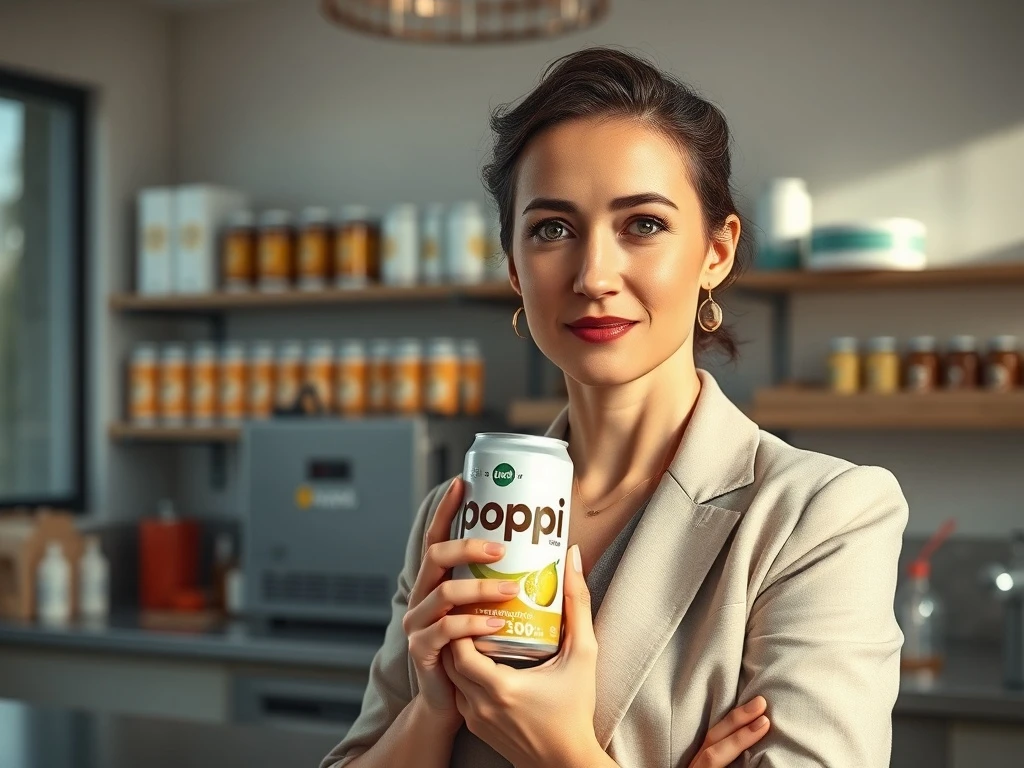
NEW YORK, NY — March 15, 2026 — Allison Ellison, the founder of prebiotic soda sensation Poppi, is detailing the unorthodox marketing playbook that transformed a kitchen experiment into a $1.95 billion acquisition by beverage giant PepsiCo. In an exclusive interview ahead of her scheduled return to ABC’s Shark Tank next week, Ellison credits a potent mix of TikTok virality, a landmark Super Bowl advertisement, and relentless community building for challenging decades of venture capital skepticism toward beverage startups. The Poppi founder‘s story provides a masterclass in modern brand building within the explosive functional soda category.
From Kitchen Counter to Carbonated Empire
Ellison started Poppi in her Austin, Texas kitchen in 2018, aiming to create a gut-healthy soda that actually tasted good. For years, venture capitalists dismissed beverage startups as capital-intensive ventures with razor-thin margins and impenetrable distribution networks. “The feedback was consistent,” Ellison recalls, citing a 2021 report from Beverage Marketing Corporation that noted over 80% of new drink brands fail within their first two years. “They saw shelves as cemeteries for good ideas.” However, Poppi’s early traction on direct-to-consumer platforms and in local retailers hinted at a shifting consumer appetite. The brand’s breakthrough came not from traditional grocery aisle warfare, but from a strategic embrace of social media authenticity.
By 2023, Poppi had cultivated a massive following on TikTok, where users shared “#GutHealthCheck” videos and recipes using the soda. This organic, creator-driven content provided a marketing engine that legacy brands couldn’t buy. “We didn’t have a nine-figure ad budget,” Ellison states. “We had a nine-figure community.” This groundswell supported the brand’s audacious decision to advertise during Super Bowl LVIII in 2024—a move typically reserved for established corporate players. The 30-second spot, featuring a humorous take on digestive health, immediately spiked online searches for Poppi by 450%, according to Google Trends data from that period.
The $1.95 Billion Validation of Functional Soda
PepsiCo’s blockbuster acquisition of Poppi in late 2025 sent shockwaves through the food and beverage industry. The deal validated the entire functional beverage sector, signaling that large conglomerates now view gut-health and wellness positioning as critical to future growth. The impact extends far beyond a single brand’s exit. First, it has unlocked unprecedented venture capital flow into the category. Data from PitchBook shows investment in functional beverage startups surged 120% in Q1 2026 compared to the previous year. Second, it has forced incumbent soda makers to rapidly innovate or acquire. Finally, it has reshaped retailer expectations, with major chains now actively curating “better-for-you” soda sections.
- Capital Influx: Venture funding for beverage startups hit a record $2.3 billion in 2025, with functional drinks claiming the lion’s share.
- Strategic Pressure: Competitors like Coca-Cola and Keurig Dr Pepper have since announced new probiotic and prebiotic lines or made their own acquisitions.
- Retail Revolution: Grocery sets are being redesigned to highlight sugar content, fiber, and probiotic claims, moving beyond just calorie count.
Expert Analysis: A Paradigm Shift in Consumer Packaged Goods
Dr. Lina Patel, a consumer packaged goods analyst at Bernstein Research, attributes Poppi’s success to a fundamental shift in how brands are built. “The old CPG model was about blanketing TV networks and fighting for endcap displays,” Patel explains. “Poppi’s model is digital-first, community-led, and proof-point driven. They built a belief system, not just a beverage.” Patel notes that this requires a different skillset from founders—one rooted in digital narrative and direct consumer engagement. Furthermore, she points to PepsiCo’s acquisition as a clear signal that large players are willing to pay premium multiples for brands with this authentic, digital-native DNA, seeing them as pipelines to younger, health-conscious consumers they struggle to reach directly.
Beyond the Hype: The Challenges of Scaling a Viral Brand
While Poppi’s story is a landmark success, it also highlights the brutal realities of scaling a viral hit into a sustainable business. The path from DTC darling to national supermarket staple is fraught with operational hurdles. For instance, securing consistent, high-quality prebiotic fiber (agave inulin) at scale became a major supply chain challenge. Additionally, the cost of goods sold for a product using premium ingredients and unique packaging remains a pressure point. The table below contrasts the traditional beverage startup path with the modern, digital-first approach exemplified by Poppi.
| Growth Driver | Traditional Beverage Startup (Pre-2020) | Modern Digital-First Model (Poppi) |
|---|---|---|
| Primary Marketing | Trade marketing, sample events, broker relationships | TikTok/Instagram creators, DTC community, performance marketing |
| Funding Path | VC -> Strategic Corporate Investment | Angel/Crowdfunding -> VC -> Rapid Exit via Acquisition |
| Proof of Concept | Regional grocery chain placement | Direct-to-consumer subscription metrics & social engagement |
| Biggest Hurdle | Physical distribution and shelf space | Maintaining authentic community culture at scale |
The Strategic Return to Shark Tank
Ellison’s upcoming return to Shark Tank is not a fundraising pitch but a strategic full-circle moment. She first appeared on the show in 2021, securing an investment from Rohan Oza that provided crucial early capital and mentorship. “Going back isn’t about the money,” Ellison clarifies. “It’s about showing aspiring entrepreneurs that the journey is real. It’s about thanking the platform that believed in us early and demonstrating what’s possible with that belief.” Industry observers see the move as a savvy brand-building exercise, reinforcing Poppi’s entrepreneurial roots just as it integrates into a global corporation. It also serves as a powerful recruitment tool, signaling to top talent that innovation remains a priority post-acquisition.
Stakeholder Reactions: From Skepticism to Celebration
The reaction within the beverage industry has evolved from skepticism to intense study. Early competitors now cite Poppi as a case study. “We watched them crack a code we didn’t fully understand,” admits the CEO of a rival kombucha brand, speaking on background. On social media, the brand’s core community has met the PepsiCo news with mixed emotions—pride in the success, but concern about potential recipe changes or loss of indie ethos. Ellison has publicly committed to maintaining Poppi’s operational independence within PepsiCo’s portfolio, a structure similar to Pepsi’s previous acquisition of SodaStream. Financial analysts, meanwhile, are scrutinizing whether PepsiCo can achieve the return on its massive investment by leveraging its distribution to accelerate Poppi’s global expansion without diluting its premium cachet.
Conclusion
The rise of Poppi from a kitchen project to a nearly $2 billion brand marks a definitive turning point for the beverage industry. Founder Allison Ellison’s blend of social media savvy, community focus, and bold marketing moves like the Super Bowl ad proved that new rules can rewrite old playbooks. The PepsiCo acquisition validates the functional soda category as a major growth vector, ensuring a wave of innovation and investment for years to come. As Ellison returns to Shark Tank, her journey offers a master blueprint: identify a genuine health need, build a digital-native community, and use that authentic power to challenge—and ultimately reshape—entire industry paradigms. The key question now is whether this model is replicable or a unique phenomenon, a debate that will define the next generation of food and beverage entrepreneurship.
Frequently Asked Questions
Q1: What exactly is Poppi, and why is it called a ‘prebiotic soda’?
Poppi is a carbonated beverage that uses agave inulin as a prebiotic fiber. Unlike probiotics (which are live bacteria), prebiotics are fibers that feed the beneficial bacteria already in your gut. Each can contains about 2 grams of fiber and is sweetened with a blend of cane sugar and stevia, with only about 5 grams of sugar.
Q2: How much did PepsiCo pay to acquire Poppi, and when did the deal close?
PepsiCo acquired Poppi for $1.95 billion in an all-cash transaction. The deal was officially announced on November 5, 2025, and closed by the end of that fiscal quarter, making it one of the largest beverage acquisitions of the year.
Q3: Why is the Poppi founder returning to Shark Tank after the acquisition?
Allison Ellison is returning to Shark Tank in a special “Update” segment, not to seek new investment. The appearance is strategic, aimed at reinforcing the brand’s entrepreneurial story, thanking early supporters like investor Rohan Oza, and inspiring other founders by showcasing a successful journey that started on the show.
Q4: What does PepsiCo’s acquisition mean for the future of Poppi’s product and brand?
PepsiCo has stated that Poppi will operate as a standalone brand within its portfolio, similar to its structure for SodaStream. The immediate plan is to leverage PepsiCo’s massive global distribution network to expand Poppi’s availability internationally, while the founding team retains control over product formulation and brand marketing to preserve its authentic identity.
Q5: How did TikTok contribute to Poppi’s massive growth?
TikTok was instrumental through organic, user-generated content. Creators used the #GutHealthCheck hashtag to share their experiences, created recipes using Poppi as a mixer, and discussed digestive wellness, driving massive awareness and credibility among Gen Z and Millennial consumers without traditional advertising spend.
Q6: What are the biggest challenges facing other beverage startups trying to replicate Poppi’s success?
Key challenges include achieving standout virality in an increasingly crowded social media landscape, managing the high cost of premium ingredients and sustainable packaging at scale, navigating complex food retail distribution systems, and ultimately building a brand with enough consumer loyalty to justify a premium price point in a competitive market.