
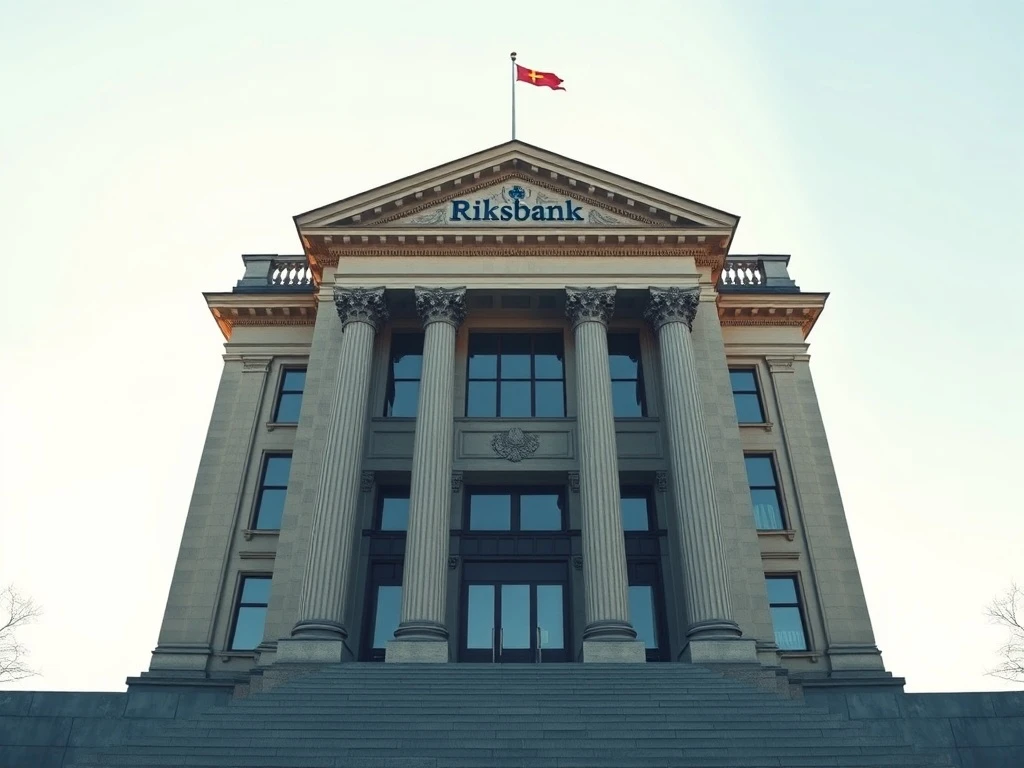
STOCKHOLM, March 15, 2026 – The Swedish Riksbank is poised for a prolonged pause in its interest rate cycle, according to a new analysis from global financial firm Nomura. This forecast for an extended hold on monetary policy places the trajectory of the Swedish Krona (SEK) squarely under the spotlight for currency traders and economists. The central bank’s cautious stance emerges against a complex backdrop of stubborn domestic service inflation and a shifting global monetary landscape, where the European Central Bank and the Federal Reserve are charting divergent courses. Consequently, market participants are now recalibrating expectations for the SEK’s performance through the remainder of the year.
Nomura’s Forecast: A Detailed Outlook for Riksbank Policy
Analysts at Nomura, led by senior strategist Peter Attard Montalto, published a client note this week arguing that the Riksbank’s next move is unlikely to be a rate cut before late 2026. This projection extends the timeline for monetary easing well beyond current market pricing. The firm’s model points to underlying inflationary pressures, particularly in the services sector, which remain above the Riksbank’s 2% target. Furthermore, recent labor market data showing wage growth of 4.1% year-on-year in the last quarter has reinforced the case for patience. The Riksbank’s own February meeting minutes revealed a governing council deeply concerned about inflation expectations becoming unanchored, a primary risk that justifies a higher-for-longer rate environment.
This analysis is not formed in a vacuum. It follows the Riksbank’s decision in February to hold its policy rate at 4.25%, a level maintained since November 2023. Governor Erik Thedéen explicitly stated that the fight against inflation was “not yet won,” signaling a clear bias toward maintaining restrictive policy. Nomura’s forecast essentially interprets this rhetoric as a commitment that will stretch across several more policy meetings. The timeline is critical; while other major central banks have begun or signaled imminent easing cycles, Sweden’s path appears uniquely constrained by its domestic price dynamics.
Implications for the Swedish Krona and Financial Markets
The direct consequence of an extended hold is a recalibration of interest rate differentials, a key driver of currency valuation. A persistently hawkish Riksbank, set against a more dovish ECB, could provide fundamental support for the SEK against the Euro. However, the currency’s sensitivity to global risk sentiment and its status as a pro-cyclical asset complicates the outlook. Nomura’s report suggests the SEK may experience periods of strength on policy divergence headlines but could remain vulnerable to broader slowdowns in European growth.
- Forex Market Volatility: Currency traders will closely monitor any shift in the Riksbank’s communication for trading signals, likely increasing short-term volatility in EUR/SEK and USD/SEK pairs.
- Swedish Bond Yields: Longer-dated Swedish government bond yields may face upward pressure as the market prices in a delayed easing cycle, affecting borrowing costs for corporations and the government.
- Export Sector Challenges: A stronger-than-anticipated SEK, supported by rate differentials, could pose headwinds for Sweden’s vital export-oriented industries, including manufacturing and technology.
Institutional and Expert Perspectives on the Stance
Nomura’s view finds both alignment and contrast with other leading institutions. Handelsbanken, in its latest quarterly review, also pushed back its forecast for the first Riksbank rate cut to early 2026, citing similar concerns over core inflation. Conversely, analysts at SEB maintain a slightly more optimistic view, projecting a first cut in November 2025 if inflation data softens convincingly over the summer. This divergence of opinion among major banks, as documented in their publicly available research, underscores the high degree of uncertainty surrounding the Swedish economic outlook. Independent economist Anna Breman, former Deputy Governor at the Riksbank, noted in a recent seminar that “the policy trade-off is exceptionally delicate,” balancing the risk of entrenched inflation against the growing strain of high mortgage costs on Swedish households.
Global Context: The Riksbank’s Path Amid Central Bank Divergence
The Swedish central bank’s potential extended hold occurs as its peers globally embark on different journeys. The Federal Reserve has signaled a pause but remains data-dependent, while the European Central Bank has explicitly guided toward a June rate cut. This creates a triangular dynamic for the SEK, caught between transatlantic monetary policies. Historically, the Riksbank has often moved in loose concert with the ECB, but current domestic inflation pressures are forcing a decoupling.
| Central Bank | Current Policy Rate | Market Expectation for First Cut | Key Inflation Metric |
|---|---|---|---|
| Swedish Riksbank | 4.25% | Late 2026 (per Nomura) | CPIF Inflation 2.9% (Feb 2026) |
| European Central Bank | 3.75% | June 2026 | HICP Inflation 2.3% (Feb 2026) |
| US Federal Reserve | 4.75% | Q3 2026 | Core PCE 2.5% (Jan 2026) |
This comparative landscape highlights Sweden’s outlier status. The nation’s inflation is driven more by domestic wage and service price dynamics than imported energy costs, which have normalized elsewhere. Therefore, the Riksbank’s mandate requires a focus on local conditions, even if it means temporarily diverging from its major trading partners’ policies. The last similar period of policy divergence was in 2010-2011, when the Riksbank hiked rates preemptively while the ECB held steady.
What Happens Next: Key Data and Decision Points
The immediate future for the Riksbank and the SEK hinges on incoming economic data. The next Consumer Price Index with Fixed Interest Rate (CPIF) release on April 10, 2026, will be scrutinized for signs of service inflation moderation. Subsequently, the Riksbank’s next monetary policy meeting on April 24 will provide the crucial platform for Governor Thedéen to either reinforce or soften the bank’s hawkish messaging. Market participants will dissect every word of the accompanying statement and the subsequent press conference for clues about the duration of the hold.
Market and Political Reactions to the Extended Hold Forecast
Initial market reaction to Nomura’s report saw a brief strengthening of the SEK, though gains were tempered by broader risk-off sentiment. Within Sweden, political reactions have begun to surface. Opposition politicians have voiced concerns about the impact of prolonged high-interest rates on mortgage holders and small businesses. Meanwhile, industry groups like the Confederation of Swedish Enterprise have issued statements urging caution, warning that an overly restrictive policy could stifle investment. This creates a delicate communication challenge for the Riksbank, which must maintain its independence while acknowledging the real economic pain its policies may cause.
Conclusion
Nomura’s analysis of an extended hold by the Riksbank underscores a critical phase for Sweden’s monetary policy and the Swedish Krona. The central bank is navigating a narrow path, compelled by domestic inflation to maintain restrictive rates even as global peers ease. For the SEK, this suggests a foundation of support from interest rate differentials, though its ultimate direction will also be swayed by the health of the European economy and global risk appetite. Investors and policymakers alike should prepare for a prolonged period of high Swedish interest rates, with every inflation and wage data point carrying heightened significance for financial markets through 2026.
Frequently Asked Questions
Q1: What does an “extended hold” mean for Riksbank interest rates?
An extended hold means Nomura forecasts the Swedish Riksbank will keep its main policy rate at the current level of 4.25% for a prolonged period, likely until late 2026, before considering any rate cuts, due to persistent underlying inflation.
Q2: How does this forecast impact the Swedish Krona (SEK)?
It could provide fundamental support for the SEK against currencies like the Euro, as higher Swedish interest rates relative to others make the krona more attractive for yield-seeking investors, though global risk sentiment remains a key factor.
Q3: What is the next key date for the Riksbank’s policy?
The next monetary policy decision is scheduled for April 24, 2026. However, the CPIF inflation data release on April 10 will be a critical input for that decision.
Q4: Why is the Riksbank potentially holding rates while other banks cut?
Sweden’s inflation, particularly in services and wages, is declining more slowly than in the eurozone, forcing the Riksbank to prioritize its domestic 2% inflation target over aligning with other central banks.
Q5: What are the risks of keeping rates high for too long?
The primary risks include excessive pressure on households with variable-rate mortgages, a potential slowdown in business investment, and an overly strong krona that hurts export competitiveness.
Q6: How reliable are Nomura’s forecasts compared to other banks?
Forecasts vary. While Nomura predicts a hold until late 2026, other major Swedish banks like SEB project a cut in late 2025, highlighting the uncertainty and data-dependent nature of the current economic environment.



