
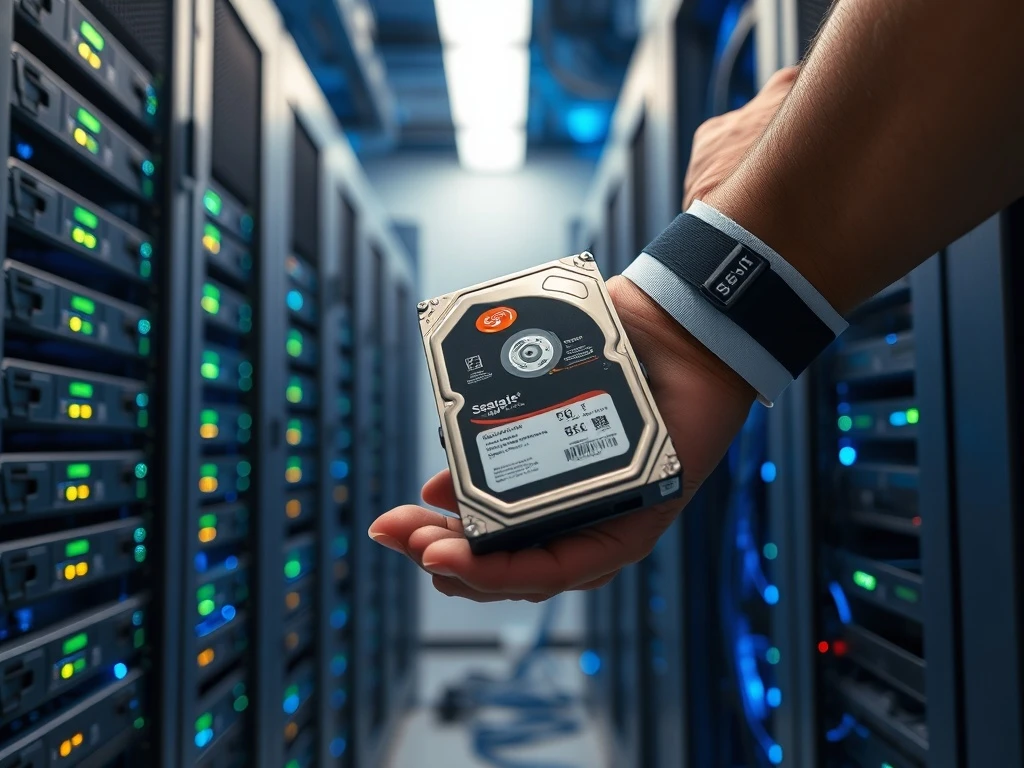
March 11, 2026 — Cupertino, California — Seagate Technology Holdings plc (STX) reported unprecedented profitability metrics in its second-quarter fiscal 2026 earnings, sparking immediate questions about whether the data storage giant can sustain its remarkable margin expansion through the remainder of the year. The company achieved a non-GAAP gross margin of 42.2%, representing a 210 basis point sequential improvement, while operating margin expanded 290 basis points to 31.9%. These results, announced this morning, reflect what management called “company records” across multiple metrics including exabyte shipments and earnings per share. The performance comes amid what industry analysts describe as the strongest data center storage demand cycle since the pre-pandemic infrastructure buildout, driven largely by artificial intelligence workloads and cloud migration acceleration.
Seagate’s Margin Expansion Driven by HAMR Technology Adoption
Seagate’s financial results reveal a strategic transformation in execution. According to the company’s earnings call transcript, the margin improvement stems directly from two interconnected factors: disciplined pricing strategy execution and a rapid mix shift toward higher-capacity drives featuring Heat-Assisted Magnetic Recording (HAMR) technology. “The quarter set company records for exabyte shipments, gross margin, operating margin and non-GAAP earnings per share,” stated Seagate’s Chief Financial Officer during the investor presentation. The company shipped what industry analysts estimate to be approximately 140 exabytes of storage capacity during the quarter, with high-capacity nearline drives for cloud data centers representing the fastest-growing segment.
HAMR technology represents Seagate’s most significant engineering breakthrough in a decade. Unlike conventional perpendicular magnetic recording, HAMR uses a tiny laser to heat the disk surface momentarily, allowing data to be written to much smaller, denser areas. This technological advancement enables drives with capacities exceeding 30 terabytes, compared to the 18-20 terabyte range of previous generation products. Consequently, as HAMR shipments ramp from pilot production to volume manufacturing, Seagate benefits from both premium pricing and improved cost structures. “Increasing capacity per drive helps lower cost per terabyte,” management explained, “as unit costs tend to remain fairly similar while more content is added per unit.”
Data Center Demand Creates Favorable Supply-Demand Dynamics
The storage industry currently operates in what analysts describe as a “goldilocks” environment for drive manufacturers. Demand from hyperscale cloud providers—including Amazon Web Services, Microsoft Azure, and Google Cloud—continues to outstrip available supply of high-capacity drives. According to data from TrendFocus, a storage industry research firm, cloud provider demand for nearline hard drives grew approximately 25% year-over-year in the fourth quarter of 2025. Meanwhile, supply remains constrained by the complex manufacturing transition to HAMR technology, which requires entirely new production equipment and processes.
- Cloud Migration Acceleration: Enterprise migration to cloud infrastructure continues unabated, with Synergy Research Group reporting cloud spending grew 19% in 2025
- AI Workload Proliferation: Training and inference of large language models require massive storage pools for training data and model parameters
- Content Creation Explosion: Video streaming, social media, and metaverse applications generate unprecedented amounts of unstructured data
Industry Analysts Weigh In on Sustainability Questions
Storage industry analysts express cautious optimism about Seagate’s margin trajectory. “Seagate’s execution on the HAMR transition has been impressive,” noted John Chen, senior storage analyst at Wells Fargo Securities. “The technology provides a clear competitive moat that should support pricing power through at least 2027.” However, Chen also highlighted potential headwinds, including potential inventory corrections if cloud spending moderates and competitive responses from Western Digital, which is pursuing its own energy-assisted recording technology. Meanwhile, Morgan Stanley’s hardware team published a research note suggesting that while near-term momentum appears strong, “the sustainability of 30%+ operating margins in the historically cyclical storage industry warrants monitoring.”
Competitive Landscape: Western Digital and Micron Also Benefit
Seagate operates in a concentrated industry where competitive dynamics significantly influence margin sustainability. Western Digital Corporation (WDC), Seagate’s primary competitor in hard disk drives, reported even stronger gross margins of 46.1% in its second fiscal quarter, up 770 basis points year-over-year. The company attributed its performance to similar factors: transition to higher-capacity drives and rigorous cost management. Meanwhile, Micron Technology (MU), while operating in the adjacent NAND flash memory market, reported staggering gross margins of 56.8%, benefiting from what CEO Sanjay Mehrotra called “the most favorable supply-demand balance in a decade” for memory chips.
| Company | Q2 FY2026 Gross Margin | Year-over-Year Change | Key Driver |
|---|---|---|---|
| Seagate (STX) | 42.2% | +680 bps | HAMR adoption, pricing discipline |
| Western Digital (WDC) | 46.1% | +770 bps | Higher-capacity drives, cost management |
| Micron (MU) | 56.8% | +1730 bps | AI memory demand, inventory normalization |
Forward Guidance Suggests Continued Momentum
Seagate’s management expressed confidence in the sustainability of current trends. For the fiscal third quarter, the company expects revenue of $2.9 billion (±$100 million), representing approximately 34% year-over-year growth at the midpoint. More significantly, non-GAAP operating margin is projected to approach “the mid-30% range,” suggesting further expansion from the current 31.9%. “We expect sequential improvement in both the top and bottom line throughout fiscal 2026,” the company stated, “supported by sustained demand and continued operational execution.” The guidance explicitly includes continued ramp-up of HAMR products, which management indicated should contribute to further gross margin improvement.
Investor Response and Valuation Considerations
The market response to Seagate’s earnings has been overwhelmingly positive, with shares rising approximately 12% in pre-market trading following the announcement. Over the past year, STX shares have skyrocketed 350.3%, dramatically outperforming the broader Computer Integrated Systems industry’s 108.4% growth. This performance reflects what portfolio managers describe as a “re-rating” of storage stocks from cyclical commodity businesses to technology infrastructure plays. However, valuation metrics now reflect elevated expectations: Seagate trades at 23.73 times forward earnings, significantly above the industry average of 15.25 times. This premium suggests investors are pricing in sustained margin expansion rather than anticipating a reversion to historical norms.
Conclusion
Seagate Technology stands at an inflection point where technological innovation, favorable industry dynamics, and disciplined execution have converged to produce record profitability. The company’s margin expansion appears sustainable through at least fiscal 2026, supported by the ongoing HAMR transition and robust data center demand. However, investors should monitor several key variables: competitive responses from Western Digital, potential moderation in cloud capital expenditures, and the pace of HAMR manufacturing ramp. While near-term momentum appears strong, the storage industry’s historical cyclicality suggests maintaining realistic expectations about how long 30%+ operating margins can persist in this capital-intensive business. For now, Seagate’s execution deserves recognition, but its margin sustainability faces an ongoing test throughout 2026.
Frequently Asked Questions
Q1: What is driving Seagate’s margin expansion in 2026?
Seagate’s margin improvement stems from two primary factors: successful adoption of HAMR (Heat-Assisted Magnetic Recording) technology, which enables higher-capacity drives with better economics, and favorable supply-demand dynamics in the data center storage market where demand outpaces available supply.
Q2: How does Seagate’s performance compare to competitors like Western Digital?
While both companies are benefiting from strong industry conditions, Western Digital reported slightly higher gross margins (46.1% vs. 42.2%) in their most recent quarters. Both attribute their performance to transitions to higher-capacity drives and disciplined cost management.
Q3: What is HAMR technology and why is it important for margins?
HAMR (Heat-Assisted Magnetic Recording) uses a tiny laser to heat disk surfaces momentarily, allowing data to be written to much denser areas. This enables drives with capacities exceeding 30TB, which command premium pricing while improving cost per terabyte economics through greater capacity per unit.
Q4: Is the current data center storage demand sustainable?
Industry analysts project strong demand through at least 2027, driven by cloud migration, AI workload proliferation, and content creation. However, the storage industry has historically been cyclical, so moderation in cloud capital expenditures represents a potential risk.
Q5: What are Seagate’s projections for the next quarter?
For Q3 fiscal 2026, Seagate expects revenue of approximately $2.9 billion (±$100 million) and operating margins approaching the mid-30% range, suggesting continued sequential improvement from current levels.
Q6: How should investors interpret Seagate’s premium valuation multiple?
Seagate’s forward P/E ratio of 23.73x reflects investor expectations of sustained margin expansion rather than a reversion to historical norms. This premium suggests the market is pricing the company more as a technology infrastructure play than as a cyclical hardware business.



