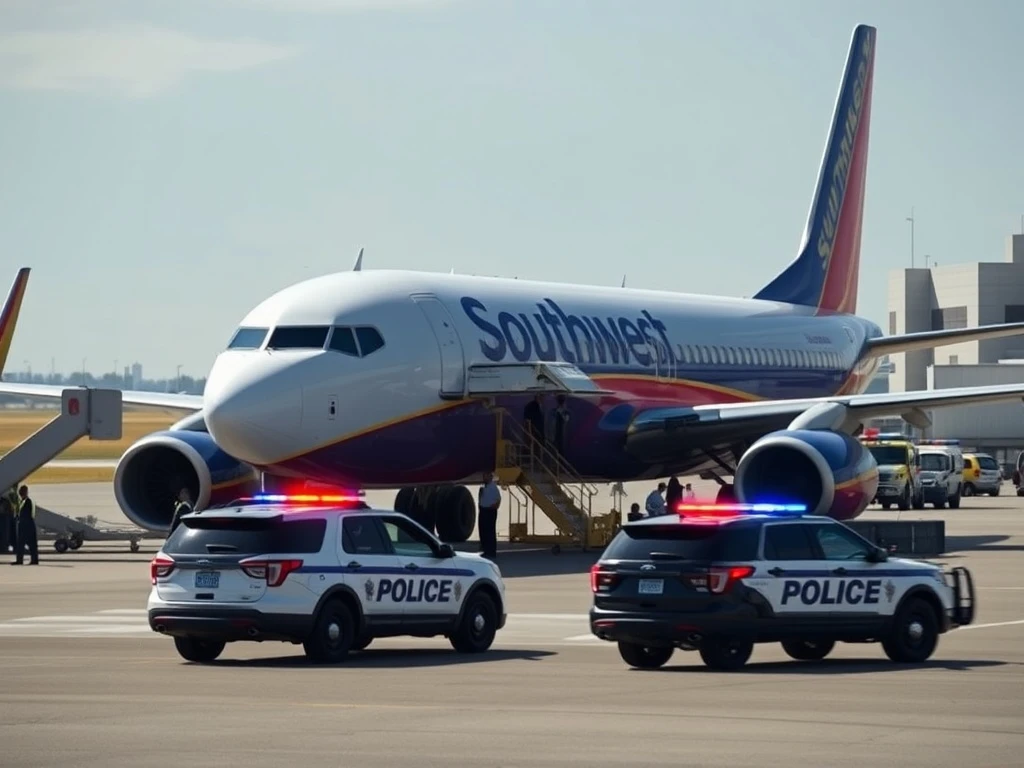
ATLANTA, GA — A Southwest Airlines flight made an emergency diversion to Hartsfield-Jackson Atlanta International Airport on Tuesday morning after a security scare prompted an armed tactical response. Flight WN 2347, operating from Baltimore/Washington International Airport to Tampa International Airport, landed under emergency protocols at approximately 10:45 AM Eastern Time. Law enforcement sources confirm armed tactical units from the Atlanta Police Department and airport security detained one male passenger following what authorities describe as a “credible security concern.” The incident caused significant disruption at the world’s busiest airport, affecting multiple concourses and delaying dozens of flights during peak morning travel hours.
Southwest Flight Diverts to Atlanta Airport Following Mid-Air Security Alert
Southwest Airlines Flight 2347 departed Baltimore at 8:15 AM with 143 passengers and six crew members aboard. Approximately 90 minutes into the scheduled two-hour flight, cabin crew reported concerning behavior from a passenger in row 12. According to preliminary reports from the Federal Aviation Administration, the captain declared an emergency and requested priority routing to Atlanta, the nearest major airport with appropriate security resources. Air traffic controllers cleared airspace around the aircraft as it descended from cruising altitude. Meanwhile, Atlanta airport authorities activated their emergency response protocol, notifying multiple law enforcement agencies. The Boeing 737-800 landed on runway 9L and taxied to a remote security area near the airport’s south cargo facilities, away from main passenger terminals.
Passenger accounts describe a tense but controlled atmosphere during the final approach. “The captain came on and said we had a security situation and needed to land immediately in Atlanta,” said Miranda Chen, a passenger seated in row 8. “Flight attendants moved people away from the middle section. They remained professional, but you could feel the anxiety building.” Chen noted that the concerning behavior involved a passenger repeatedly accessing overhead compartments and making statements that alarmed nearby travelers. Another passenger, David Rodriguez, reported seeing the individual attempting to access the forward lavatory multiple times despite crew instructions to remain seated. These observations triggered the crew’s security protocols, which follow strict FAA-mandated procedures for in-flight threats.
Armed Tactical Units Detain Passenger in Coordinated Response
As the Southwest aircraft reached its isolated parking position, a multi-agency tactical response unfolded. Atlanta Police Department’s Aviation Unit, Clayton County Police SWAT, and Transportation Security Administration Special Response Teams established a perimeter around the aircraft. Officers wearing tactical gear and carrying rifles positioned themselves near the jet bridge that was moved to the aircraft door. Video footage from airport surveillance, reviewed by authorities, shows a coordinated approach: tactical teams first secured the exterior, then boarding stairs were attached. Passengers remained onboard for approximately 25 minutes while teams assessed the situation. During this period, the individual in question was separated from other passengers in the forward galley area under crew supervision.
At 11:10 AM, tactical officers entered the aircraft and detained the passenger without incident. “The individual was compliant during the detention process,” stated Atlanta Police Department spokesperson Officer Michael Reynolds during a midday press briefing. “No weapons were found in his possession or in his carry-on luggage during the initial search.” The detained passenger, identified as 34-year-old Marcus Johnson of Richmond, Virginia, was transported to Atlanta Police headquarters for questioning. Federal Bureau of Investigation agents joined the investigation within an hour of the detention, indicating potential federal jurisdiction. Importantly, no injuries were reported among passengers, crew, or responding officers during the entire operation.
- Flight Disruption: 47 subsequent flights experienced delays averaging 85 minutes, while 12 flights were canceled entirely as security operations occupied critical ramp space.
- Terminal Impact: Concourses T and A experienced temporary access restrictions as a precaution, affecting approximately 3,200 passengers already in secure areas.
- Economic Cost: Airport operations analysts estimate the total economic impact of the four-hour disruption exceeds $1.2 million in direct operational costs and passenger delays.
Aviation Security Experts Analyze Protocol Effectiveness
Dr. Eleanor Vance, former TSA Assistant Administrator for Security Operations and current director of the Center for Aviation Security Studies, provided context about the response. “This incident demonstrates the layered security system working as designed,” Vance explained. “The cabin crew identified concerning behavior, the pilot executed proper diversion protocols, and ground resources were prepositioned appropriately. The absence of weapons doesn’t diminish the validity of the response—crews are trained to err on the side of caution with any potential threat.” Vance noted that since 2021, the FAA has recorded 142 similar security-related diversions nationwide, with approximately 68% resulting in no physical threat found. However, she emphasized that all such incidents require full protocol execution.
The International Air Transport Association’s 2025 Security Report highlights that behavioral detection remains a critical component of aviation security. IATA data shows that crew-reported concerns lead to approximately 40% of security-related diversions globally. “Crew members receive extensive training in behavioral recognition,” said IATA security director Karl Richter in a statement provided to news organizations. “When they escalate a concern, authorities must treat it with utmost seriousness regardless of eventual findings.” Richter pointed to the 2023 update to Annex 17 of the Chicago Convention, which strengthened guidelines for handling in-flight security threats and mandated improved coordination between airlines and law enforcement during diversions.
Broader Context: Aviation Security Incidents and Response Trends
Tuesday’s incident represents the third security-related diversion at a U.S. airport this month and the fourteenth this year. While statistically rare—occurring in approximately 0.003% of all commercial flights—such events trigger disproportionate disruption due to their resource-intensive responses. The Atlanta response followed protocols established after the 2024 National Aviation Security Strategy update, which emphasized integrated local-federal coordination. A comparison with similar incidents reveals evolving response patterns and outcomes.
| Date | Airline/Flight | Diversion Airport | Response Time | Outcome |
|---|---|---|---|---|
| March 3, 2026 | Delta DL 1892 | Denver (DEN) | 22 minutes | Unfounded threat |
| February 18, 2026 | American AA 447 | Chicago O’Hare (ORD) | 31 minutes | Arrest for disturbance |
| January 9, 2026 | United UA 2118 | Dallas/Fort Worth (DFW) | 28 minutes | Medical emergency |
| December 5, 2025 | Southwest WN 1123 | Phoenix (PHX) | 35 minutes | Security threat verified |
The table illustrates that most security diversions result from perceived rather than actual threats, but response times have improved consistently since 2022. Aviation security analyst James Corbin notes that post-9/11 protocols have created a “zero-tolerance environment” for in-flight disturbances. “The threshold for diversion has lowered significantly,” Corbin observed. “While this prevents potential tragedies, it also increases operational disruptions. Airlines and airports continuously balance these competing priorities through improved threat assessment technologies and crew training.” The FAA’s NextGen aviation system includes enhanced communication protocols that allow real-time threat assessment between aircraft and security centers, potentially reducing unnecessary diversions.
Operational Recovery and Investigation Timeline
Normal operations at Hartsfield-Jackson resumed by 2:30 PM Tuesday, approximately four hours after the initial diversion. Southwest Airlines deployed three additional aircraft to Atlanta to accommodate displaced passengers from the affected flight and subsequent cancellations. The airline established a rebooking center in the domestic terminal and provided meal vouchers to all passengers from Flight 2347. By 5:00 PM, 89% of affected passengers had been placed on alternative flights, with the remaining passengers accommodated in airport hotels overnight. Southwest expects to operate a recovery flight to Tampa at 7:00 AM Wednesday.
The Federal Aviation Administration has opened a formal investigation into the incident, standard procedure for all security-related diversions. Investigators will review cockpit voice recordings, flight data, and crew reports. Simultaneously, the FBI’s Joint Terrorism Task Force is examining the detained passenger’s background, travel history, and possible motivations. Atlanta Police confirmed they are holding Johnson on suspicion of interfering with flight crew members, a federal offense under 49 U.S.C. § 46504 that carries penalties up to 20 years imprisonment. No formal charges had been filed as of Tuesday evening, as investigators continued questioning.
Passenger Reactions and Industry Response
Passengers from Flight 2347 expressed mixed reactions to their experience. “I’m grateful the crew took it seriously,” said retiree Robert Gibson, who was traveling to visit family in Tampa. “Better safe than sorry, even if it ruined our travel plans.” Other passengers criticized the length of the detention onboard and the communication during the wait. Southwest Airlines issued a statement acknowledging the disruption while defending their protocols. “The safety of our customers and employees is our highest priority,” read the statement from Southwest CEO Bob Jordan. “We appreciate the professional response from authorities and apologize for the inconvenience to our customers.” The Air Line Pilots Association, representing Southwest’s pilots, released a separate statement supporting the crew’s actions and emphasizing that pilots must have discretion to divert when safety concerns arise.
Industry groups used the incident to advocate for increased federal funding for airport security resources. Airports Council International-North America noted that post-pandemic passenger volumes have strained security resources at major hubs. “Events like today’s diversion demonstrate why Congress must fully fund the Airport Improvement Program and TSA staffing mandates,” said ACI-NA President Kevin Burke. Data from the Department of Homeland Security shows that passenger screening volumes at Atlanta have increased 18% since 2023, while TSA staffing has grown only 6% during the same period. This disparity creates operational challenges during security incidents that require significant personnel deployment.
Conclusion
The Southwest Airlines diversion to Atlanta airport represents both a successful security response and a significant travel disruption. Armed tactical units detained one passenger following crew concerns, executing protocols that prevented potential escalation while minimizing risk to other travelers. The incident highlights the complex balance aviation security professionals maintain between threat response and operational continuity. As investigations continue into the passenger’s actions and motivations, the aviation industry will likely examine whether current diversion thresholds appropriately balance safety and efficiency. Passengers should expect continued rigorous security protocols as airlines and authorities prioritize threat prevention in an evolving security landscape. The ultimate test of Tuesday’s response will be whether it deters future incidents while maintaining public confidence in air travel security.
Frequently Asked Questions
Q1: Why did the Southwest flight divert to Atlanta airport?
The flight diverted due to concerning passenger behavior that cabin crew identified as a potential security threat. The captain followed FAA protocols by landing at the nearest suitable airport with appropriate security resources, which was Hartsfield-Jackson Atlanta International Airport.
Q2: What happened to the passenger who was detained?
Atlanta Police Department tactical units detained the 34-year-old male passenger without incident. He was transported for questioning by local and federal authorities. As of Tuesday evening, he was being held on suspicion of interfering with flight crew members while investigations continued.
Q3: Were any weapons found on the flight or passenger?
Initial searches by law enforcement found no weapons in the passenger’s possession or carry-on luggage. The response was based on behavioral concerns rather than confirmed weapon possession, following standard aviation security protocols.
Q4: How long were passengers kept on the plane after landing?
Passengers remained onboard for approximately 25 minutes while tactical teams secured the aircraft and assessed the situation. All passengers were safely deplaned by 11:35 AM and processed through security screening before continuing their travels.
Q5: How common are security-related flight diversions?
Such diversions are statistically rare, occurring in about 0.003% of commercial flights. The FAA records approximately 15-20 security-related diversions annually in the United States, though most involve unfounded threats rather than verified dangers.
Q6: What should passengers do if they witness concerning behavior on a flight?
Passengers should immediately notify a flight attendant discreetly, providing specific details about the concerning behavior. Avoid confronting the individual directly. Flight crews receive extensive training in threat assessment and will determine appropriate actions following established protocols.